Abstract
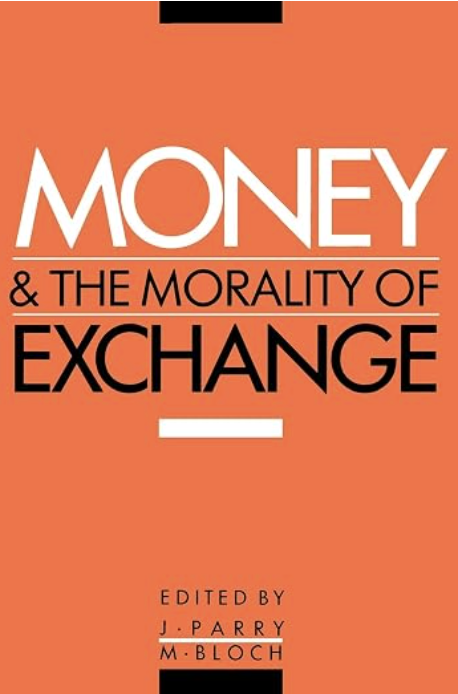
In the substantivist and post-Marxist tradition of economic anthropology, Parry and Bloch’s 1989 Money and the Morality of Exchange is one of the most influential works on the theory of money (Maurer 2006). Occasionally, scholars fail to stress that it is an edited volume which includes contributions by nine authors (7 of whom hold positions at the London School of Economics). The book’s critique of the substantivist division of pre-monitary / monetary societies (pre-capitalist/capitalist, gift / commodity et cet.), has been almost universally accepted. In brief, this critique can be summarized as a general proposition: money is not something that engenders mentality, mentality engenders money with meaning. This is to study money as ideology outside of capitalism. Scholars who contend the opposite are ultimately guilty of perpetuating a strand of “Western discourse” that derived from Aristotle, Aquinas, Marx and Simmel. This strand of discousre is ethically opposed to trade and contends that money, once invented or introduced, becomes an agentive force that acts with mythic or religious power to transform qualitiative, communal social relations into quantitative, individualistic relations of domination. This, according to the authors, is ultimately a theory that is guilty of the “fetishization” of money – a theory which after Marx and Simmel is largely responsible for the false binaries of scholarship that seek to explain money as a cause of mentalities in economic anthropology. The solution, for Parry and Bloch, is a return to the study of cultural symbolic systems, their matrices and networks, in order to excavate a general theory from “thick description” and emic categorical experience. From such studies, they attempt to draw a theory capable of transcending the limitations of the Marxian “western discourse.” This posits two “spheres of transactions,” which include (1) the individualist, short-term sphere of commercial transaction and (2) the communal, long-term sphere of social reproduction. However, the theory of short-term and long-term transactions, while interesting enough in its own right, has been largely ignored in economic anthropology. This makes sense as it fails to offer a theory or definition of money and instead attempts to redefine the institutional categories of substantive anthropology without a serious engagement with Polanyi or Sahlins.
I. Introduction
The central theoretical contribution of the volume is put forth in a co-written chapter by Parry and Bloch: “Introduction: Money and the Morality of Exchange” (p. 1–33).In the spirit of academia in the late 1980s and early 1990s, the volume is concerned with the symbolic. It does not engage with “economic monetary theory” or “primitive money.” Instead, it focuses principally on “state-issued currencies which act as a general medium of exchange” (p. 1). The overarching argument and contribution is simple: to understand money it is necessary to understand the “cultural matrix into which it is incorporated” (p. 1). In short, money does not cause the way the world is conceived; the way the world is conceived causes the way money is conceived. What is important, as is generally true for all anthropological work in the era of the late 19080s, is the cultural “matrix,” network,” et cet. The secondary argument, which seeks to contribute to a more general theory of money, is more difficult to parse:
At another level, however, our essays reveal a unity which underlies all of the apparently diverse examples they consider. This is to be found neither in the meanings attributed to money nor in the moral evaluation of particular types of exchange, but rather in the way the totality of transactions form a general pattern which is part of the reproduction of social and ideological systems concerned with a time-scale far longer than the individual human life. (p. 1)
Each of our case studies, we argue, reveals a strikingly similar concern with the relationship between a cycle of short-term exchange which is the legitimate domain of individual — often acquisitive — activity, and a cycle of long-term exchanges concerned with the reproduction of the social and cosmic order (p.2).
The essay is divided into two parts. The first provides a critique of the western theory of money; the second provides the foundations of their own theory.
II. Part One: A Critique of the Western Discourse of Marxian Theory
Parry and Bloch argue that there are two basic strands of thought in “in Western discourse” – the pro and antitheories of trade. The anti-trade theory goes back to Aristotle, and thus a line of thought is drawn from Aristotle to Aquinas. Finally, quoting Tawnye (1972: 48), “‘the true descendant of the doctrines of Aquinas is the labour theory of value. The last of the Schoolmen was Karl Marx.” The pro-trade theory, the second line of thought, is drawn from “Mandeville’s Fable of the bees and from the ‘many advantages’ Adam Smith put down to man’s propensity ‘to truck, barter and exchange’ was that the happiness and prosperity of society was founded on the individual pursuit of monetary self-gain.” (p. 3). Immediately, the acknowledge the intermediate ground, scholars such as Simmel, but they remain committed to the binary distinction. Most importantly, however, they stress that all intellectuals in the Western tradition have given money an agency that is described as “fetishization” (p. 3).
To prove their point, they provide a brief analysis of Marx and Simmel. The major claim is that, “as Marx saw it, this fetishism of money as the pre-eminent example of the fetishism of commodities is inseparable from capitalism.” (p. 6) Marx’s theory, unfortunately, led to a “tendency to postulate a fundamental division between non- monetary and monetary economies (or even societies).” (p. 7). Furthermore, it is a distinction that encouraged “Marx in the formulation of his highly questionable theory of an unchanging ‘Asiatic mode of production’” (p. 7). Consequent work has been influenced and thus have established a series of binaries: (1) Traditional vs. Modern, (2) Pre-capitalist vs. capitalist, (3) Gift economies vs. commodity economies, (4) Production for use vs. production for exchange. Money, according to this theory, ultimtaetly acts as the “major catalyst of the ‘great transformation’ between them” (p. 7). The reference here is, of course, to Polanyi’s essential work (uncited and absent from the bibliography). Despite a brief allusion to positive aspects of his approach in a different work, Polanyi’s absence is one of the most striking elements of this work (see the conclusion for thoughts regarding this ellipsis). The binary conception derived from Marx’s continuation Western discourse has ultimately caused scholars to turn a ‘blind’ eye to money in pre-capitalist societies.
The notion of the gift is treated as such a blind alley in the history of scholarship. As Block and Parry write,
The radical opposition which so many anthropologists have discovered between the principles on which gift and commodity exchange are founded derives in part, we believe, from the fact that our ideology of the gift has been constructed in antithesis to market exchange. The idea of the purely altruistic gift is the other side of the coin from the idea of the purely interested utilitarian exchange (Parry 1986), and we cannot therefore expect the ideologies of non-market societies to reproduce this kind of opposition (cf. Strathern 1985). (p. 9)
The romantic idealoization of the non-capitalist, because non-market, because non-monitary society has created an ethical and idealist reading of anthropological societies that wish to uncover the communal and non-idividualist base of pre-capitalist social organization. This, however, is said to be wrong. Fuller (Chapter 2) is said to disprove colonial misappraisals of the village non-market communities in India, and the following chapters largely offer in turn to dispel the myth of the non-monitary society. The Marxist fetishization of money (its thesis that money is an agentive, destructive power that threatens traditional ethical non-market life) that leads to a binary opposition of gift – commodity societies and with it an idealization of the ethical, non-market, world of the indigenous society is said to be overturned by recent work. Thus, the empirical data in the Trobriands, where coastal and mountain villages trade fish for yams and vegetables shows that there is trade by communities (wasti) as well as individual households (vava) [Hart 1986] in both ceremonial exchange and barter exist in fluid form that break down the theoretical division drawn from Marx’s theory of fetishization (p. 10). They conclude that there is thus no useful distinction to be drawn categorically from the Marx tradition or theory of money. This, it is important to stress, is based solely on their understanding of Marx’s fetish theory of money (p.12).
This dominant notion, however, has been accepted by anthropology. They conclude their critique with two examples of where the dominant notion has led to trouble: Bohannan’s work on the Tiv of in N. Nigeria (Bohannan 1955, 1959, Bohannan and Bohannan 1968), and Kopytoff’s (1986). This rounds out their directed criticisms of Gerogry, Taussig and MacPhearson throughout. In the end, to ascribe agency to money as a revolutionary force or technology deemed a “kind of technological determinism” (16), and the Marxian view that contends that “money gives rise to a particular world view” (p. 17) must be regarded as false. Instead, particular world views give rise to the context in which money is given meaning. From this idealist critique of Marxian materialism, which is drawn as a monolithic perpetuator of “Western discourse” (a serious restatement, critique or understanding of Marx’s theory of money is never provided), the authors attempt to draw a new anthropological theory of money. This is put forth in part two.
Part Two: The Bloch and Parry Theory of Money
A proper, defensible theory of money must draw from the cultural matrix or network itself. What general theory is possibly drawn from such non-empirical, non-binary ethnological studies of the indigenous cultures studied by the economists at the London School of Economy? Where their colleagues ‘failed,’ how do Parry, Bloch et al. succeed? First, “While writers like Simmel and Macfarlane see money as giving rise to a particular world view, what we would like to emphasise is how an existing world view gives rise to particular ways of representing money” (p. 19). How does an existing world give rise to a particular way of representing money? Previously scholars have failed to give weight to this “cultural template.” Bloch and Parry seek to reinstitute the cultural symbolic system as a way of knowing meaning. What does this mean? In the case of the Andes, the “the real explanation… lies in ideas about the cosmological significance of precious metals as supreme commodities, the proper use of which is to flow upwards as tribute to the state” (p. 20); “tribute reproduces an ordered relationship between the state and the local community — a relationship which is the source of the latter’s fertility and prosperity,” (p. 20). Such an example shows that
the meanings with which money is invested are quite as much a product of the cultural matrix into which it is incorporated as of the economic functions it performs as a means of exchange, unit of account, store of value and so on. It is therefore impossible to predict its symbolic meanings from these functions alone (p. 21).
Instead, they seek to discover the “interconnected concepts which are part of a transformative discourse” (p. 22). Instead, however, they provide another example that defies generalization: kinship. They write,
This is easiest to appreciate when we consider the kinship aspect of the Fijian contrast which opposes an image of society as ordered by a fixed hierarchical pattern of consanguinity, affinity and chiefship represented in the ritual of yagona drinking, to an image of the ephemeral, egalitarian, sexual and chaotic relations of unmarried cross-cousins. The relationship between these two orders is not, however, one of static and absolute opposition, for one side of the contrast is continually being transformed into the other in a way which, far from being threatening, actually represents an image of the successful reproduction of the community. This is because cross-cousins should become spouses, and hence the chaotic world which is partly conjured up by money is the necessary precursor to the world of ordered hierarchy conjured up by yagona. What we therefore have is a continuing dialectic in which cross-cousins who are opposed are then united by marriages which belong to the domain of hierarchical kinship, but these in turn renew the opposition through the birth of children who are again opposed as cross-cousins. This synthesis is represented in the ritual of ‘drinking cash’ by the combination of the symbolism of money and of yagona drinking. In the first part of the ritual the subversive creativity of cross-cousins assumes the form of monetary competition, but in the second part this chaotic behaviour is harnessed to the reproduction of the ordered yagona drinking community when the result of the cash rivalry becomes a beneficial social fund. This type of transformation is — as we shall see — in no way exceptional. (p.22)
The point is explained: “Not only does money mean different things in different cultures, but — as this example suggests — it may mean different things within the same culture… What the Fijian example also demonstrates therefore is the misleading nature of the assumption that symbolic meanings can be precisely specified.” (p. 22) This, again, is a reformulation of their central critique. Difference is endemic to the study of culture. They conclude: “It is consequently not only impossible to say what money will ‘mean’ irrespective of cultural context, it is even misleading to presuppose that it will have any fixed and immutable meaning in a given context” (p. 23).
Finally, they get to the point. Since the tribute and kinship (conventional macro generalizations) fail to explain the deeper general context of money’s meaning, they must look elsewhere. Here, at last, they put forth their own contribution. Instead, it is necessary to understand “the meanings of whole transactional systems and to the kind of transformative process we have identified” (p. 23). They use the example of “the fishermen of Langkawi” to draw out their theory. There are, they argue, “two transactional orders” that explain the process of exchange. First, there is a “world of fishing and commerce.” Second, there is a sphere “oriented towards the longer-term goals of reproducing the household” (p. 23). This, we are told is the crucial discovery: “What we claim to be describing then is an extremely general set of ideas about the place of the individual in a social or cosmic order which transcends the individual” (p. 26).
The crucial and more general point is that… in one form or another, each of the cases discussed in this volume reveals a similar pattern of two related but separate transactional orders: on the one hand transactions concerned with the reproduction of the long-term social or cosmic order; on the other, a ‘sphere’ of short-term transactions concerned with the arena of individual competition (p. 24).
The full theory is best captured in the following paragraph in which they draw out the universal theory they here offer:
The possibility of conversions between the two orders also has much to do with their moral evaluation. While the long-term cycle is always positively associated with the central precepts of morality, the short-term order tends to be morally undetermined since it concerns individual purposes which are largely irrelevant to the long-term order. If, however, that which is obtained in the short-term individualistic cycle is converted to serve the reproduction of the long-term cycle, then it becomes morally positive — like the cash ‘drunk’ in Fiji or the wealth given as dana in Hindu India. But equally there is always the opposite possibility — and this evokes the strongest censure — the possibility that individual involvement in the short-term cycle will become an end in itself which is no longer subordinated to the reproduction of the larger cycle; or, more horrifying still, that grasping individuals will divert the resources of the long-term cycle for their own short-term transactions. The nightmarish spectre of this last eventuality is illustrated by our two Andean cases. (p. 26-27).
The “nightmarish spectre” is found not in capitalism, as works like the Communist Manifesto would appear to suggest, but in indigenous non-capitalist societies as well. Money then must not be conceived as either good or bad (as the dominant Western discourse would have it, but it must depending on the situation in which money is developed or introduced within these two polar spheres of transaction.
III. Conclusions
Parry and Block conclude with a restatement of their critique and theoretical contribution:
It is, as we have seen, a commonplace assumption that money gives rise to a specific world view and to particular kinds of social relationship, but this is very dubious. The further implication of our discussion however is that — within rigorously circumscribed limits and with or without money — the vast majority of cultures make some space for exchanges which display many of the features which are sometimes, as in our own society, associated with monetary exchange (a degree of impersonality, consider- able scope for individual gratification and a concern for pure instrumentality, for example). Those writers who credit money with the paternity of these features are therefore constructing a false history in which what is actually an extremely general contrast within cultures between the domains of the long and short-term orders becomes a contrast between cultures — and it is on this basis that the notion of a ‘great divide’ between the monetary and pre-monetary worlds has rested. In one way or another the chapters by Fuller, Harris, Lan and Bloch which follow all make reference to this kind of historical falsification (p. 29).
All attempts to study the divide between non-monetary and monetary societies are thus charged with “historical falsification” of the kind diagnosed above. This is a strong claim and it is one that has been used to discredit many serious theories of economic anthropology (See Maurer 2006). It is worth questioning three strong causal claims made by the authors. First, did Marx derive his theory of money from the “Western discourse” of Aristotle and Aquinas? Second, did Marx hold a theory of the fetishization of money? Second, is the binary of (i) monetary / non-monetary, (ii) gift / commodity, (iii) traditional / modern, and (iv) production for use / production for exchange a unilinear concept derived from the prior two? The answer to each of these is likely no. Yet, even if each and every claim is correct, it still leaves a fundamental problem. Why can one derive for a theory of exchange from a deconstruction of the concept of money? The authors, who never offer a definition of money (nor share a single definition of money provided by the scholars they critique), put forth a theory of transactional spheres on the basis that money has been poorly defined. This is much like arguing that one has a new theory of the atom which is both necessary and reasonable because other scholars have failed to define the chemical composition of water. To draw the analogy further, it is do so without offering a single scholar’s definition of the chemical composition of water. And for those distrustful of analogies with the sciences, we can imagine a case in which a group of state-financed scholars at the London School of economics in 1989 declared that colonial money isn’t a real historical object that can be defined because indigenous people have always had unique exchange systems of their own which were more like our own than we ever realized. Thus, both are subject to a new theory of transactional spheres because to say otherwise would be to reify “western discourse” on the indigenous people. That their own scholarship could be critiqued on similar grounds – that is continued the Western discourse of neo-liberalism and that they were provided a life-time of state-secured wealth and retirement to do so would of course be unfair to their genuine attempts to transcend the binaries of western thought and experience.
According to the authors, there are two potential take aways for understanding of modern capitalism:
- While we believe the pattern we have identified as common to all our case studies is typical of a wide range of societies, it is arguable that the mature ideology of capitalism would be an example of something entirely different. By a remarkable conceptual revolution what has uniquely happened in capitalist ideology, the argument would run, is that the values of the short-term order have become elaborated into a theory of long-term reproduction. What our culture (like others) had previously made room for in a separate and subordinate domain has, in some quarters at least, been turned into a theory of the encompassing order — a theory in which it is only unalloyed private vice that can sustain the public benefit. (p. 29)
- What is also possible, however, is that the conceptual shift has been rather less radical, and that what has really happened — as Mauss’s essay on the The Gift implied long ago — is rather that Western ideology has so emphasised the distinctiveness of the two cycles that it is then unable to imagine the mechanisms by which they are linked. One of the merits of this formulation would be that it suggests a way of understanding the quite contradictory representations of money — as devilish acid or as instrument and guarantor of liberty — to which we are heirs. What, in other words, these two different discourses would reflect is the radical divorce between the two cycles, each discourse deriving from the perspective of one side of the dichotomy alone. (p. 29-30)
One can see the clear shift from the post-Marxist critique of the 1970s in the first to the new neo-liberal dialectic of the 1990s. In the prior, the critique of capitalism was not yet entirely abandoned, even if working with and for the working class long had been. In the latter, there is look to the world ahead: the empty recycling of the christian and democratic socialism of the early 20th century which soon would be lost in the nave gaze of amnesiac Marxism. The circle of dialectic, celebrating their own performances in an empty, nihilistic spiral of forgotten scripts and meaningless academic volumes. This volume is a look into a troubling look into what is on the horizon for the scholarship of economic history and anthropology after 1989.

Leave a Reply