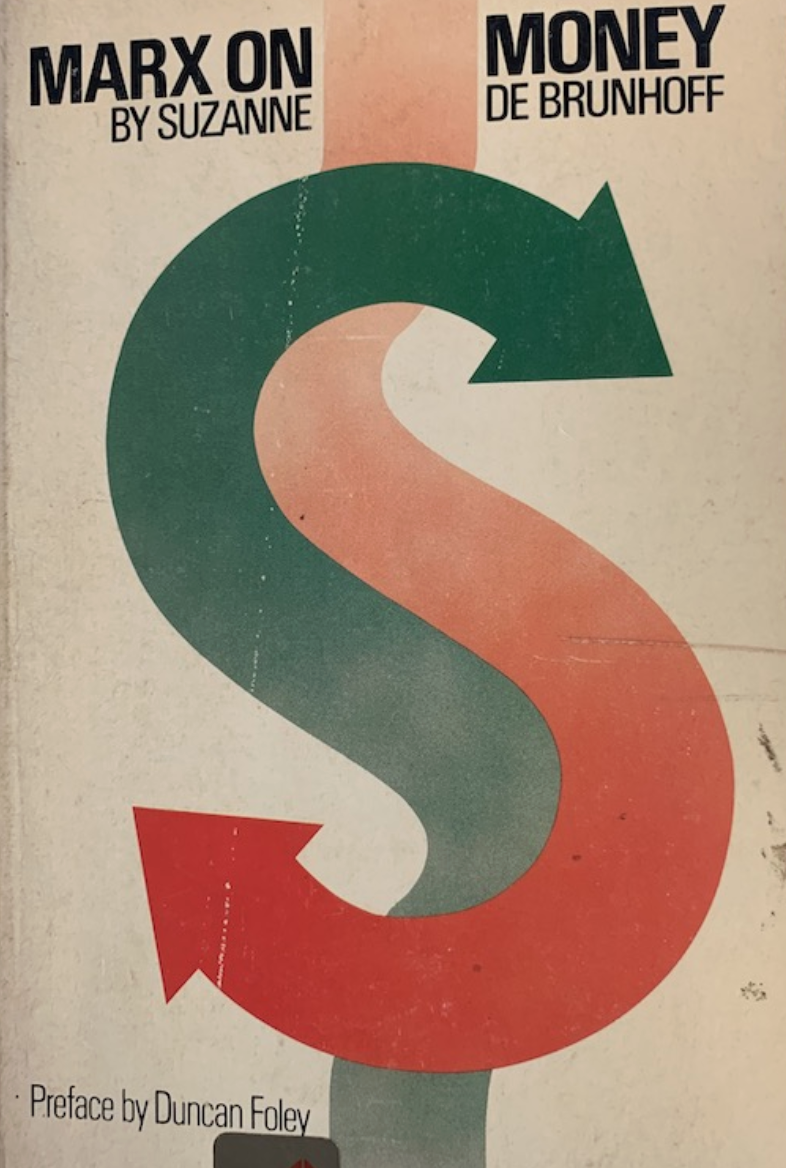
In The Merchant of Venice, when Besannio goes to Antonio to borrow money for his expedition, Antonio replies:
Thou know’st that all my fortunes are at sea;
Neither have I money nor commodity
To raise a present sum: therefore go forth;
Try what my credit can in Venice do:
That shall be rack’d, even to the uttermost,
To furnish thee to Belmont, to fair Portia.
Unfortunately, since all his “fortunes are at sea,” Antonio has no real means at hand to lend to Bessanio. He has no money nor commodity. Instead, he must try his credit to raise the 3000 ducats Bessanio and the plot need to begin their journey to Portia. According to the French Marxist economist, Suzanne de Brunhoff, Marx wants us to pay very careful theoretical attention to these three forms of wealth: the commodity, money, and credit. In fact, he wants us to figure out what exactly each of these three things are. What is a commodity? What is money? And, what is credit? To answer these questions, provides the structural foundations for understanding capitalism as well as the basic logic of Marx’s Capital.
La Monnaie chez Marx, first published in 1967, seeks to explain Marx’s commodity theory of money and answer these questions in turn. In contrast to credit theorists of money who contend that the modern fiat monetary system invalidates the theory of Marx, she argues that his general analysis remains not only theoretically and scientifically valid but politically vital in order to understand the realities of capitalist credit and financial capital. The preface for the English edition, written by the economist Duncan Foley, reminds us why these questions are politically essentional:
Those who are engaged in these struggles on the side of the working class can only be weakened by relying on a monetary analysis adopted from Keynes or other bourgeois economists to the extent that this analysis is incorrect. A correct theory of money firmly based on the principles of the materialist conception of history is essential (p. ix).
While these “ideas that have been much neglected in twentieth·century debates on monetary theory and policy,” he argues that they still “provide… valuable and plausible scientific alternatives” (p. v). Thus, this book provides an alternative to the economic anthropology of Karl Polanyi, Marshall Sahlins, and David Graeber as well as bourgeois economic history.
It may be helpful to try to provide a brief overview of the historical materialist theory of money Brunhoff finds in Marx. Marx, who developed his theory within the 19th century debates on the Bank Charter system, stood between two influential schools of thought: (1) the Currency School and (2) the Banking School. These two schools influenced the modern theoretical debate between the commodity theory of money and the credit theory of money (Graeber, for instance, is a credit theorist of money).
Marx, who disagreed with both on political and theoretical grounds, is nonetheless primarily a commodity theorist of money, which means that Marx contends that money is first and foremost a special kind of commodity (a commodity capable of providing a universalized measure of other commodity values). Money develops from the universal commodity (i.e. Gold). And, finally, money provides the material foundation of fiat money and credit. Brunhoff charts this relationship in clear and logical terms, arguing that money entails the logically sequential development of three functions (1) the measure of value, (2) the medium of exchange, and (3) Money. From the third function, the following develops: (a.) the instrument of hoarding, (b.) the means of payment, and (c.) credit.
Marx on Money consists of two parts: Part 1, The Marxist Theory of Money and Part 2, Money and Capitalism. Broadly put, Part 1 provides an analysis of money in Capital Vol. I, while Part 2 covers the theory of credit in Capital Vol. II and Vol. III. This review covers Part 1. [Part 2 will be covered in a subsequent article and covers Brunhoff’s analysis of how the circulation of money develops credit-money and the development of (i.) commercial, (ii.) financial, and (iii) fictitious credit-money.]
Part I: The Marxist Theory of Money
a. Marx’s Method and General Theory of Money
Marx wrote in Capital, “The difficulty lies, not in comprehending that money is a commodity, but in discovering how, why, and by what means a commodity becomes money…” (quoted by B. on p. 24). To understand what money is today it is necessary to understand where money came from. It is necessary to have a general theory of money which captures its fundamental essence before or without its specific function in capitalism. There have been two basic theories that have attempted to define or categorize the general form of money. There are those, like Marx, who argue that money must be a specific form of the commodity, and there are those who believe that money is a type of debt. In the 20th century, especially in the second half, there also arose those who largely accept the debt theory of money but that are sceptical of definitions and categorical relations themselves. Marx’s theory is predicated instead on his method, which seeks to discover and explain the general form of money that arose from the universal commodity and which ultimately became the specific form of capitalist money. Brunhoff seeks to explain and defend Marx’s “general” theory. She writes,
Hence a theory of money applicable to the capitalist system must be subsumed under a theory of money in general, valid for every monetary economy; in other words, a general theory of money. And Marx’s examination of this question bears fruit in the Mar:t:ist theonj of money expounded in the first section of Part 1 of Capital. Thus Marx considers it necessary to begin with a study of money in its general aspect. independent of the capitalist form of production in order, among other things, to determine its role in the capitalist form of production. (p. 19)
She warns against readers of Marx who fail to understand the general theory of money Marx puts forward in the opening sections of Capital. Such failures have led to influential Marxist theories of financial capital because they fail to understand Marx’s theory of credit. This has grave implications for our theories of credit and financial capitalism, as well as the socialist theories we develop to face the modern conditions of global capitalism. Marx is clear that an understanding of money cannot be deduced directly from the observations of contemporary money. Brunhoff puts forth three methodological principles of Marx’s theory of money:
- Social commodity circulation logically precedes private money circulation.
- Consequently, neither the general nor specific aspects of commodities or money can be drawn from their qualities as capital.
- Therefore, it is necessary to begin with “metallic money” in order to construct a general theory of money.
Here, Brunhoff is certainly correct in her analysis of the logic of Marx’s method, but she is surprisingly sceptical of the historical elements of Marx’s argument. She discusses this in the Afterward to the 1976 edition, explaining that the historical dimension is perhaps more important than she appreciated at first. However, she also clarifies that brings with it difficult questions that have not been satisfactorily answered.
b. Marx’s Complete Theory of Money
In the section, “Marx’s Complete Theory of Money,” Brunhoff provides an overview of Marx’s basic outline of money in Capital: (1) The Measure of Value, (2) The Medium of Exchange, (3) Money. “It is only,” we are asked to rememember, “at the end of the three steps that ‘the econamic existence’ of money is fully defined, although its character of general equivalent is the animating principle of all its functions and their articulation” (p. 26).
1. The Measure of Value
According to Brunhoff, Marx’s first function of money is deduced from the following general logic. If money is a universal commodity, its unique characteristic is its ability to provide a general equivalence for other commodities. For example, when gold becomes capable of expressing a measure of value for all other commodities, it expresses the first function of money. The measure that is expressed in exchange is “money form” of a commodity. Therefore, one is capable of saying that a large bundle of wheat is “worth” a gram of gold. This is what Marx calls the “money form as the price of commodities” (p. 26) – the price is weight of gold used to express the value of the commodity. Each “price” in this example is determined by the actual amount of money (i.e. gold) that is actually exchanged for any other commodity.
The value of gold, however, is not determined only by its appearance in the act of exchange. It is first and foremost determined by the socially necessary labor time it takes to produce. Marx’s ontology does not allow us to introduce in the distinction of marginal utility (or supply and demand) to explain “price.” And therefore Marx does not at this level of analysis allow us to introduce a distinction between “ ‘relative prices’ in the ‘real’ sector and ‘monitary prices’ “ (p. 27-28). As Brunhoff writes,
In Capital, the problem of the distinction between price and value, so far as it concerns the value relationships of the gold price and the commodity value of the commodity, is simultaneously posed and resolved by the definition of the money form. So far as it concerns the market price of commodity values, it cannot be resolved or even posed in the study of simple circulation, since it has reference to the analysis of markets in a capitalist society. Hence the prob- lem of divergence between money prices and relative values of commodities is not “the monetary problem par excelleuce.” The problem here, that of the money form and its solution as previ- ously noted, does not depend on the way different markets are interconnected, but on the exchange of equivalents and the coming into existence of a general equivalent. “Price, in its gen- eral meaning, is but value in the form of money.” (p. 28, n. 15 cit. Marx.)
This entails that gold cannot serve as its own equivalence. These theoretical distinctions are easy for modern readers to miss, but for Marx they defined his own use (and transcendence) of classical economics. It is the standard that is given a certain weight of gold that provides a commodity with its ability to express “monetary price” and thus serve as a “standard unit of account” (p. 30). This, according to Brunhoff, introduces the questions of the state. Since it is the state that grants a particular weight of gold a standard unit of account, it must be essential in order to understand its role in the creation of the standardized social norms of money. These considerations, she says, are discussed in Marx’s first draft version of the The Critique of Political Economy (i.e. as “money power).
This is an ontological argument that has caused misunderstanding when read as a theory of general prices. The “monitary problem par excellence,” which seeks to explain the relation between money in circulation and the general price index, is not the order in which Marx understands the problem. It matters at this point whether or not we think that Marx’s order is logical, historical, or both. Brunhoff herself addresses this problem in an “Afterward” written for the 1976 edition, saying that she underestimated the historical considerations. Unfortunately, the seemingly simple question opens problems that have not been satisfactorily answered by historical materialism. As Brunhoff herself admits, the problem in the book’s exposition is its failure to incorporate and explain Marx’s socially necessary labor time theory of value (p. 127). As I understand the problem, we must be able to explain when exchange-value, alienation, abstract labor, the labor market, and capitalist surplus value arise in history. Did “value in exchange” belong to the period before capitalism? Did, as Marx’s ontological theory clearly implies, the “money form” and “price” emerge as early as the first appearance of the universal equivalent? It is a question that goes back to Marx and Engels discussion of pre-history: in particular, nomadic pastoralism (now thought to arise in the early neolithic) and the first metallic general quivalences (generally thought to arise at some point between the late neolithic and late bronze age). Without a clear understanding of the historical dimension of Marx’s ontological theory, it is impossible to maintain the strong defense of Marx’s definition of “price” provided above. This leads Brunhoff to state that Marxist research is not currently able to provide a coherent answer to the basic problem of “price.”
2. The Medium of Exchange (Coins)
According to Brunhoff, the first function of money is a precondition for the second (p. 31). If gold serves as a measure of value, it must circulate in exchange in order to be money. It is one thing for gold to express the value of all other commodites; It is another for gold to serve as the material means by which all commodity exchange must proceed. How does the exchange of a universal equivalent like gold arise? And, once it does, what does it do to the value expressed by gold – social labor? Brunhoff primarily contextualizes these questions within the 19th cenury debate on the Quantity Theory of Money. This is helpful (and necessary historical context for Marx’s theory), but it also takes the reader out of the logic of the argument Marx is developing. Since it is hard to follow in Brunhoff’s account, it is worth mentioning that here Marx shows the way in which the medium of circulation achieves the exchange of diverse commodities on the market. What appears to be the free circulation of basic commodities, is shown to be transformed by the use of gold as a medium of circulation. This arises from gold’s power to generalize not only the general equivalent of commodity values but also the value of human labor because now it is tied to social forces it can neither control nor direct. This in turn allows labor to be generalized and even universalized as a commodity itself – a process that can only fully unfold with the creation of a global market.
Within this general exposition, Marx addresses the Law of Circulation which states that the quantity of “the circulating medium is equal to the sum of the prices of the commodities divided by the number of moves made by coins of the same denomination. This law holds generally” (MECW 35, p. 130). It is imperative for Marx’s theory of Capital that the quantity of money in circulation (i.e. the money supply) is not a primary cause of the money form (or price). If this were the case, then his general theory would be invalidated. Instead, he seeks to explain how the socially necessary labor time embodied in the commodity comes to the market before its exchange can be facilitated by money (gold). In short, the value of money must exist before it can be used for circulation; circulation cannot determine the value of money. As Marx wrote, “Any scholarly investigation of the relation between the volume of means of circulation and movements in commodity-prices must assume that the value of the monetary material is given” (p. 31-32, n.22 w/ Marx cit.).
Marx’s theory is at odds with both Riccardo and Tooke. For Brunhoff, the central concern here is Marx’s differentiation of money and credit-money. This entails complex and difficult questions. But, the main point is driven home in the following analysis:
The measure of value does not imply the ac- tual circulation of money, once there has been the initial exchange which makes it possible to set up the equation of price, x commodity C=y money commodity. it is only money as in- strument of circulation that makes it possible to establish the formula for cash transactions, C-M-C (commodity-money- commodity). But the money which circulates in causing com- modities to circulate and is hence to be found present “side by side with them” is not necessarily present as the money com- modity. As currency, it can be represented by the symbol of gold, and “Its functional existence absorbs, so to say, its mate- rial existence.”41 The differences of nature and quantity between the measure of value and the currency both have the effect of separating the general equivalent from its money form, the specific commodity which functions as such in practice. From this arises hoarding, the third function of money, which gold ful- fills when “in person or by representative, it congeals into the sole form of value, the only adequate form of existence of exchange-value, in opposition to use-value, represented by all other commodities.”42 (p. 38)
3. Money
a. Hoarding
“Hoarding is a demand for money as money, the general equivalent possessing special qualities that distinguish it from all commodities” (p. 39). Hoarding, for Marx, is the removal of the universal commodity in the form of a medium of exchange (i.e. coin) from circulation. He says that this alone allows money to function as a medium of exchange. At one point he even makes the seemingly paradoxical claim that money truly appears when gold (and silver) no longer act as direct mediums of exchange but only as hoards that provide it with a stable measure of value (double check). Thus, the quantity of money in circulation is controlled by the accumulation of hoards of stored value. As Brunhoff explains,
The result is that money, despite the secondary nature of its importance, is not neutral and can never be completely neutralized (whether by the development of credit or by monetary policy), since it puts into effect certain private decisions. Money in circulation really belongs to no one, but its very circulation is conditioned on the formation of hoards. (p. 43)
b. Means of Payment (Credit)
Money “properly so-called” finally appears in Marx’s account at the end of section 3. These, according to Brunhoff, are “the means of settling transactions” (p. 44). As Marx writes,
Gold becomes money, as distinct from coin, first by being withdrawn from circulation and hoarded, then by entering circulation· as a non-means of circulation, finally however by breaking through the barriers of domestic circulation in order to function as universal equivalent in the world Gf com- modities. (p. 44, n.56).
Brunhoff provides an extremely helpful and concise desription of Marx’s idea:
Hoarding has appeared as a separation of the sale and pur- chase of commodities, or. to use Marx’s customary symbols, C-M// … C. Money as means of payment plays its role at the end of a sale on credit, commodities having actually circulated with- out monetary means of circulation, in the pattern: C-credit. .. -M (means of payment). To settle with his creditor, the debtor has to sell C and put the money in reserve to pay on the due date. The whole chain of commercial credit can be put together from these transactions as a starting-point; they rest on the agree- ment of the parties to an exchange on their reciprocal obliga- tions and rights. To meet the maturities, money enters into circu- lation as means of payment, it “appears to be the absolute commodity, but within the sphere of circulation, not outside it as with the hoards.”57 Nevertheless, in case of ·a commercial crisis, it is loudly hailed as the “unique form of wealth, exactly as it is regarded by the hoarder,”58 and there is a “sudden transforma- tion of the credit system into a monetary system.”59 This funda- mental point, to be explained in the course of the analysis of credit, shows that the theory of money preserves its significance however much money may in practice be eliminated by credit. (p. 44)
c. Universal Money
Finally, “universal money” is given the following explanation:
Finally, the “universal money” is gold, the general equivalent, in “its original form of bullion.”60 “it is only in the markets of the world that money acquires to the full extent the character of the commodity whose bodily form is also the immediate social in- carnation of human labour in the abstract. Its real mode of existence in this sphere adequately corresponds to its ideal concept. “61 All the functions of money are then fulfilled by this universal money. Nevertheless. “With the development of commodity exchange between different national spheres of circulation, the function which world money fulfills as means of payment for settling international balances develops also. “62 (p. 44-45)
The fact that this theory of money ends with the state creation of the gold reserve has lead to comment and questions. Brunhoff discusses this question in the final section of part I – “Money and State Power” (p. 45-47). The first half of the book ends with a table that formally schematizes her understanding of Marx’s theory and since it provides an invaluable resource, I have reproduced it below.

Leave a Reply