Engels theory of Roman development is put forth in the fourth chapter of Engels’ The Origin of the Family, Private Property and the State. It draws from the same general theory put forth in the introductory chapters. Thus, it sets out to derive the general course of development of the Roman constitution and republic from the tribal kinship which he and Marx, and Morgan believed preceded the origin of the early Roman state. As the Greek constitution began in the heroic age, the Roman state was also derived from “a military democracy founded on gentes, phratries, and tribes and developed out of them” (p. 70). He writes,
Like the Greeks of the heroic age, the Romans in the age of the so-called kings lived in a military democracy founded on gentes, phratries, and tribes and developed out of them. Even if the curiae and tribes were to a certain extent artificial groups, they were formed after the genuine, primitive models of the society out of which they had arisen and by which they were still surrounded on all sides. Even if the primitive patrician nobility had already gained ground, even if the reges were endeavoring gradually to extend their power, it does not change the original, fundamental character of the constitution, and that alone matters (p. 70).
For Engels, Roman history begins with the establishment of 100 gentes “united into a tribe,” which in turn was followed by the subsequent inclusion of two tribes, each composed of 100 gentes. He writes, “It is not… an impossibility that the core of each of the three tribes was a genuine old tribe.” Therefore, to the extent it is possible to reconstruct the “legendary account,” it appears most reasonable to Engels that the earliest Roman form of Roman synoecism was based on the following kinship-military structure of three tribes:
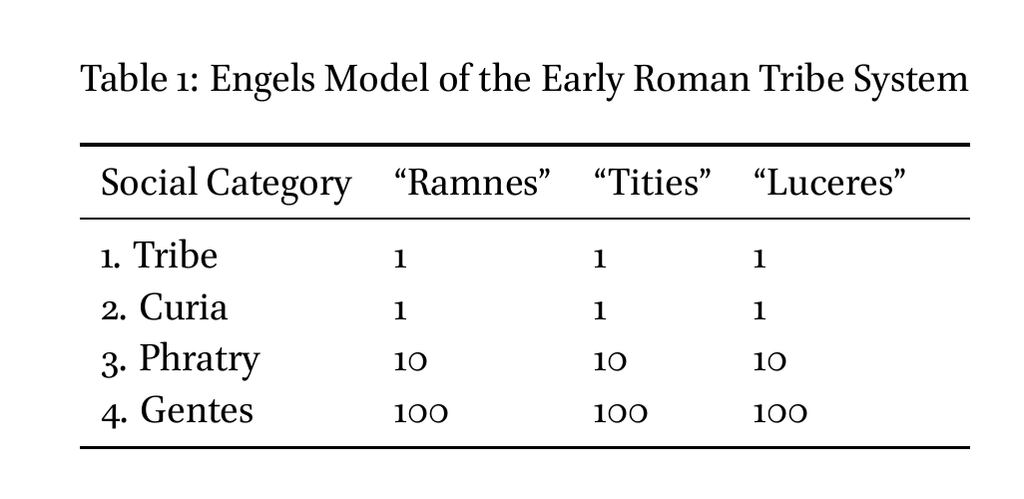
Each curia in turn held its own religious rites, shrines and priests; the latter, as a body, formed one of the Roman priestly colleges. Ten curiae formed a tribe, which probably, like the rest of the Latin tribes, originally had an elected president-military leader and high priest. The three tribes together formed the Roman people, the Populus Romanus” (p. 69).
The senate, “as Niebuhr first rightly saw,” was made up of the leaders of the 300 gentes. These were the elders of gens. The social division that arises internally is explained as follows:
the custom of electing always from the same family in the gens brought into being the first hereditary nobility; these families called themselves “patricians,” and claimed for themselves exclusive right of entry into the senate and tenure of all other offices. (p. 69)
Engels contends that this historical process is preserved in the legendary history of Romulus. The senate then (as the boule in Athens) made decisions and prepared preparatory discussion on laws and other decisions. This received final support from a gathering of all 30 curiae. The gathering of the people was called the comitia curiata – “assembly of the curiae” (p. 69). Finally the rex was chosen comitia curiata. Like the Gk. basileus, he did not hold civil power – no “power of the life, liberty, or property” of the people but instead was a military leader, high priest and “president of certain courts” (p. 69-70).
He seeks to draw his understanding from the comparison of native American kinship, ancient Greek kinship, and early Rome. Engels lists 9 features of the Roman Gens:
- Mutual Right of Inheritance
- Possession of Common Burial Place
- Common Religious Rites (sacra gentilitia)
- Obligation Not to Marry
- Common Land
- Obligation of Mutual Protection and Aid
- Right to Gentile Name
- Right to Adopt Strangers
- Right to Elect and Depose Chief
The Age of Expansion
Military expansion led to the increased population and ultimately led to the development of the plebs. They stood outside the populus and were differentiated by the fact that “they could not hold any office, nor take part in the assembly of the curiae, nor share in the allotment of conquered state lands.” (p. 70) In the process of development, the plebs held a greater part of the “commercial and industrial wealth” (p. 70). While Engels is careful to note the limit of the literary sources, he remains certain that the end of the gentile constitution is ultimately brought about by the “struggles between plebs and populus” (p. 70).
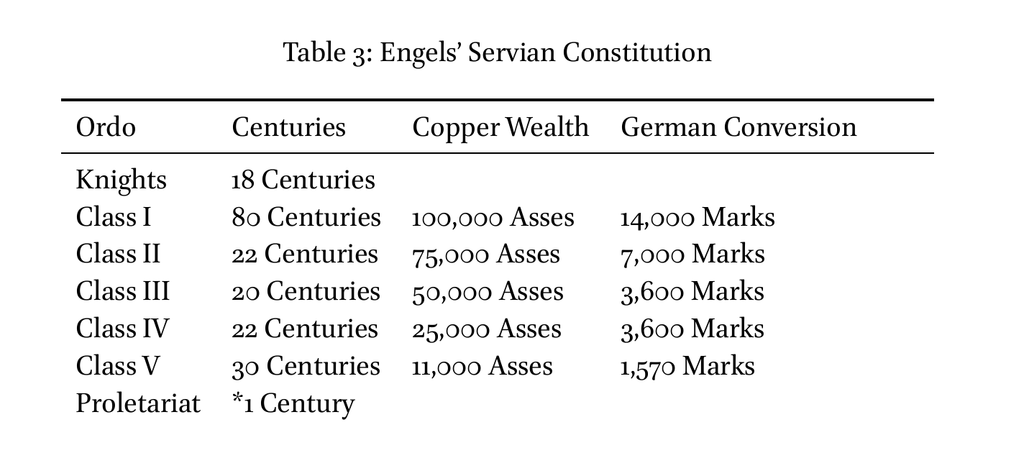
The class division that results is explained as follows:
In order that the three old tribes of kinship should also be excluded from the state, four local tribes were instituted, each of which inhabited one quarter of the city and possessed a number of political rights. Thus in Rome also, even before the abolition of the so-called monarchy, the old order of society based on personal ties of blood was destroyed and in its place was set up a new and complete state constitution based on territorial division and difference of wealth. Here the public power consisted of the body of citizens liable to military service, in opposition not only to the slaves, but also to those excluded from service in the army and from possession of arms, the so-called proletarians (p. 71)
The Republican Constitution
With the banishment of the Tarquins, Rome established the early republican constitution. This is explain in the following terms:
The banishment of the last rex, Tarquinius Superbus, who usurped real monarchic power, and the replacement of the office of rex by two military leaders (consuls) with equal powers (as among the Iroquois) was simply a further development of this new constitution. Within this new constitution, the whole history of the Roman Republic runs its course, with all the struggles between patricians and plebeians for admission to office and share in the state lands, and the final merging of the patrician nobility in the new class of the great land and money owners, who, gradually swallowing up all the land of the peasants ruined by military service, employed slave labor to cultivate the enormous estates thus formed, depopulated Italy and so threw open the door, not only to the emperors, but also to their successors, the German barbarians.


Leave a Reply