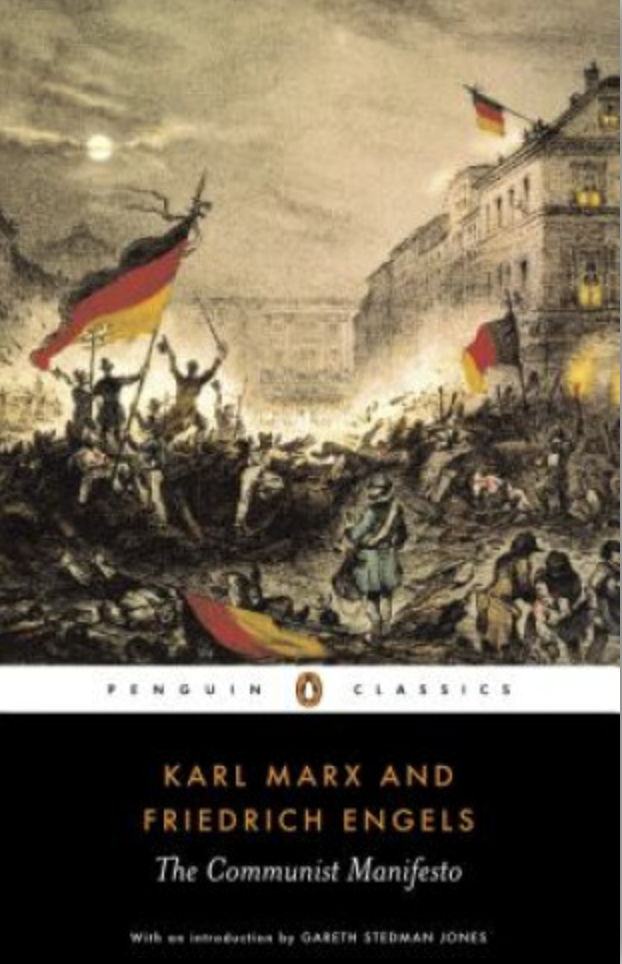
1. Bourgeoise and Proletarians
The first section is the most important and it outlines the basic historical views that Marx will develop for the rest of his life. It contains an extraordinarily high level of analysis and detail and can be seen to outline the history of the two classes Marx believed would struggle for supremacy in the future: the bourgeoise and the proletarians.
A. The Bourgeoise
“The history of all hitherto existing society is the history of class struggles” (MECW 6, p. 482). In short, the ghost – the specter – is the class struggle. It is the class struggle between the money-class (the owners of capital who buy labor) and the working-class (those who own little but their own labor and live off their wages). The terms Marx uses are deeply associated with Marxism today but when he wrote they were broadly accepted terms of social analysis. The capitalists were termed the “bourgeoisie” because they developed in the German cities (burghers), in which craft and guild production ultimately provided the seeds of the early factory system. The working-class were termed the “proletariat” after the Roman terms in order to categorize the rise of a class of urban workers who moved to the cities to work in the new capitalist factory system that arose in the late 18th century. The term, used by economists and sociologists like Jean Charles Léonard de Sismondi, meant to stress the rise of a new class of urban workers without ownership (or even predictable lang-terms assurance of the use) of the basic means of reproduction (i.e. food and shelter). All they “owned” – so to speak – were their children (i.e. Latin, proles).
For Marx, the ghost of history is the laboring class – in particular, the modern working class who are treated as objects of horror by the very people who force them into the monstrous conditions of the 19th century factory. These people are still easy to see in the paintings of the Fin de siècle, walking down the streets of London or Paris, lined with the bourgoeise shops that still largely define our ideals of civilized ‘Western’ life. It is the working-class that remains an apparition, ghostly figures seen only in the life of the things people buy and wear. Their struggle, whenever they succeed in raising themselves from the shadows, can only be understood as an eruption, a volcano, a storm. In short, for the ruling class, they will always be spectre.
The Communist Manifesto seeks to put such fables finally to rest. It sets out to reveal the basic reality of the working-class. According to Marx, this reality is struggle – class-struggle. It is a long war, with deep roots, and is endemic to history itself:
Freeman and slave, patrician and plebeian, lord and serf, guild-master and journeyman, in a word, oppressor and oppressed, stood in constant opposition to one another, carried on an uninterrupted, now hidden, now open fight, a fight that each time ended, either in a revolutionary re-constitution of society at large, or in the common ruin of the contending classes.
In the earlier epochs of history, we find almost everywhere a complicated arrangement of society into various orders, a manifold gradation of social rank. In ancient Rome we have patricians, knights, plebeians, slaves; in the Middle Ages, feudal lords, vassals, guild-masters, journeymen, apprentices, serfs; in almost all of these classes, again, subordinate gradations. (MECW 6, p. 485).
To reveal the true evil lurking in history is a revolutionary act and the ancient historian, M.I. Finley was right to say that these words transformed the study of history into a political battleground. What Finley ignores, however, is the fact that Marx is writing before works like Fustel de Coulanges’ The Ancient City (1864) which sought to enshrine private property and the family into the origin myth of antiquity. Marx is writing for an audience who – in direct contrast to the contemporary scholar of ancient history – did not find this paragraph particularly polemical. It was only polemical to the extent that Marx drew the consequences to their political conclusion on behalf of the working class struggle. Even David Hume, a capitalist apologist, would have largely accepted the general point Marx is making: class struggle and oppression was a basic fact of pre-modern (that is pre-English, American, and French constitutional revolutions) history.
The part that was revolutionary to Marx’s audience was the fact that such forms of oppression and domination continued in the modern era of constitutional reform in much the same form. The Enlightenment ideals – the liberal ideals – were failing all but the rich, and the republican nationalism that guaranteed the progress of liberty, equality, and the brotherhood of man appeared only to introduce a new form of slavery: wage-slavery. Thus, Marx explained:
The modern bourgeois society that has sprouted from the ruins of feudal society has not done away with class antagonisms. It has but established new classes, new conditions of oppression, new forms of struggle in place of the old ones (MECW 6, p. 485).
Marx explains how this oppression failed to be uprooted by the revolutions of the late 18th century and they grew into new forms of exploitation under capitalism.
Capitalism’s Development
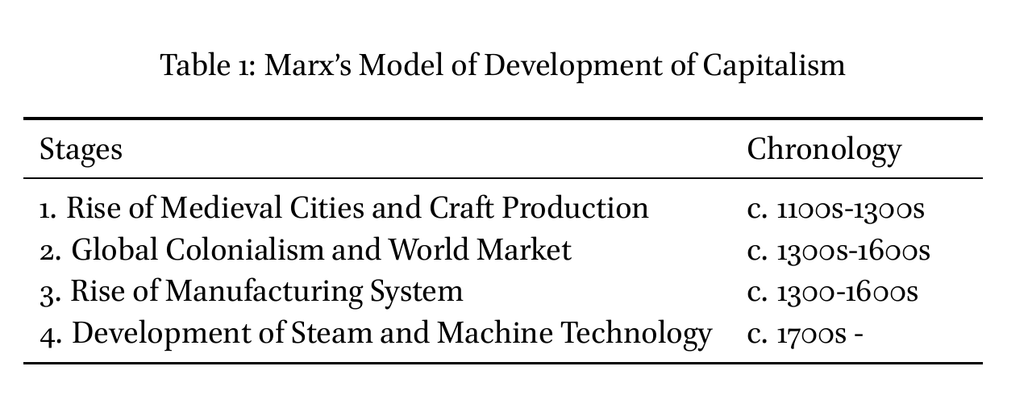
In the Manifesto, there are four basic stages in the creation of modern capitalism. First, the rise of the cities and craft production. Second, the development of global colonialism in East-India and China, the discovery of the Americas, and the rise of the world-market. Third, the rise of “the manufacturing system” which alone was capable of sustaining global trade (p. 485). Fourth, technology in steam and machinery were developed to keep pace with the creation of the global market. This final step is the form of “modern industry” that Marx seeks to understand and explain.
In particular, What did this completely new form of social organization and production do to the old forms of domination?
His basic answer is: “in proportion as industry, commerce, navigation, railways extended, in the same proportion the bourgeoisie developed, increased its capital, and pushed into the background every class handed down from the Middle Ages.” (p. 486). Thus, we can see how the modern form of wealth and power – the capitalist – developed. It was the product of “a series of revolutions in the modes of production and of exchange” MECW 6, (p. 486). He charts out a brief overview of how the capitalist arose from these changes.
Bourgeoisie’s Development
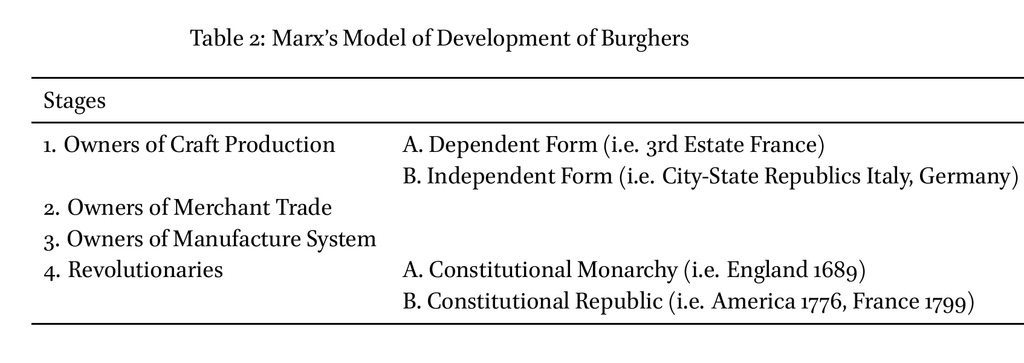
Since, for Marx, it is obvious that a Silicon Valley venture capitalist cannot develop ex tempore from a courtier in the Renaissance palace of Urbino, he must explain how the capitalist class developed. His theoretical argument is outlined as follows. First, the burghers. The capitalist developed directly from the oppressed owners of the manufacture system within the feudal system – the burghers who created the armed and “self-governing association in the medieval commune.” The proto-capitalists (i.e. the burghers) took different courses – either depending on whether or not they achieved independence from the feudal tax system.
- The dependent form was taxed by the nobility (i.e. The 3rd Estate in France)
- The independent form was not (i.e. the City-State Republics of Italy and Germany)
Second, global trade and manufacturing. The burghers developed global trade and the early manufacturing system, during which they were protected by the monarchies of Europe. This allowed them to rise to power and brought them into direct conflict with the nobility, (i.e. the landed ruling class who were largely exempt from taxation). Third, revolution. The burghers ultimately revolutionized the state and in turn created the modern constitutional republican nation state in order to serve their needs and interests and overthrow the aristocracy. This also took two forms:
- Constitutional Monarchy: In England, by taking partial control and power in England (1689) where they secured the creation of the constitutional monarchy.
- Constitutional Republic: In America, by creating the modern Republican nation-state in 1776-89 and France soon thereafter in 1799-.
According to Marx, this is the untold revolutionary history of the modern capitalist class.
It is the world they came to dominate and which they wish to continue to control and define. Where they have been victorious, they have torn down and destroyed all competing forms of social existence, ideals, and life. It is a revolution, which for Marx, has truly dire consequences for the organization of social life. It has “left remaining,” he says,
… no other nexus between man and man than naked self-interest, than callous “cash payment”. It has drowned the most heavenly ecstasies of religious fervour, of chivalrous enthusiasm, of philistine sentimentalism, in the icy water of egotistical calculation. It has resolved personal worth into exchange value, and in place of the numberless indefeasible chartered freedoms, has set up that single, unconscionable freedom—Free Trade. In one word, for exploitation, veiled by religious and political illusions, it has substituted naked, shameless, direct, brutal exploitation. (MECW 6, p. 487).
The bourgeoisie has stripped of its halo every occupation hitherto honoured and looked up to with reverent awe. (MECW 6, p. 487).
It has converted the physician, the lawyer, the priest, the poet, the man of science, into its paid wage-labourers. The bourgeoisie has torn away from the family its sentimental veil, and has reduced the family relation to a mere money relation. (MECW 6, p. 487).
Some scholars claim that Marx praises the transformative power of capitalism in these pages. While he clearly appreciates the magnitude of capitalism’s power for revolutionary change, he is horrified by its ultimate ends and what it has destroyed. It is often forgotten that Marx, like his father, were children of the Enlightenment. Marx held culture and the arts in extremely high esteem. What he found perhaps most haunting about capitalism was its need for the constant revolution of organized human life. There can be no fixity, no reason. “Constant revolutionising of production, uninterrupted disturbance of all social conditions, everlasting uncertainty and agitation” are all necessary in order for capitalism to function.
B. The Proletariat
These are the horrifying conditions under which we are tasked to create our own freedom. Marx, however, does not despair. He believes he has found the way forward and out of such monstrous conditions. We can, he believes, find our way out only once we have dispelled our of our illusions – all of the myths of civilization which have steadied the ancient ship of state. This is the one thing capitalism itself will provide in the end because “All that is solid melts into air, all that is holy is profaned, and man is at last compelled to face with sober senses, his real conditions of life, and his relations with his kind.” (p. 488). Once we look to understand these relations for what they are – the people who build and sustain human life and reproduction together – we will be able to take it for ourselves and forge a new, democratic, and free world. For, as Marx sees it, there will be no reason left to sustain the illusions of our past. If capitalism will leave no tradition, no form of production, and no basis of knowledge left secure, no solid form of life and existence of dignity and freedom for the worker, then there is no reason in the end not to begin anew. From the real, concrete relations that are revealed by the braekdown of society under capitalism, we will be able to understand humanity and nature. We can finally, Marx believes, build up a world from the bottom up.
Capitalist Overproduction
Since capitalism is global, this means that the struggle can only be won if it is international. The illusions of national identity which the ruling class have created to replace the flags of feudalism must fade in the face of the global realities of capitalist expansion. Globalism, Marx argues, will have to replace the ideals of nationalism itself in the end in order to serve capitalism’s expansion. As he explains,
[Capitalism] compels all nations, on pain of extinction, to adopt the bourgeois mode of production; it compels them to introduce what it calls civilisation into their midst, i.e., to become bourgeois themselves. In one word, it creates a world after its own image. (p. 488)
Just as it has made the country dependent on the towns, so it has made barbarian and semi-barbarian countries dependent on the civilised ones, nations of peasants on nations of bourgeois, the East on the West. The bourgeoisie keeps more and more doing away with the scattered state of the population, of the means of production, and of property. It has agglomerated the population, centralised means of production, and has concentrated property in a few hands. (p. ?)
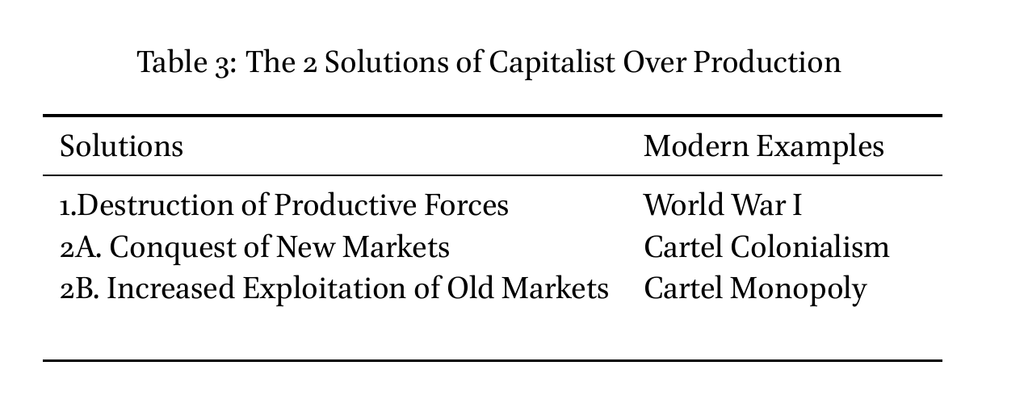
This leads to the crisis of overproduction (p. 490):
Society suddenly finds itself put back into a state of momentary barbarism; it appears as if a famine, a universal war of devastation had cut off the supply of every means of subsistence; industry and commerce seem to be destroyed; and why? Because there is too much civilisation, too much means of subsistence, too much industry, too much commerce (p. 490).
And though it is important to remember that Marx had not developed the labor theory of value or other essential elements of this economic theory, he already had an economic theory in the Manifesto. He argues that there are ultimately only two methods capable of dealing with the inevitable crisis of capitalist over production:
Proletariat Development
The proletariat was the product of this historical process. And while Marx believed that capitalism was destined to collapse under the continued and necessary rise of crisis caused by overproduction, there was another factor that led him to think that revolution would ultimately rise in the wake of capitalist crisis. As Marx writes, “… not only has the bourgeoisie forged the weapons that bring death to itself; it has also called into existence the men who are to wield those weapons—the modern working class—the proletarians.” (490). He defines the proletariat as follows:
a class of labourers, who live only so long as they find work, and who find work only so long as their labour increases capital. These labourers, who must sell themselves piecemeal, are a commodity, like every other article of commerce, and are conse- quently exposed to all the vicissitudes of competition, to all the fluctuations of the market (p. 490)
The proletariat are a product of capitalism and thus a unique development of the traditional 4th estate. Unlike the peasants and rural poor, the working class is brought into existence by the forces of capitalism and the global market. For Marx, this it further exacerbated by what he terms the “law of declining wages” :
the cost of production of a workman is restricted, almost entirely, to the means of subsistence that he requires for his maintenance, and for the propagation of his race. But the price of a commodity, and therefore also of labour, is equal to its cost of production. In proportion, therefore, as the repulsiveness of the work increases, the wage decreases (p. 491).
This leads to a class that lives by wages, ever decreasing and ever impoverishing the working class. As many other in his time, Marx termed this a new form of ancient class war and ancient slavery. It was “wage slavery.” He writes:
Not only are they slaves of the bourgeois class, and of the bourgeois State; they are daily and hourly enslaved by the machine, by the overlooker, and, above all, by the individual bourgeois manufacturer himself. The more openly this despotism proclaims gain to be its end and aim, the more petty, the more hateful and the more embittering it is (p. 491).
Finally, in the Manifesto, Marx argues that “The Lower Strata of Middle Class” ultimately is fated to suffer the same fate. These include the following: small tradespeople, shopkeepers, retired tradesmen, the handicraftsmen, peasants. According to Marx’s theory of capitalism – overproduction and the law of declining wages- “all these sink gradually into the proletariat” for the following reason:
because their diminutive capital does not suffice for the scale on which Modern Industry is carried on, and is swamped in the competition with the large capitalists, partly because their specialised skill is rendered worthless by new methods of production (p. 492).
Thus the proletariat rises from the urbanization of the 4th estate in the major cities of capitalist production. As they are subject to the law of declining wages they will be forced to recognize the conditions of their own struggle and ultimately take back the means of reproduction they have had stolen from them. This, for Marx, was taking place in the year he wrote. And it looked like there were many reasons that the proletariat indeed would rise to revolutionize the state in the same way the merchants and manufacture owners had in the previous century.

Leave a Reply