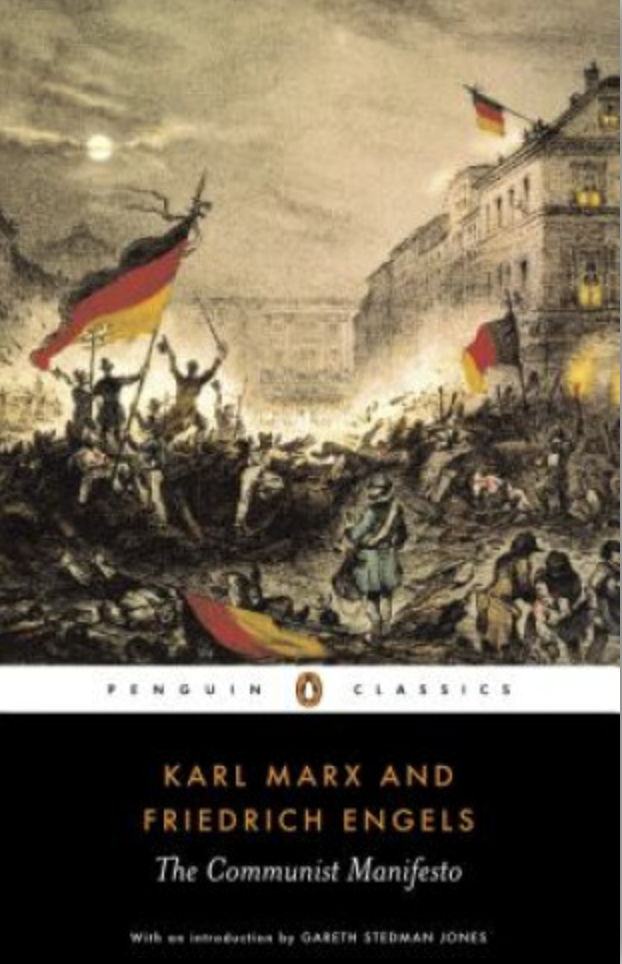
The Communist Manifesto is essential for all students of history. Since its publication, ancient history has been forced to face Marx’s incidneary claim: all history that fails to explain the history of class struggle is myth. Worse, such history is but the myth of the ruling class. The ruled, Marx argues, must seize history, return the class struggle to its pages, and thus understand the material forces that stand between it and libberation. These, of course, are revolutionary claims. Yet, it is one that was largely accepted by both socialist and liberal scholars in academia from the 1950s to the 1970s – albeit reshaped to fit the theoretical needs of the professional state-sponsored scholar of post-WW2 academia. M.I. Finley, for instance, is such a scholar whose Western, liberal post-Marxism did much to shape the modern research agendas and concepts that drive the scholarship of the ancient world today. For Marx, however, myth meant something different than it did the ‘Marxist’ intellectuals in the 1970s. Myth, for Marx, served as an antinymn to truth. Like Gramsci, Marx believed that all truth is revolutionary.
This is important to remember if we wish to understand Marx and Engels’ argument in The Communist Manifesto. Written in the revolutionary year of 1848, The Communist Manifesto opened with the famous words: “A spectre (Ein Gespenst) is haunting Europe – the spectre of communism (das Gespenst des Kommunismus.” (MECW 6, p. 81). This line has become so famous that we must take a little time to remember what it really means. In particular, why does it begin with a spectre? What do ghosts have to do with revolutionary communism?
Marx tells us in his own words. The Communist Manifesto was written in order to dispel the “nursery tale of the Spectre of Communism,” which was being told by the intellectuals of Europe. The “nursery tale” (den Mährchen) – that 19th century obsession of nationalist scholarship – is not the answer. We do not need, for instance, the Grimm brothers’ canon of national identity. We need the real history of the people – of those who had no place in the intellectual history of the French revolution. Not the priests and kings. Not the aristocrats. And, perhaps most importantly, not the merchants and capitalists. These had their estates and they had their history. Marx sets out to tell the history of “the rest” – what people in his time would have known as the fourth estate. This background is important because it reveals a different understanding of “spectre” than that frequently celebrated in contemporary Marxist thought.
For Marx, the spectre is “an apparition (erscheinung), a spectral being (gespenstisches wesen), or a disembodied soul.” And what The Communist Manifesto sets out to do is reveal the actual history – the material reality – hidden behind “the ghost” story being told by the ruling-class in Europe. He is responding, for example, to intellectuals like Alexis de Tocqueville, whose 1832 Democracy in America remains revered by the liberal intellectual elites today, and the fear they were stoking in the government and the press. When de Tocqueville, in the French Chamber of Deputies on January 29, 1848, cried out “We are sleeping on a volcano… A wind of revolution blows, the storm is on the horizon,” Marx believed he spoke in fables, ghost stories, and nursery tales. The people are not a volcano anymore than they are a storm. Such stories, Marx believed, should be kept to the hymns of the ancient Greeks and the sacred epics of the Near East. These are myths.
What is the real story? What is the terrifying volcano and storm on the horizon? What is the horror story that elites tell their readers and children in order to sleep at night? What, exactly, is the “holy alliance” of European powers trying to “excorsize” ? The short answer is: the people, the majority, the 4th estate. The Communist Manisfesto outlines the material and intellectual history of the people in three sections of the Manifesto:
- Bourgeois and Proletarians (p. 482-496)
- Proletarians and Communists (p. 497-506)
- Socialist and Communist Literature (p. 507ff.)

Leave a Reply