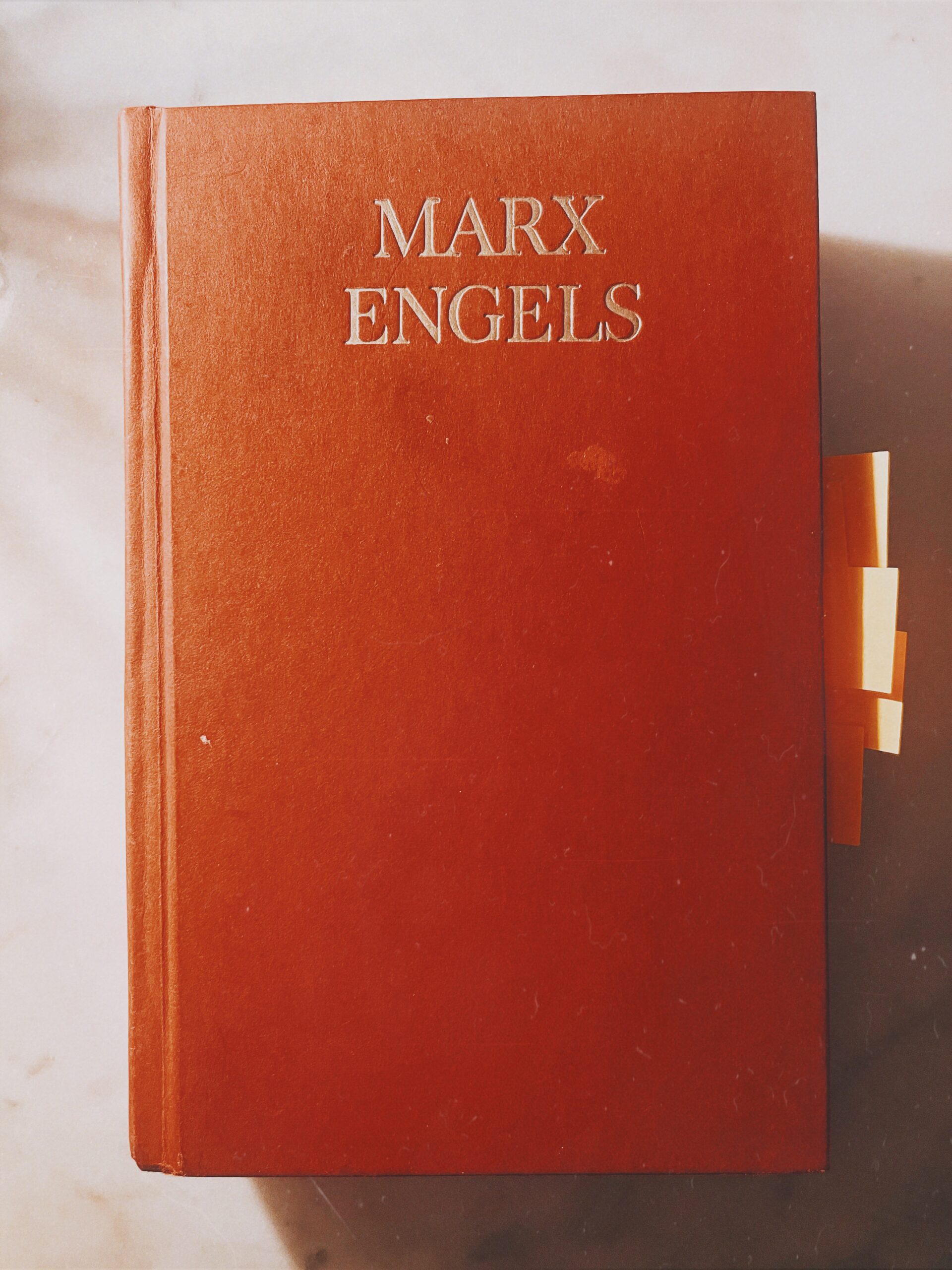
“The fact is, therefore, that definite individuals who are productively active in a definitive way enter into definite social and political relations. Empirical observation must in each separate instance bring out empirically, and without any mystification and speculation, the connection of the social and political structure with production” (p. 35).
I. Background
The German Ideology, written by Marx and Engels in 1845 and completed in 1847, is – like much of Marxism – better ‘known’ than read. This, in part, is for good reason. It was not published until 1903 (by Bernstein) – and then only in part. In full, it was finally published in 1932 (in MEGA1). It is at once an attack on idealism and intellectual radicalism. It opens with the line: “Hitherto men have always formed the wrong ideas about themselves, about what they are and what they ought to be” (MECW 5, p. 23). Ideas, we are told, stand between us and liberation, and concepts between us and revolution. If we can teach ourselves a new vocabulary – one that corresponds to our true essence, if we can learn to critique the concepts we have inherited, if we can “get” these ideas and meaning of our “heads,” then “existing reality will collapse” (MECW 5, p. 23).
These “innocent and child-like fancies are the kernel” of modern radical philosophy. The problem, according to Marx and Engles, is rather blunt. We do not drown because we believe in water and we do not die of consumption because we believe in tuberculosis. The Young Hegelians, according to Marx, made such simple, absurd mistakes and The German Ideology set out “to uncloak” “these sheep, who take themselves and are taken to be wolves.” Their philosophy, in the end, is only a mirror of the material conditions. It is a mirror – not of the prince – but “the wretchedness of the real conditions” in Germany and the marketplace of ideas in which the philosophers compete (MECW 5, p. 23): “It has not occurred to any one of these philosophers to inquire into the connection of German philosophy with German reality, the connection of their criticism with their own material surroundings” (MECW 5, p. 30).
Marx and Engels did not draw their criticism out of thin-air. They were both deeply concerned with the failure of philosophy to address the question of human liberation. They lived in the generation that followed the French Revolution (1789) and were at once deeply impressed by both the ideal and hypocrisy of republican, constitutional liberalism. Above all, they took seriously the notion of “freedom, equality, and brotherhood.” Marx had himself been a member of the radical Hegelians he critiques and knew first hand the experience of its failures. The working classes in England and France led both Marx and Engels to turn to communism in the previous two years. They did not believe that the critique of ideas – what they called “shadow boxing” – produced material change. Intellectuals “who are fighting against ‘phrases’” forget that “they themselves are opposing nothing but phrases to these phrases, and that they are in no way combating the real existing world” (MECW 5, p. 30). The critique they provide is thorough. It is a critique that speaks no less powerfully to the German philosophy of modern “critical theory” and French “post-structuralism” than the Young Hegelians and Utopian socialists. Despite their “revolutionary” performance, they are in material terms “the staunchest conservatives.”
II. Historical Materialism
It is often argued that Marx never used the term “historical materialism” (hereafter HM). This is only true if one wishes to apply the strictest (and most absurd) criterion of definition. In The German Ideology, Marx and Engels begin with an articulation of their new philosophy of history. This is titled “Premises of the Materialist Conceptions of History.” Many important scholars in the Marxist tradition of historiography have ignored this text, focusing instead on the meaning of ideology put forth in their critique. This has been unfortunate. The following will lay out the basic theory and argument put forward by Marx and Engels.
IIA. The First Premise of Historical Materialism
Contra the idealist and utopian philosophy of history, which begins with “arbitrary” and “dogmatic” premises, HM begins with “real premises from which abstraction can only be made in the imagination” (p. 31). By real, the mean: real individuals, the activity of real individuals, and the material conditions of real individuals.
Premise 1: The existence of living human individuals (Ex : x = human beings)
Therefore, the “first facts to be established is the physical organization of these individuals and their consequent relation to the rest of nature” (p. 31).
First Facts to be established:
(A) The physical organization of human individuals
(B) The consequent relation to the rest of nature
Here, they delimit the study of human individuals from other domains of study. The natural conditions (geological, oro-hydrological, climactic etc.), animal biology in general, and the physical nature of the human species are beyond the scope of their particular analysis at this point. Unlike scholars in the Idealist school, they argue that the history of humanity (as a subject of study) begins when they start “to distinguish themselves from animals as soon as they begin to produce their means of subsistence, a step which is conditioned by their physical organization” (p. 31). What differentiates human history from animal history is how humans “produce their means of subsistence.”
It is important to note that this argument, as it is presented so far, is incompatible with a materialist history founded on the theory of human consciousness, religion, or (as becomes extremely influential) psychology. Humanity can be distinguished “from animals by consciousness, by religion, or anything else you like” (31). But these will be arbitrary premises because they are human concepts. Consciousness refers to an idea. Marx believes (and this is extremely important) that his premise is fundamentally material. Human individuals refer to actual human individuals. For a human being who wishes to study history, it is entailed that there are two facts that must be established: how are human individuals physically organized? And, how does this physical organization relate to nature?
IIB. The Mode of Production
The way in which human individuals produce is conditioned by the natural environment. As M&E write, “The means of subsistence” depends on “the nature of the means of subsistence they actually find in existence and have to reproduce” (p. 31). What do they produce? How do they produce? These two questions offer the criterion for the excavation of definite forms of social life. They eschew the false abstractions of idealism and liberalism which seek to define all forms, expressions, and modes of life by means of concepts and ideas without a definite material reference. “What individuals are,” concludes M&E, “depends on the material conditions of their production.” (p. 32) This is an ontological and epistemological argument. It states the fundamental limits of historical observation: we can only observe what people do (i.e. how they are physically organized and how they relate to nature by means of their production).
Production appears with the increase in human population which “presupposes the intercourse of individuals with one another.” (32)
III. The History of Property
Proposition: “The relations of different nations among themselves depend on the extent to which each has developed (1) its productive forces, (2) the division of labor, and (3) internal intercourse” (p. 32)
They claim this proposition to be generally accepted for explanation of relations between “nations” but contend it also is true within a nation. “The whole internal structure of nation itself depends on the stage of development reached by its production and its internal and external environment intercourse” (32). The best indication of “how far the productive forces of a nation are developed is shown most manifestly by the degree to which the division of labour has been carried” (3). Each new productive force (that isn’t only extension) increases the division of labor.
Division 1: Agriculture } Commercial-Industrial
Country Town
Division 2: Commercial } Industrial
This leads to division between and within production groups. “The relative position of these individual groups is determined by the way work is organized…” (32). Interestingly, it is here that M&E define property.
Def. of Property: “The various stages of development in the division of labour are just so many different forms of property, i.e. the existing stage in the division of labour determines also the relations of individuals to one another with reference to the material, instrument and product of labour” (p. 32)
Property, in this definition, is first and foremost a social relation. This is important and it will be central to Marx’s work in the late 1850s and his discovery of the theory of surplus value and his unique re-theorization of the commodity. Here, however, they define property in historical stages. There are three pre-capitalist forms: the tribal, the ancient-communal, and the feudal form.
IIIA. The Three Stages of Pre-capitalist Property
i. Tribal Property
The first form is the tribal. It is restricted to the following forms of primary production: hunting, fishing, cattle raising, and “at most” agriculture. It does not use the word property and this could lead one to think that they did not think there was common property. It is a stage of production that “presupposes a mass of uncultivated stretches of land” (33). M&E contend that the division of labour is “confined to a further extension of the natural division of labour existing in the family” (p. 33). “Social Structure” therefore limited to extension of the family, which is defined as “patriarchal” (in the English edition at least). They perceive the division of society as marked by the following divisions:
- Patriarchal Chieftains
- Member of the Tribes
- Slaves
Slavery, which they appear to argue is endemic to the family, exists in the earliest stage of property. They write, “The slavery latent in the family only develops only gradually with the increase of population, the growth of wants, and with the extension of external intercourse, both of war and of barter” (p. 33). Contra Engles’ The Origin of the Family, here, they seem to presuppose that the study of social relations begins with the patriarchal family – a form they interestingly associate with slavery. More work must be done on this conception and the history of their understanding of pre-capitalist history.
They return to the question of “primitive” history and property in their extended critique of Feuerbach. The passage is rarely noted and discussed so here it will be quoted in full:
The building of houses. With savages each family has as a matter of course its own cave or hut like the separate family tent of the nomads. This separate domestic economy is made only the more necessary by the further development of private property. With the agricultural peoples a communal domestic economy is just as impossible as a communal cultivation of the soil. A great advance was the building of towns. In all previous periods, however, the abolition [aufhebung] of individual economy, which is inseparable from the abolition of private property, was impossible for the simple reason that the material conditions required were not present. The setting up of a communal domestic economy presupposes the development of machinery, the use of natural forces and of many other productive forces – e.g., of water-supplies, gas-lighting, steam-heating, etc., for the supersession [aufhebung] of town and country. Without these conditions a communal economy would not in itself form a new productive force; it would lack material basis and rest on a purely theoretical foundation, in other words, it would be a mere freak and would amount to nothing more than a monastic economy. – What was possible can be seen in the towns brought into existence by concentration and in the construction of communal buildings for various definite purposes (prisons, barracks, etc.). That the supersession of the individual economy is inseparable from the supersession of the family is self-evident (p. 76).
ii. Ancient Communal and State Property
The next stage of property “…proceeds from the union of several tribes into a city by agreement or conquest, and which is still accompanied by slavery” (p. 33). This clearly indicates that they saw social development as the unification process of tribes. There are two possibilities: “agreement” or “conquest.” (On conquest and colonialism, see p. 83 on Carthage, Greece as well as N. America). The ancient union of tribes centered in the city. This created the conflict between town and country. The city is the locus of the ancient world. Unlike modern theories of internal growth, they perceive as fundamentally separate societies of individuals. If one assumes that property was common in tribal societies, it appears that moveable and immoveable property development as new historical, social forms. They write, “Besides communal property we already find moveable, and later immoveable, private property developing, but as an abnormal form subordinate to communal property” (33). Since M&E believe that property is a social relation, it is defined by which individuals use the basic resources of society and nature. Since they knew the basic evidence for slavery in the ancient Greek and Roman societies in which they were well versed and studied, they sought to understand how a group of unified tribes agreed to hold property over animals, over agricultural land, and over slaves. (See p. 136-144 for their satire and critique of Max Stirner’s view of ancient Greece and Rome and their critique of his understanding of ancient society and philosophy). They wrote, “The citizens hold power over their labouring slaves only in their community, and even on this account alone they are bound to the form of communal property” (p. 33).
Thus, they perceived that slavery as property only existed to the extent that the community of unified tribes protected the right to own humans as property. Thus, slavery is fundamentally a communal form of ownership. They explain this in a very important and largely overlooked passage that must be quoted in full:
It constitutes the communal private property of the active citizens who, in relation to their slaves, are compelled to remain in this spontaneously derived form of association. For this reason the whole structure of society based on this communal property, and with it the power of the people, decays in the same measure in which immoveable property evolves (p. 33).
At this point, they were not particularly focused on the civilizations of the ‘Near East’ and knew little of the archaeology that would reveal the extent of the Bronze Age societies that preceded the development of the ancient societies they knew well – ancient Greece and Rome. (They were, however, aware of Egyptian history and comment on both Napoleon’s expedition and critique Max Stirner’s use of African history, see p. 163 ff.). They were especially – though not only – focused on the development of these societies because they became the paradigm for the new constitutional forms of liberalism that were developed in the wake of the English, American, and French revolutions. In the ancient Greek and Roman worlds, first with moveable property and slavery, and then moveable property, private property took its earliest form. This, for them, was also the origin of class. The describe this process as follows:
The division of labour is already more developed. We already find the opposition of town and country; later the opposition between those states which represent town interests and those which represent country interests, and inside the towns themselves the opposition between industry and maritime commerce. The class relations between citizens and slaves are now completely developed (p. 33).
Unfortunately, the passages they provide are very concise and dense. The development is captured in one brief paragraph:
With the development of private property, we find here for the first time the same relations which we shall find again, only on a more extensive scale, with modern private property. On the one hand, the concentration of private property, which began very early in Rome (as the Licinian agrarian law proves) and proceeded very rapidly from the time of the civil wars to the emperors; on the other hand, coupled with this, the transformation of the plebeian small peasantry into a proletariat, which, however, owing to its intermediate position between propertied citizens and slaves, never achieved an independent development (p. 33).
One interesting claim is that the plebeian peasantry were forced to become the proletariat of Rome. This is such an important concept of Marxism that it must be further investigated. The proletariat (largely as defined by Sismondi) became central to the Marxist socialist movements of the 19th and 20th century. Here the central difference between the ancient and the modern is the fact that the proletariat never became fully independent as they did in factory production in European cities in the 16th and 17th century. They remained forever stuck between “propertied citizens” and the “slaves.”
M&E return to Rome near the end of their critique of Feuerbach (p. 84-85). In a section titled, “The Role of Violence (Conquest) in History” (p. 84), they write:
In Italy… the concentration of landed property (caused not only by buying-up and indebtedness but also by inheritance, since loose living being rife and marriage rare, the old families gradually died out and their possessions fell into the hands of a few) and its conversion into grazing land (caused not only by the usual economic factors still operative today but also by the importation of plundered and tribute corn and the resultant lack of of demand for Italian corn) brought about by the almost total disappearance of the free population: the slaves died out again and again, and had constantly to be replaced by new ones. Slavery remained the basis of the entire production process. The plebieans, midway between freemen and slaves, never succeeded in becoming more than a proletarian rabble. Rome indeed never became more than a city; its connection with the provinces was almost exclusively political and could, therefore, easily be broken again by political events (p. 84).
In a satiric passage, mocking the idealism of Max Stirner’s conception of Roman history, they reveal their general understanding of the end of Roman history and the important of land: “The powerful mechanic shocks which the Roman empire received as a result of its division among several Caesars and their wars against one another, as a result of the colossal concentration of property, particularly landed property, in Rome, and the decrease in Italy’s population caused by this, and as a result of the [pressure of the] Huns and Teuton…” (p. 187). These are conditions captured well by Lucian (p. 187).
iii. Feudal or Estate Property
The feudal system was “in part” brought from “Germany” and had “its origin, as far as the conquerors were concerned, in the martial organization of the the army” which “evolved only after the conquest into the feudal system proper through the action of the productive forces found in the conquered countries” (p. 84). The central difference between the ancient form of property and the feudal form is two-fold. First, society is primarily located in the country at Feudal estates. Second, these feudal estates are worked primarily by serfs. Property is always a social relation. As they write, “If antiquity started out from the town and its small territory, the Middle Ages started out from the country” (34). Furthermore, “Like tribal and communal property, it is also based on a community; but the directly producing class standing over and against it is not, as in the case of the ancient community, the slaves, but the enserfed small peasantry” (34). This arose from the conditions of the fall of the Roman empire and the barbarian conquests which destroyed “the productive forces” (34): “agriculture had declined, industry had decayed for want of a market, trade had died out or been violently been violently interrupted” (p. 34). These conditions plus the organization of “the German military constitution” (p. 34) created conditions of feudalism.
In the country, “The hierarchical structure of landownership, and the armed bodies of retainers associated with it, gave the nobility over the serfs” (34). The seeds of capitalism by contrast slowly arose in the towns – in the forms of new production which demanded the “corporative property” of the guilds and which provided a – “counterpoint” to the landed property of the feudal lords. This, for a reason that they do not state, gave rise to
The simple class structure is put forth around these basic divides, which they argue is limited by “the strip” agricultural system.
- The Country 2. The City
Prince Master
Nobility Journeymen
Clergy Apprentice
Peasant The “rabble of casual labourers” (p. 35)
The break up of feudalism is discussed in a later section (MECW 5, p. 75-79]: “The extension of trade, the establishment of communications, led separate to establish contact with other towns, which had asserted the same interests in the struggle with the same antagonist. Out of the many local communities of citizens in the various towns there arose only gradually the middle class… these common conditions developed into class conditions” (p. 76). This is the class from which the “bourgeoisie develops” and which will lead to the “absorption” of “all propertied classes in existence” – “in the measure to which all property found in existence is transformed into industrial or commercial capital” (p. 77). This is followed by an important (and much understudied) theoretical analysis of class. It is worth citing at length:
The separate individuals form a class only insofar as they have to carry on a common battle against another class; in other respects they are on hostile terms with each other as competitors. On the other hand, the class in its turn assumes an independent existence as against the individuals, so that the latter find their conditions of life predetermined, and have their position in life and hence their personal development assigned to them by their class, thus becoming subsumed under it. This is the same phenomenon as the subjection of the separate individuals to the division of labour and can only be removed by the abolition of private property and of labour itself. We have already indicated several times that this subsuming of individuals under the class brings with it their subjection to all kinds of ideas, etc.
If this development of individuals, which proceeds within the common condition of existence of estates and classes, historically following one another, and the general competitions thereby forced upon them – if this development is considered from a philosophical point of view, it is certainly very easy to imagine that in these individuals the species, or man, has evolved, or that they evolved man – and in this way one can give history some hard clouts on the ear. One can then conceive these various estates and classes to be specific terms of the general expression, subordinate varieties of the species, or evolutionary phases of man.
This subsuming of individuals under definite classes cannot be abolished until a class has evolved which has no longer any particular class interest to assert against a ruling class (p. 77)
M&E provide a helpful summary of their central argument at the end of the section on Feuerbach. They write,
The first form of property, in the ancient word as in the Middle Ages, is tribal property, determined with the Romans chiefly by war, with the Germans chiefly by the rearing of cattle. In the case of the ancient peoples, since several tribes live together in one city, tribal property appears as state property, and the right of the individual to it as mere “possession” which, however, like tribal property as a whole, is confined to landed property only. Real private property began with the ancients, as with modern nations, with moveable property. (Slavery and community) (dominium ex jure Quiritum). – In the case of the nations which grew out of the Middle Ages, tribal property evolved through various stages – feudal landed property, cooperative moveable property, capital invested in manufacture – to modern capital, determined by large-scale industry and universal competition, i.e. pure private property, which has cast off all semblance of a communal institution and has shut out the state from any influence on the development of property (p. 88-90).
The consequences for modern politics and political economy are presented as self-evident. Unlike modern academic scholarship, Marx and Engels were clear about the direct connection between the ancient and modern property. They write,
To this modern private property corresponds the modern state, which, purchased gradually by the owners of property by means of taxation, has fallen entirely into their hands by means of the national debt, and its existence has become wholly dependent on the commercial credit which the owners of property, the bourgeoise, extend to it, as reflected in the rise and fall of government securities on the stock exchange. By the mere fact that it is a class and no longer an estate, the bourgeoisie is forced to organize itself no longer locally , but nationally, and to give a general form to its average interests (p. 90).
Like so much in The German Ideology, it has been overlooked that M&E proceed to draw a theory of the modern nation-state from their historical synopsis. The modern nation is state is defined as follows:
Through the emancipation of private property from the community, the state has become a separate entity, alongside and outside civil society; but it is nothing more than the form of organization which the bourgeoisie are compelled to adopt, both for the internal and external purposes, for the mutual guarantee of their property and interests… The most perfect example of the modern state is North America (p. 90).
V. Conclusion
This, for Marx and Engles in 1845-1847, has revolutionary implications. It is not possible to overthrow the power of the ruling class under capitalism by “dismissing the general idea of it from one’s mind” – it can only be abolished by the overthrow of the actual, concrete, material conditions. True revolution is the overthrow of the division of labor – making the working-class the subject of the “material powers” of labor. “This is not possible without the community” (78). This is the point of Marx and Engels work – what is known most broadly as “Marxism.” As they write, in “The Essence of the Materialist Conception of Social Being and Social Consciousness,” ideology obscures the material conditions of capitalist domination: “If in all ideology men in their relations appear upside-down as in a camera obscura, this phenomenon arises just as much from their historical life processes as the inversion of objects on the retina does from their physical life-process” (p. 36). The purpose of concrete, real (and thus revolutionary) knowledge is revelatory. “Communism differs from all previous movements in that it overturns the basis of all earlier relations of production and intercourse, and for the first time treats all naturally evolved premises as the creation of hitherto existing men, strips them of their natural character and subjugates them to the power of the united individuals.” (p. 81)