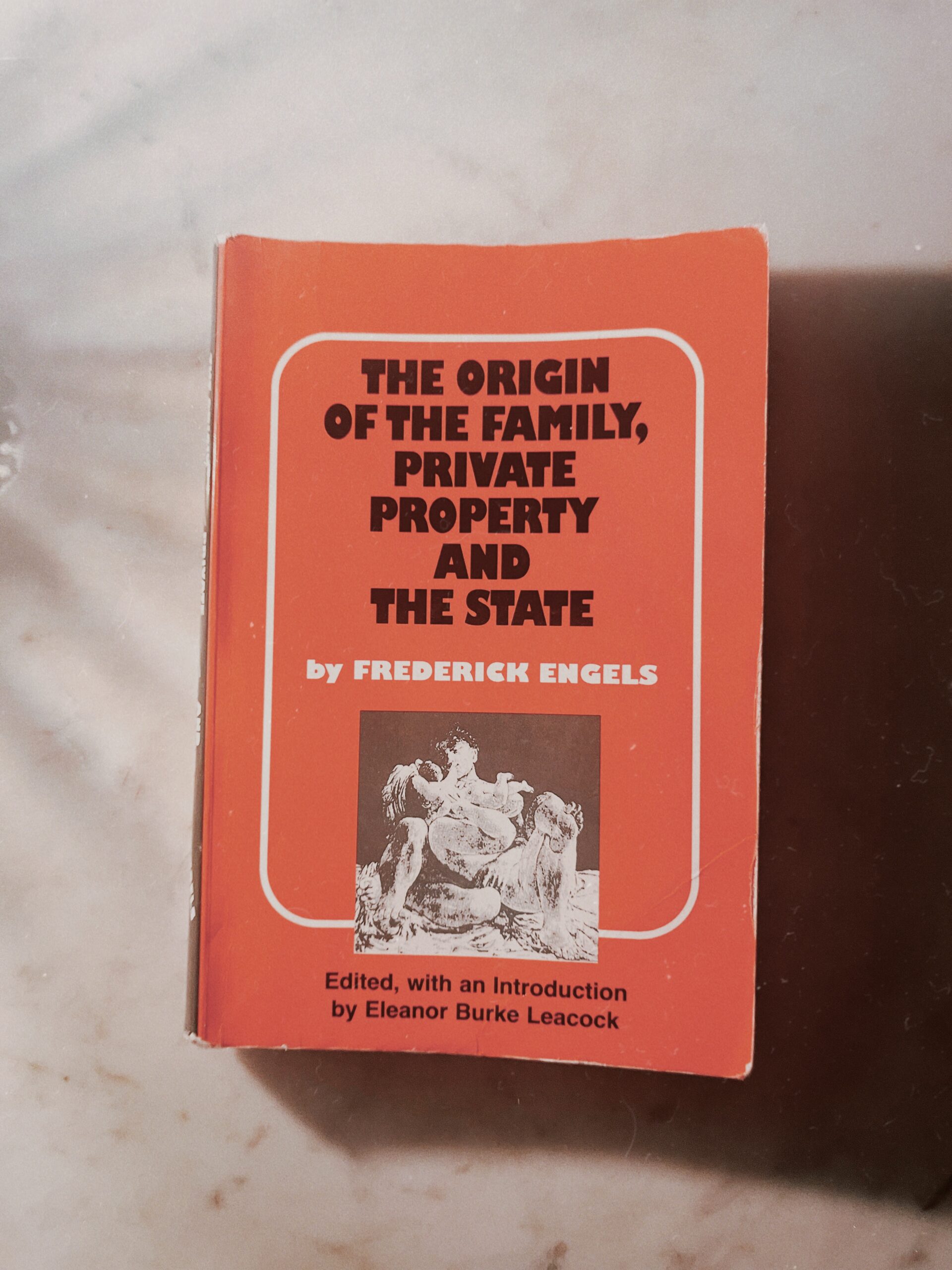
The scholarship of Engles is rarely treated fairly and seriously. By serious, I mean treated with the general norms of academic, professional scholarship: review, critique, and citation. One finds countless examples of dismissal of Engles’ eurocentrism, unilinear evolutionary theory, colonialism. It is also frequently contended that his ideas and theories were overturned by the the very positivism and/or scientism he practiced. The question, if put fairly, is what did Engles actually argue in The Origin of the Family and what has been overturned. I think to this we should clarify three forms of ‘critique’ : (1) the hard science criterion (i.e. falsifiability & replicability), the social science criterion (i.e. systemic categorization and statistical correlation) and (3) the cultural history criterion (i.e. academic definition and professional consensus).
In the first half the work, I believe Engles makes the following claims and arguments.
- The “Group-Marriage” Hypothesis: Human social organization was originally based on group-marriage. It transitioned to a particular historically observable form in which group-marriage is constrained by collateral sibling incest prohibition. [Prior development = Non-sedentary “hunter-gatherer” Societies]
- Kinship Argument: logical deduction on the basis of comparative kinship.
- Mother-Right Argument: logical deduction on the basis of paternity uncertainty.
- Communist Household Argument: common ownership of reproduction, food, goods of the household. Basis of female power. Limited personal ownership of tools of labor.
- The “Pair-Marriage” Hypothesis: Pair-marriage developed from the constraints of the extension of kinship prohibition to the full community. [Prior development = semi-sedentary “horticulture” and high-surplus food societies]
- Female Scarcity Argument: Scarcity of women is caused by extension of kinship restrictions, leading to development of (1) bride ‘capture,’ and (2) bride ‘purchase’
- Historical Hypothetical Reconstruction:
- Earlier Stage:
- Marriage dissolvable by both sexes
- Polygamy existent, rare
- Female fidelity prohibition (punishment of adultery)
- Children belong to mother
- Later Stage:
- *Pre-marital female sexual license
- Bride capture and bride purchase > religious and ritual ‘prostitution’
- Female-driven intensification of exclusive rites of the pair-bond
- Earlier Stage:
- The “Monogamy” Hypothesis:
- Pastoral Domestication Argument:
- Pastoral domestication creates private property in moveable wealth, leads to lever of male power and inheritance through the male descendants.
- Correlation between cattle and rise of patrilineal kinship descent
- Chattel Slavery Argument
- Intensification of slavery leads to privatization of land in Greece, leads to domestic slavery in the oikos
- Pastoral Domestication Argument:
It would take a great deal of work to determine to what extent these theories have been invalidated in the hard sciences, social sciences, and cultural history. The latter often proclaims these to be invalid, but unfortunately the work remains to be done.