Part I: Theory and Ideas
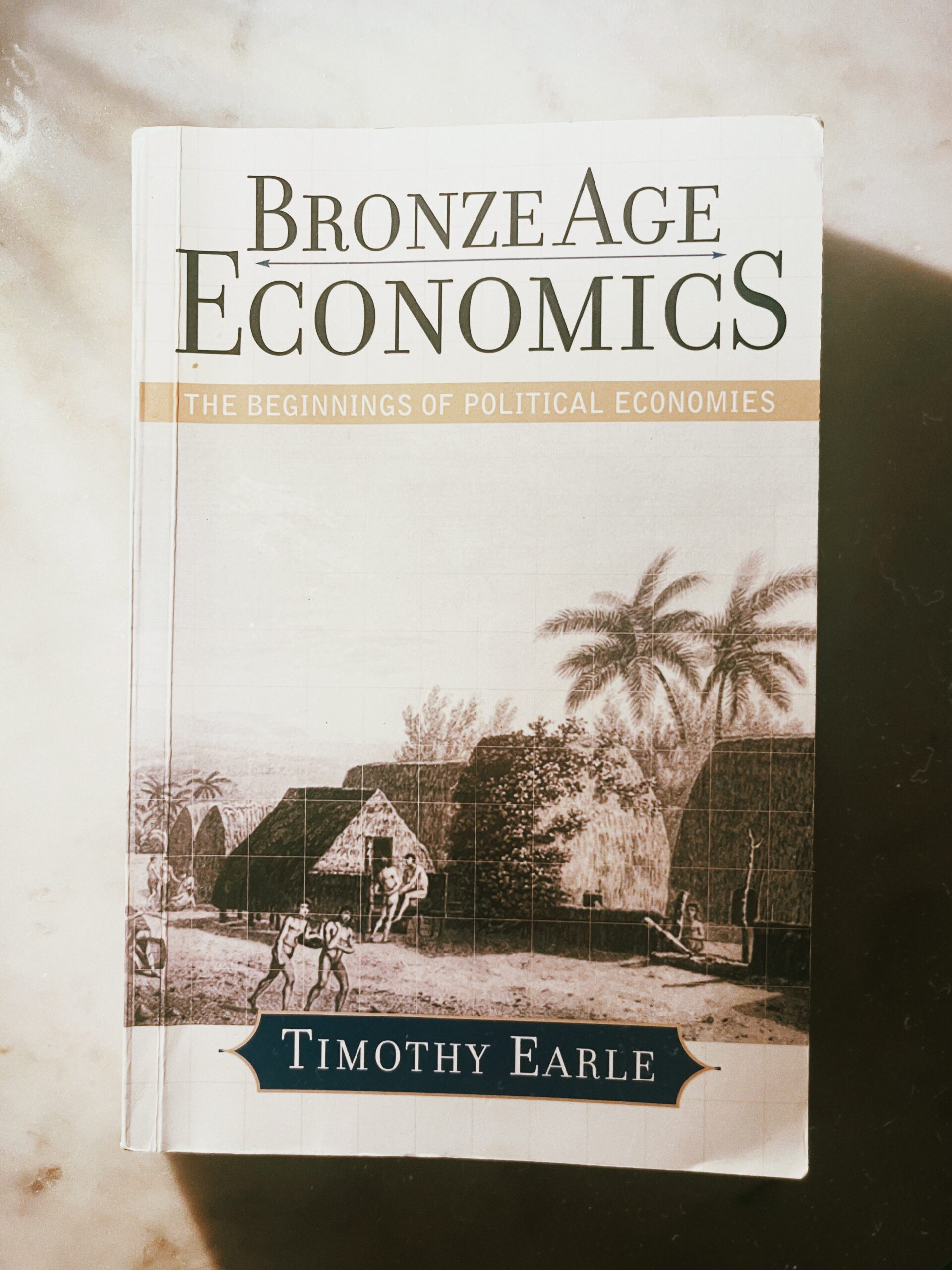
Timothy Earle’s Bronze Age Economics: The Beginning of Political Economy (2002) remains the central work on the economic anthropology of the Bronze Age. Working within the substantivist school, Earle continues Sahlin’s work on the evolution of stratified pre-capitalist societies. The project is best understood as a continuation of Polanyi’s work in the 1940s and 1950s. Above all, it begins with Earle’s work taking its starting point from Sahlin’s 1958 comparative contrast of Melanesian and Polynesian stratification – a work which provided anthropologists with the much misunderstood but nonetheless enduring concept of the “bigman” and the “chief.” Earle’s Bronze Age Economics provides a collection of updated articles on work on three comparative case studies: Hawaiian Chiefdoms, Andean Chiefdoms, and the Chiefdoms of Denmark.
The first three chapters provide an overview of the Earles’ theory of economic anthropology and history. The first chapter, “Political Economies of Chiefdoms and Agrarian States,” declares itself as an homage to Sahlins’ Stone Age Economics (1972). This book desires to present itself as the second volume, seeking to answer the questions Sahlins put forth to define the “stone age.” Why did bronze age political economies emerge in the New and Old World? These societies, for Earle, provide the “historical bridge between the societies studied by Sahlins and the modern societies in which we live.” Political economy, which is defined as “the material flow of goods and labor through a society, channeled to create wealth and to finance institutions of rule” (p. 1),” is the study of distribution and power.
Earle provides a brief overview of the history of economic anthropology (p. 1-8), beginning with the conventional academic narrative of the development of the substantive school: it began with Malinowski, Firth developed functionalism, Mauss developed proto-structuralism. With Polanyi, the field became split between substantivists and functionalists. In the 1970s, formalists focused on ecological evolution, scarcity, and the psychology of supply and demand – “how individuals choose among alternative possibilities to allocate time, money, and other resources” (p.2). Substantivists in turn “focused on how economies are embedded within cultural institutions to meet the material desires of societies” (p. 3). Earle, however, attempts to include the influence of Marxist scholarship.
It is told, unfortunately, from the perspective of his own academic trajectory which sought in the 1980s to “retain the proper balance between substantivist and formalist (relativist and universalist)” theories “in economic anthropology” (p. 3). Adam Smith’s Wealth of Nations (1776) and Riccardo’s Law of Comparative Advantage is presented as a prefiguration of microeconomics, which Earle accepts as both useful for the economic analysis of globalism and the pre-capitalist history. Thus, he believes the language of microeconomics and capitalist imperialism have proved fruitful. Simultaneously, he argues that substantivisim has been enriched by processuralism, structural Marxism, and new institutional economics. Marx is reduced to these academic re-formulations. He provides the following overview of Marxist ideas before the 1930s:
On the basis of the comparative evolutionary synthesis of Henry Louis Morgan, Karl Marx and Friedrich Engels developed an evolutionary narrative based on proposed changes in political economies. Marxists emphasized three main points: (1) social differences were derived from the material process in production; (2) political institutions were built by those in power to maintain and extend their domination over the economy and society; and (3) human nature was malleable, a product of institutional arrangement of society. Since these seminal works of the 19th century, Marxists have developed these ideas, largely outside of anthropology with explicit political agendas” (p. 4).
Earle’s own blend of substantivism is a blend of five schools of what he terms “institutional economics”: (1) neo-evolutionary Marxism (Harris 1968, 1974; White 1959; Wolf 1982, Adams 1966; Childe 1942; Earle 1997; Gilman 1976; Trigger 1998); (2) the Malinowski-Boas-Polanyi school, which culminated in Polanyi’s 1957 essay “The Economy as Instituted Process” and Sahlins “concept of the Domestic Mode of Production (with its intriguingly Marxist sound)” and (3) New / Processural Archaeology (Renfrew 1975), and (4) Structural Marxism (Bloch 1989; Godelier 1977; Ingold 1980; Meillassoux 1981), and (5) New Institutional Economics (North 1990). Earle notes “drawing rather eclectically from these five approaches” (p. 7). He believes they all help him to “explain how complex political institutions were established based on certain economic options to intensify and mobilize surplus” (p. 7).
Earles provides a perfect example of what happens to intellectual history when it is subjected to the performance of individual self-fashioning. This is what Nietzsche celebrated as “the use and abuse” of history and it is indicative of the genealogical branding necessary for academic survival in the era of neo-liberal ideology in the 1990s and 2000s. These are different schools with fundamentally diverse aims and political agendas. Most importantly, this narrative fails to understand that Adams Smith and Karl Marx had ideas and work that simply came before the work of Malinowski. When the history of economic anthropology is presented historically – as it is done by Earle’s contemporary, C.A. Gregory (1982) – it reveals that the political and class struggle inherent to Smith and Marx’s ideas.
The struggle between bourgeois anthropology and Marxist pre-capitalist history was central to Rosa Luxemburg and Max Weber’ economic history, both of whom were contemporaries of Malinowski Boas and Polanyi. The Marxist roots of economic history – how they were used to fashion the ideas of Max Weber, and how they became part and parcel of European socialism through the Vienna circle of Lukacs and Horkheimer is simply ignored. This, of course, is where Polanyi developed the ideas that he brought to Columbia University in the 1940s and which he used to defend and define state-sponsored socialism. The inability to understand the political meaning of the economic theories Earle invokes leads to a theoretically confused work that does much to malign economic anthropology’s claim to “science.” It also unfairly leaves Marxism subject to criticism on the same grounds. When Marxism is claimed (sheepishly and confusedly) by academic scholars disinterested in political history, it creates work that is terminologically confused and unhelpful. It is subject to refutation and quick dismissal. These are problems that run throughout this book.
Serious readers will seek to understand the meaning of “goods,” “labor,” “services,” “growth,” “capital investment,” “finance,” “ownership” et cet. in vain. They are self-justified because they appear in the theories of 5 diverse schools that represent almost every school of thought on the subject since 1920. Readers will also be disappointed by his inability to see how the material conditions of U.S. imperial capitalism created the conditions for such forms of “synthesis” in the academy. “Within less than a century, globalization has radically changed all economies as commodity flows from expanding capitalism engulf societies from the dark forest to the most remote desert” (p. 7). Did such thoughts lead Earle to reflect on how global capitalism might pressure ‘Marxist’ academics to validate and accept the terms of bourgeois microeconomics? There is no indication that he saw any contradiction in validating the ideas of Douglas North’s theory of history which sought to rewrite all human history and capitalist domination as human progress.
Despite this confused use of terms, Earle does focus on three relatively simple concepts drawn directly from Polanyi and Sahlins (since Marx is not relevant to Earle’s project, it is best understood merely as part and parcel of the general influence of Polanyi’s own reformulation of Marx’s ideas). First, reciprocity and the domestic mode of production. Two, redistribution and centralization. Third, specialization and the state. In each of these three areas, Earle makes substantial contributions to the Polanyi-Sahlins Model. Despite his use of the language of formalism and new institutional economics, it is clear that his primary debate remains with formalist scholarship and its focus on cultural evolution. Contra this theory, Earle continues to defend Sahlin’s theory of domestic mode of production with its defense of non-capitalist forms of social life: primarily, its disinterest in the production of surplus and growth.
The rest of the book turns to the analysis of case studies. In the next section, we will look at his analysis of the development of Hawaiian “chiefdoms.” In it, we can see how Earle approaches the central ideas and theories he puts forth. It will be argued that each of these central concepts entail a re-writing of Marx’s theory of historical materialism. In particular, the domestic mode of production and reciprocity is a refashioning of “primitive communism,” redistribution and centralization is rewriting of the “Asiatic mode of production,” and specialization and the state is a basic interpretation of the “division of labor.”