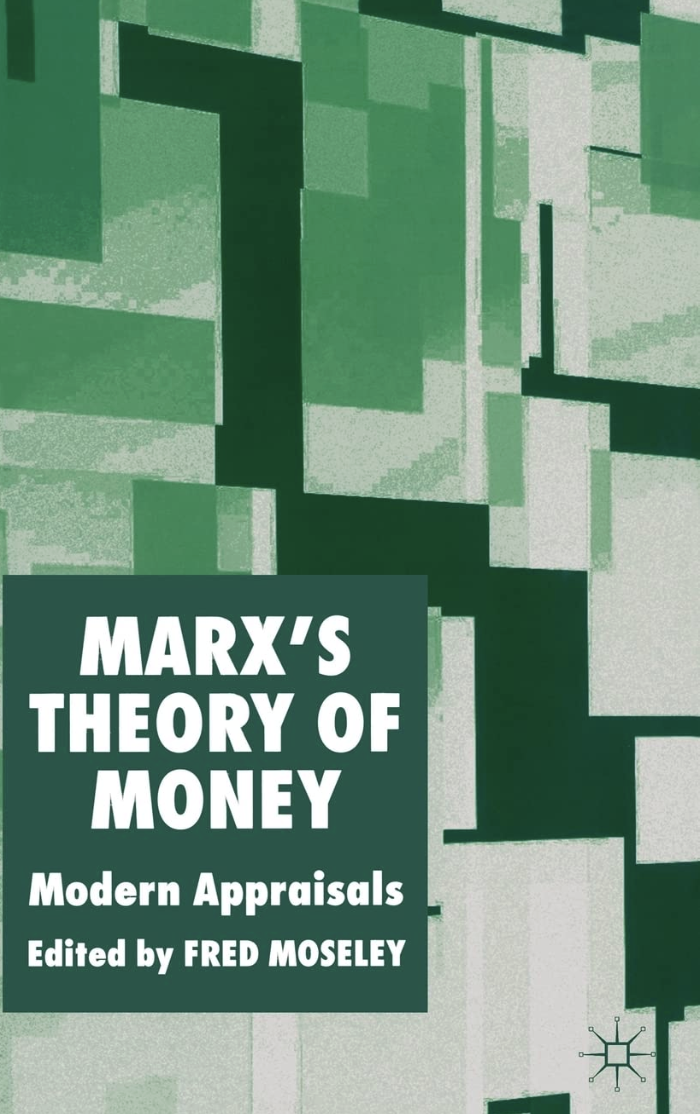
Marx’x Theory of Money, published by Palgrave Macmillan in 2005, brings together participants from the International Symposium on Marxian Theory, founded by the Marxian economicist Fred Moseley in 1990, which met annually from 1991-2012. It provides an essential introduction to recent scholarship on Marx’s theory of money. The introduction, written by Mosely, elucidates the basic problems and research questions that confront the Marxist study of money. The most important question is whether or not Marx’s commodity theory of money (largely outlined in Section 1.1-3 of Capital, Vol I) is necessary for his theory of capital, correct in its analysis of late 19th century capitalism, and relevant to the economics of the late 20th century (especially since the U.S. dollar left the gold standard in 1971). To answer these questions, it is necessary to be clear about how we interpret the precise meaning of use-valeu, exchange-value, abstract labor, the magnitude of value and price. This volume does not always succeed in carefully delineating and discussing these theoretical categories. But it does helpfully attempt to explain how Marx’s theory develops from the logic of his analysis of money in Section 3 of Capital and his polemic critique of the quantity theory of money. For scholars and economists who wish to apply Marx’s theory of money (and Capital) to contemporary capitalism, they must be able to understand and answer the central questions Mosely puts forth for the field.
How is value of money determined today ? How can we quantity the “monitary expression of labour time” ? What developments of Marxist theory are possible with or without the commodity theory of money and the logic of price and circulation put forth in the first and second volumes of Capital? The volume contains 14 contributions that seek various answers to these questions. On the central question of Marx’s commodity theory of money, there are two contradictory views.
For Mosley, Marx begins with the labor theory of value. Marx “derived the necessity of money in a commodity (or market) economy from his fundamental assumption of the labour theory of value, in the crucial but often neglected section 3 of chapter 1 of Volume I of Capital.” (p. 1-2). As Marx wrote:
Because all commodities, as values, are objectified human labour, and therefore in themselves commensurable, their values can be communally measured in one and the same specific commodity, and this commodity can be converted into the common measure of their values, that is into money. Money as a measure of value is the necessary form of appearance of the measure of value which is immanent in commodities, namely labour-time. (Marx 1867, p. 188)
First, money is “a measure of value,” and the value it measures is “labour-time.” More precisely, socially necessary labor time. Socially necessary labor time is an abstraction, since it is drawn from the average amount of time it takes to produce a commodity under the general conditions of production available. The exchange of commodities, according to Marx, presumes a quantitative relation between two things which are qualitatively incomparable (i.e. apples and oranges). The essential thing that makes them equivalent as quantities is “the abstract labour they all contain” (p. 2). Money, ultimately, provides the objective form of abstract labor embodied in all commodities and allows us to fix a quantitative “price” to the universe of qualitatively different things produced by human labor.
If this is correct, Marx’s theory of money should be able to express “important quantitative conclusions regarding the price of commodities and the quantity of money in circulation” (p. 3). Since prices, defined as “the exchange ratios between commodities and money,” “…are determined by the relative quantities of socially necessary labour-time contained in the commodities and the money commodity” (p. 3), we should be able to use Marx’s theory of money to mathmatically express the relation between the price of a commodity and the quantity of money in circulation. Moseley provides the following equations to capture Marx’s theory:
- Price Pi = (1 / Lg) Li
- Or, Pi = (MELT) Li
- MELT MELT = 1 / Lg
- MELTp MELT = (1 /Lg) (Mp / M*)
- Where M* = P/V
These are given the following definitions:
Pi : the price of each commodity
Li: the socially necessary labour-time contained in each commodity
Lg: the labour-time contained in a unit of gold (i.e. the value of money)
Mp: the ratio of the quantity of paper money forced into circulation
– nominal money requiredM*: the quantity of gold money that would be required if paper money were convertible
P / Velocity: See Marx’s Law of Circulation
From these definitions, Marx is able to show that “if twice as much paper money” comes into circulation “than required for circulation on the basis of gold prices, then the MELT would double and hence the prices of all commodities would also double” (p. 5). For Mosely, Marx’s theory is superior to the quantity theory of money for two reasons: (1) “the quantity of money does not determine prices directly, but rather indirectly through the MELT” ; (2) “Marx’s theory also explains the necessity of money,” and (3) “Marx’s theory explains not only the general price level (by the MELT), but also individual prices, as determined by the MELT and quantities of socially necessary labour-time; and, most importantly, (4) Marx’s theory of money also provides the basis for a theory of surplus value, and the quantity theory does not.” (p. 5).
Why then is Marx’s theory of money and circulation not influential today? One reason is the rise of the modern U.S. monitary system in the 1970s and the end of the gold standard. He writes,
In recent decades, a new criticism has been made of Marx’s theory of money: that it requires that money be a produced commodity (e.g., gold) and, in contemporary capitalism, money is no longer based on gold in any way (since the 1930s for domestic money, and since the early 1970s for international money). Therefore, even if Marx’s theory of money might be acceptable for commodity money, critics argue that it does not apply to the current monetary regime of non-commodity money (e.g., Lavoie 1986). (p. 5)
This book was the product of a conference organized to discuss this question and the relevance of the Marx’s theory of money within the context of the modern U.S. dollar and monitary systems. As Mosely writes, it sets out to answer the following question:
In considering this criticism, it is important to distinguish between the different functions of money (which is not always done), and especially between the functions of the measure of value and the means of circulation. It is clear that money as means of circulation does not have to be a commodity in Marx’s theory, as Marx himself emphasized (Marx 1867: 221–7 and 1859: 107–22). The real question is whether money must be a commodity in Marx’s theory in its fundamental function as measure of value.
The book is a rare and important achievement in the scholarship, focusing on a set of well defined questions and problems. Mosely divides the contributions to these questions into five groups (See Table Below). The question of the commodity theory, however, is not ultimately solved by the authors. The scholars in this volume disagree on the extent to which the commodity theory is necessary ontologically in order to explain both Marx’s theory of Capital and capitalism cince 1971. See Mosely 2010 for further study of the MELT and the commodity question.
- Marx’s Basic Theory of Money
- Germer, Claus “The Commodity Nature of Money in Marx’s Theory (p. 21- )
- Foley, Duncan “Marx’s Theory of Money in Historical Perspective” (p. 36 – )
- Murray, Patrick “Money as Displaced Social Form: Why Value cannot be Independent of Price” (p. 50- )
- Nelson, Anita “ Marx’s Objection to Credit Theories of Money” (p. 65- )
- Reuten, Geert “Money as Constituent of Value” (p. 78- )
- Extensions and Reconstructions of Marx’s Theory of Money
- Marx’s Critique of the Quantity Theory of Money
- Momey and the Transformation Problem
- Marx’s Theory of World Money

Leave a Reply