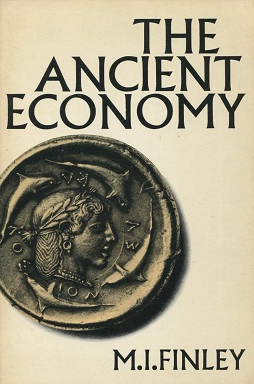
I. Introduction
The Ancient Economy sets out to answer a question that scholars still grapple with today. How should we study the economy in the ancient Greek and Roman world? Did they have an economy like our own? What is the same and what is different. Most importantly, what method and ideas can we use to compare our evidence for the past with what we know today? The question becomes especially difficult when we wish to justify how the modern study of history is more scientific (or more justifiable) than those narratives that say it was caused by the spirit of god, the spiritual growth of society, or the emancipation of the self. If economic history is part of the material record of the past, it is necessary to answer the following question: what were the natural or the social forces that changed over time in human history and were (or are) different in different types of societies?
M.I. Finley provides the following answers. First, we must reveal the categories of economic experience that exist(ed) in the language and thought of the people we are studying (i.e. the emic ‘natural language’ categories observed primarily in the literary record). This is the basic theoretical position of German historicism. Second, with these categories in hand, we should work to demonstrate how the forms of social organization explain social development and change in the past. This is basically the epistemology of the German sociologist, Max Weber. The first and most important epistemological thesis revealed by Finley’s method is that:
(1) There is no concept of ‘economics’ in the ancient Greek and Roman World that corresponds to the modern ‘economic rationality’ (i.e. the pursuit of capital accumulation via recursive [potentially infinite] investment in expanded production and exchange (110).
For Finley, this thesis is important in the political debates of his own time. In particular, it refutes the central claim of ‘capitalist’ history, which has always sought to justify the trans-historical nature of capitalism. In this perspective, he shares the general beliefs of both the Frankfurt school of post-Marxist theory, and the economic anthropology of Karl Polanyi, and Marshall Sahlins, which remains central to the work of David Graeber of David Wengrove. Thus, on one side, Finley’s work is deeply anti-capitalist. Finley’s historicism, however, also is central to his second central thesis, which is profoundly anti-Marxist:
(2) There was no concept of the class struggle in the in the ancient Greek and Roman World that corresponds to Karl Marx and F. Engles’ definition of class (i.e. a portion of society that is defined via its relationship to ownership of the means of production).
Out of these two critiques, Finley constructs his own analysis of the economic world of ancient society. Using the language of the Frankfurt school of critical theory, Finley contends that ancient Greece and Rome were societies that only understood their own social divisions as forms of status (a Latin word). It was therefore status (and not capitalist economics or the Marxist economic class struggle) that represented the essential categories of political organization and conflict in the ancient world. In five chapters, M.I. Finley presents his basic outline of how status reflects the economic history of the ancient Greek and Roman world.
II. Finley Model of Ancient Economic History
In the second chapter, “Master and Slave” Finley outlines the two foundational forms of ancient status. Those familiar with Hegel will recognize the categories. The “master” and “slave” relationship arises in the context of the transition from the previous caste structure (Latin ordo, ordines). The orders, which were originally based on the tribute or taxation of the land, were fundamentally rigid and they express the form of social relations Finley associates in general with Near Eastern Bronze Age societies. By contrast, the true status society of ancient Greece arises in the years after Solon in Greece and in the 4th century in ancient Rome. The status of the free of citizen, however, is only possible because of the rise of chattel slavery. Chattel slavery, unlike both palatial slavery and peasantry, is a product of commodity exchange. This form of slavery, Finley argues, replaces the excessive tribute tax collection that produced elite wealth and led to debt bondage in the 6th century BC. Instead, the basic social relations are founded prgressively on the difference between the master who owns slaves and the slave. This, in Finley’s estimation, explains slavery and allows it to be situated with the framework of the Greek oikos and Roman familia, both of which embodied the legal and material foundation of the ‘free’ pater familias in the ancient world. The Roman pater was “father” in a sense that extended beyond the biological definition common to the modern English sense of the world. In the ancient world, it embodied the legal right of ownership over his wife (and her property), his children (and their property), and his slaves (and their property). This relations provided the material base for the ‘economic’ world of the ancient Greeks and Romans and ultimately it explains two things. First, the etymology of economics (the law of the household) which properly accounts for the nature of ancient accumulation and production. Second, the social world of the familia that provided the real base of the ancient elite citizen’s opportunity to struggle for status (i.e. to perform the social identity and agency the ideological trope of ‘Western Civilization’ presents as liberal-ism).
When Finley turns to the analysis of “Land Tenure,” he is now able to use these categories in order to show how they help to explain the dynamic changes that take place in early Greek and late Roman history. His basic thesis is that the City-State engenders ;and-tenure without tribute-taxation. By contrast, empire is built on tribute-taxation. The paradox of the free peasant is described as the contradiction between the former providing freedom with economic insecurity and the latter providing economic security without freedom. This reflects the broader categorization of the ordo society and the status society. He uses this scheme to explain the general forces that lead to the end of the Roman empire and the transition from the orders (patrician / plebes) to status (optimates / popularis) and back to imperial Feudalism (honestiores / humiliores) which transitions eventually into the coloni form of Feudalism. Throughout he contends that there is zero evidence for capitalist economic behavior and that there is zero evidence for class war or class solidarity.
III. Conclusion
With a few notable exceptions, Finley’s basic arguments came to provide the shape for the study of economic history in ancient Greece and Rome. Scholars in the 1970s and 1980s focused primarily on excavating the structures of ancient society which were reflected in the literary presentation of status. Despite the obvious epistemological pitfalls, the same method was also extremely influential in archaeology. Thus, The Ancient Economy provides an important look into the establishment of what Classical historian, Keith Hopkins, correctly termed ‘the new orthodoxy’ of ancient economic history. The orthodoxy, which was a product of Finley’s tenure at Cambridge University in the 1970s and early 1980s, dominated the study of ancient Greek and Roman history and today a small cadre of Cambridge doctorates, their students, and their ideas hold a monopoly on the study of the economic history of ancient Greece and Rome in the English language. Like most orthodoxies, however, it has effectively obscured its own intellectual foundations.
M.I. Finley’s ideas took shape in the United States in the 1930s, and were directly influenced by the Marxist intellectual work and communist organizing that resulted in M.I. Finley’s termination from Rutgers University in the early from 1948-1952. Like both Karl Marx and Max Weber before him, Finley’s early intellectual life was shaped by the land question. (See Kautsky’s 1899 The Agrarian Question). In the 1930s, the land crisis famously captured in Steinbeck’s The Grapes of Wrath, was a (if not the) central topic of the global political struggle, something elderly American scholars are apt to forget because they were able to enjoy the benefits of the U.S. National Housing Act shaped modern middle class ideology and wealth. The importance of the land tenure question is reflected in the revolutionary struggles of Zappata in Mexico in 1909, and Mao in China in the late 1940s. Globally, the privatization of the commons and communal land remained a burning issue of revolutionary politics. In reading Thurnwald, Bücher, Polanyi, and Marx, Finley struggled to understand the historical dimensions of land tenure in his dissertation at the University of Columbia. After his PhD, Finley appears to have been actively working as an communist informant for the USSR after WW2. In fact, it was recently discovered that Finley was noted to be “a devoted person, member of the communist party” in the state papers of the U.S.S.R. This statement was written in 1947. In 1951, he testified before the Senate Internal Security Committee, where he was ‘named’ as a communist by colleague and former Marxist comrade, Karl Wittfogel (see Oriental Despotism). Finley refused to out his colleagues or himself, which resulted in Finley’s termination in 1952. Ultimately, it was the “Red Scare” that brought Finley to Cambridge.
M.I. Finley’s work can only be properly understood within the framework of the Marxist thought and politics that effectively exiled him from the United States. This, indeed, is how Finley framed his intellectual development and ideas. This is also how The Ancient Economy was received by Finley’s friend, G.E.M de ste Croixe, the British Marxist Classicist. The Ancient Economy ended their friendship and spurred de ste Croixe to produce the monumental defense of the Marxist theory of class, aptly titled The Ancient Greek Class Struggle. It is important to remember that M.I. Finley’s work was part and parcel of the post-Marxism which arose in professional academia as a direct result of both Stalinist and U.S. persecution. It is extremely important because his career at Cambridge in England after his exile from the American academy in ‘the Scare Scare’ marked the abandonment of his political and scholarly Marxism. Finley’s critique of class, the class struggle, and class consciousness is essential to the Ancient Economy, and since its publication in 1973 it has served to make it almost impossible to to seriously debate and discuss the fundamental Marxist categories of analysis in Greco-Roman history. By contrast, Finley’s critique of capitalist history has been forgotten and in the end we are left with the narrative of Greco-Roman exceptionalism and its ideology of status.

Leave a Reply