I. Introduction
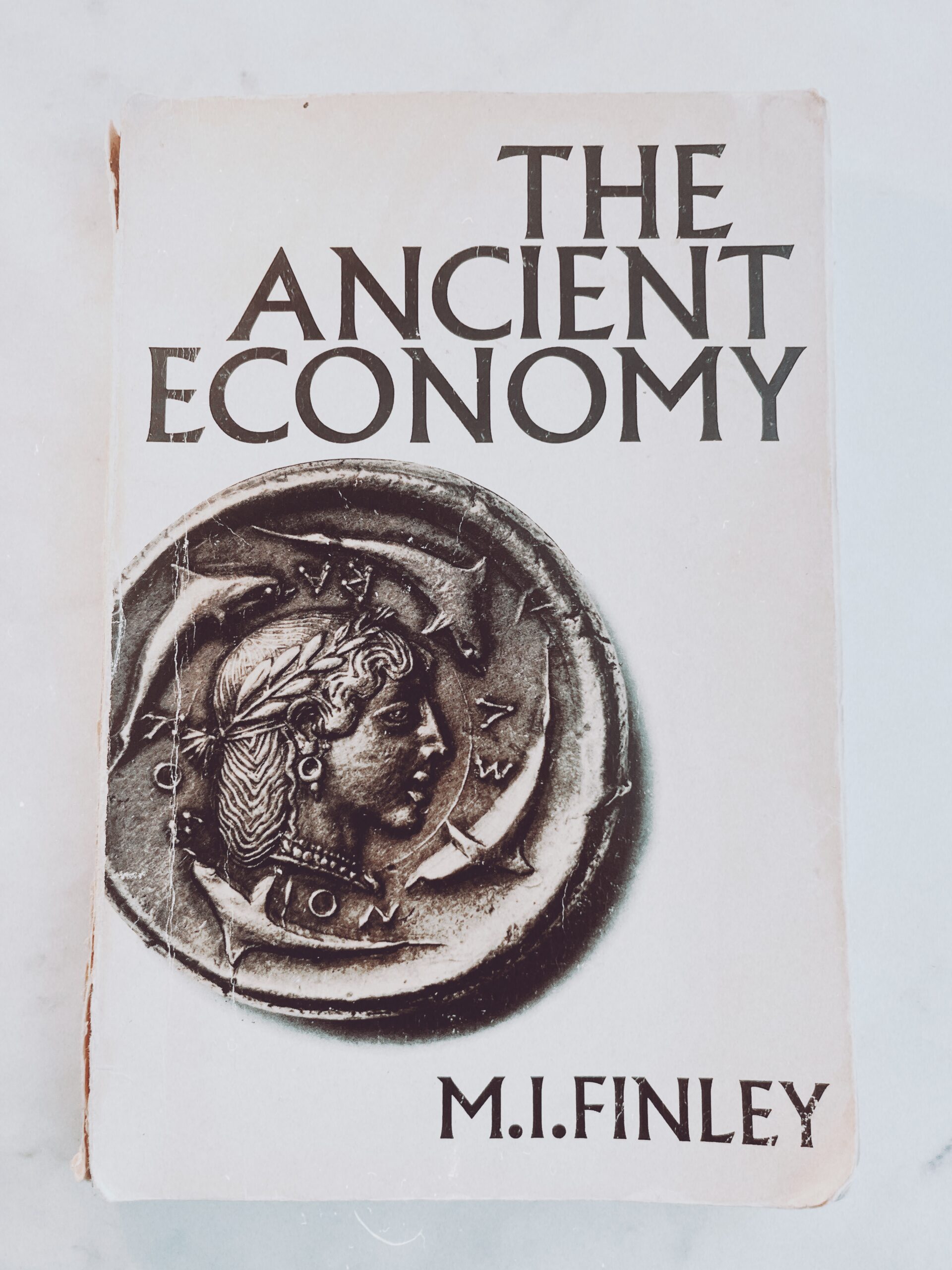
M.I. Finley is widely celebrated as the most influential ancient historian of the 20th century. The Ancient Economy is widely considered his most important book. Written for the U.C. Berkeley Sather Lectures in 1972, it is a work that marks the triumphant return of Finley to America after almost two decades of professional and political exile in the U.K. In 1953, after M.I. was dismissed from Rutgers University (largely on the grounds of Karl Wittfogel’s naming him as a“communist” before the House Un-American Activities Committee in 1951 and J. Edgar Hoover’s pressure on the University in 1952), there was little inclination that M.I. Finley would have an illustrious professional career in academia. He was, however, lucky to find a welcoming intellectual culture in the U.K. where his roots in Marxist politics and ideas served to secure him a position at Cambridge University. In the following twenty years, M.I. Finley developed the basic foundations of contemporary sociological and economic history of the ancient Greek and Roman world. The method and theory he brought to the traditionally conservative field of `Classics,’ introduced the basic ideas of German critical theory (i.e. the Frankfurt School of post-Marxist philosophy) and substantive economic anthropology (i.e. the Boas-Polanyi school of socialist anthropology).
Both influences were developed at Columbia University in the 1940s and 1950s and are central to both M.I. Finley’s work and academic success (In fact, without the professional network provided by Max Horkheimer, it is unlikely M.I. Finley would have ever held an academic position in America or the U.K.) Thus, The Ancient Economy is an important work in the history of Classics and Marxism. On the one hand, it provides a summation of the ideas M.I. Finley developed on the Homeric world, Mycenaean civilization, and ancient slavery in the 1950s and 1960s. On the other, it allows us to better understand how the central role post-Marxism played in defining the practice of bourgeois ‘Classics’ in the 1970s. The failure to understand Marxism is responsible for much of the confusion present in the study of ancient history today. The Ancient Economy attempts to answer these questions in the following chapters:
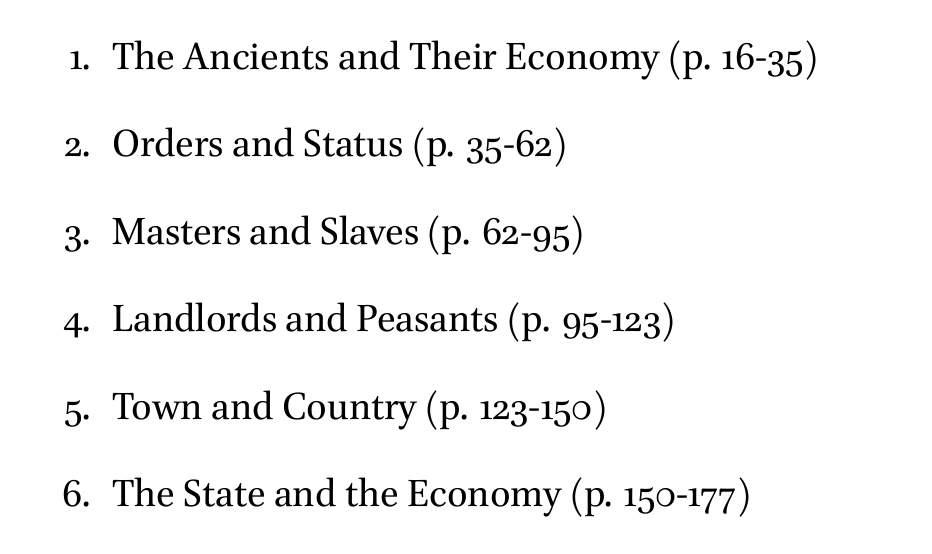
M.I. Finley provides the following answers (in reverse order). First, the categories of economic experience that exist(ed) in the language and thought of the people we are studying (i.e. the emic ‘natural language’ categories observed primarily in the literary record) reveal the forms of economic life in a particular society (This argument is made in Chapter 1 and the basic terms of analysis are put forth in Chapter 2 and Chapter 3). Second, with these categories in hand, we ought to demonstrate how they reflect social and historical change over time (This is largely explained in Chapter 4, 5, and 6. Finally, for Finley, there are no essential natural or material forces that determine the analysis of history. What comes first and foremost are the emic social categories of experience captured primarily in the literary sources. Distilled to its simplest form, the argument of the book can be stated as follows: the ancient Greek and Roman world is differentiated from the Near Eastern world by (1) the transition from the hierarchy of the orders to the political “freedom” of status in the Classical World, and (2) the development of agricultural slavery and the dominion of the master. This is the foundational argument of Finley’s work. It is articulated most concisely and powerfully in his 1959 article, “Was Greek History Based on Slave Labour?”
The Greeks, it is well known, discovered both the idea of individual freedom and the institutional framework in which it could be realized. The pre-Greek world – the world of the Sumerians, Babylonians, Egyptians, and Assyrians; and I cannot refrain from adding the Mycenaeans – was, in a very profound sense, a world without free men, in the sense in which the west has come to understand that concept. It was equally a world in which chattel slavery played no role of any consequence. That, too, was a Greek discovery. One aspect of Greek history, in short, is the advance, hand in hand, of freedom and slavery. (Finley 1959, p. 164)
For Finley, the advance of freedom and slavery was a paradox. Today, Finley’s students (even the solitary self-avowed `Marxist’) fail to remember the point of Finley’s work. He demanded that scholars and the public face the uncomfortable fact that the roots of Western civilization in the Classical world grew out of the extension of chattel slavery. Last, he believed that the study of the ancient economy revealed the fundamental novelty and strangeness of modern capitalism. Contra the belief Adam Smith (and later liberal economists and historians), capitalist rationality (i.e. the pursuit of capital accumulation via recursive and potentially infinite investment in expanded production and exchange) simply did not exist in the ancient world. (It is an argument he ascribes to the tradition of Max Webern, his disciple – Johannes Hasebroek, and Karl Polanyi).
The existence of trade, long-distance agents, never lead to the creation of corporations” in order to intensify capital resources” for the growth of commodity production, commerce, and money lending (p. 144): “In short, the strong desire to aquire wealth was not translated into a drive to create capital; stated differently, the prevailing mentality was acquisitive but not productive” (p. 144). Finley retells a famous passage in Pliny, Petronius, and Dio Cassius to make his general point. We are told that a man, in the time period of Tiberius’ reign, invented unbreakable glass. He brought his discovery directly to the emperor. When Tiberius asked the man if he had shared his invention with any other, the man replied in the negative. Tiberius had the man beheaded so, we are told, lest gold be reduced to the value of mud.” For Finley, what matters, is that none of our ancient sources found anything strange or notable in the fact that inventor turned to the emperor for a reward and not to an investor for capital with which to put his invention into production” (p. 147). The story captures Finley’s method, theory, and politics beautifully.
I. Economics
It is in the first chapter, The Ancients and Their Economy,” that Finley put forth his most famous argument:economics” in the modern sense did not exist in the ancient `Classical’ world. The world from Xenophon to Francis Hutcheson in 1742 simply did not have the concept of economics” in the sense the term would assume after Adam Smith. Furthermore, contemporary mathematical economics” in the sense the science has been defined since Alfred Marshall’s The Principle of Economics (1890) is impossible to even translate into ancient Greek. There was, strictly speaking, neither a science of national nor individual wealth in the ancient world. Finley distinguishes the ancient” from pre-history (i.e. the Neolithic) and non-literate societies studied by the anthropologists” (p. 27). Furthermore, he distinguishes European civilization” as a fundamentally distinct subject” (p. 27). He explains,
What matters is the way in which the two civilizations (or complexes of cultures) diverge fundamentally at every point, in their social structures (both internally and externally), in the relationship between the power structure and religion, in the presence or absence of the scribe as a pivotal figure… it is impossible to translate the word freedom’ … or free man,’ into any ancient Near Eastern language, including Hebrew, or any Far Eastern language either, for that matter (p. 28).
By contrast, the Graeco-Roman world” was essentially and precisely one of private ownership” (p. 29). With this in mind, We must concentrate on dominant types, the characteristic modes of behavior” (p. 29). The language is, of course, vaguely Marxist. The Marxist theory of private property and the modes of production, however, have become translated into broader, less precise terms: property becomes ownership” ; production in turn is treated as behavior.” In order to understand the Greek concept of economics, Finley argues that it is necessary to understand what the terms itself meant in the ancient world. To study the ancient economy is to study the meaning of ‘oikos’ and ‘nomos.” The “social laws” of the “ancient household” were vastly different than those in both the ancient Near Eastern world and the modern, capitalist world. The Greek “oikos” and the Roman “familia” are the central elements of ancient Graeco-Roman history and economics. The Roman pater was “father” in a sense that extended beyond the biological definition common to the modern English sense of the world. In the ancient world, it embodied the legal right of ownership over his wife (and her property), his children (and their property), and his slaves (and their property). Finley outlines these social laws, beginning with the three-fold division of the “oikos.” He believes these are best captured by the Latin terms for the classifications of the power of the pater familias:
- potestas: power over children (biological and adopted), children’s children, and slaves
- manus: power over wife and the wives of sons
- dominium: power over possession
Unlike the modern `individual’, the ancient family (household and slaves) is the central atom (or element) of ancient society. It gives rise to the status of the members who negotiate their existence both within and without this central ancient institution.
II. Status
In the second chapter, Orders and Status,” Finley contends that the orders (i.e. in the Solonic period) transition to status-groups” in the 5th century B.C. (p. 48). This transition is mirrored in Roman history (though complicated by the success of Roman expansion). The struggle of the orders” in Rome between the patricians and the plebs (like that of the struggle between eupatridae and demos in Athens) was fundamentally based on the hierarchical structure of the orders. Status could only arise within the distinction between citizen and non-citizen (Gk. politeis and L. civis). Citizenship was founded exclusively on the prerogative” to land-ownership; land-ownership led to the extension of citizen freedom” to the extent it leveraged the use of slave-labor on privately owned agriculture. Within the individually owned household” – (i.e. oikos or familia) – status became the determining form of social differentiation. Finley uses an extended passage of Cicero (De Officiis 1.150-1) in order to frame his theory of status:
Now in regard to trades and other means of livelihood, which ones are to be considered becoming to a gentleman and which ones are vulgar, we have been taught, in general, as follows. First, those means of livelihood are rejected as undesirable which incur people’s ill-will, as those of tax-gatherers and usurers. Unbecoming to a gentleman, too, and vulgar are the means of livelihood of all hired workmen whom we pay for mere manual labour, not for artistic skill; for in their case the very wage they receive is a pledge of their slavery. Vulgar we must consider those also who buy from wholesale merchants to retail immediately; for they would get no profits without a great deal of downright lying; and verily, there is no action that is meaner than misrepresentation. And all mechanics are engaged in vulgar trades; for no workshop can have anything liberal about it.
Least respectable of all are those trades which cater for sensual pleasures: “Fishmongers, butchers, cooks, and poulterers, And fishermen,” as Terence says. Add to these, if you please, the perfumers, dancers, and the whole corps de ballet. But the professions in which either a higher degree of intelligence is required or from which no small benefit to society is derived — medicine and architecture, for example, and teaching — these are proper for those whose social position they become. Trade, if it is on a small scale, is to be considered vulgar; but if wholesale and on a large scale, importing large quantities from all parts of the world and distributing to many without misrepresentation, it is not to be greatly disparaged. Nay, it even seems to deserve the highest respect, if those who are engaged in it, satiated, or rather, I should say, satisfied with the fortunes they have made, make their way from the port to a country estate, as they have often made it from the sea into port. But of all the occupations by which gain is secured, none is better than agriculture, none more profitable, none more delightful, none more becoming to a freeman.
Status, on the basis of Cicero’s passage, is argued to range from “slave” (illiberal) to “free” (liberal). The broad range of possibilities exist within these two polar ends. Within this spectrum, all sub-variations of status are performed and expressed. For Finley, status is necessary in order to understand two basic problems with Marxist analysis: first, Marxist analysis fails to account for the lack of class-consciousness in among oppressed groups in the ancient sources; second, the Marxist theory of class is incapable of distinguishing between ancient slavery and modern wage-labour. In particular, Finley contends that Marx is incapable of explaining the role of elite slaves with either small wages or ownership of any basic means of production. Finley’s dismissal of Marx’s class has been extremely influential and is at the heart of the well-known debate between himself and G. E. M. de Ste. Croix. Therefore, it worth looking at how little attention Finley actually gives to the problem:
Men are classed according to their relation to the means of production, first between those do and those who do not own the means of production; second, among the former, between those who work themselves and those who live off the labour of others… for the ancient historian, there is an obvious difficulty; the slave and the free-labourer would then be a member of the same class, on a mechanical interpretation, as would the richest senator and the non-working owner of a small pottery. That does not seem to be a very sensible way to analyse ancient history. (p. 49)
There is no citation of Marx or further discussion. Finley does cite Vidal-Naquet in support of his claims (1968). Vidal-Naquet provides a brief citation of Marx’s reference in The 18th Brumaire. We can only safely adhere to the paraphrase given by Finley himself. Class is determined by the ownership of the means of production and the distinction between the leisured and laboring. If Marx’s theory of class was incapable of explaining the difference between slaves and wage-labor or Cicero and the owner of a pottery shop that would be a problem. We would need to seek fundamentally new paradigms and theories. The fact, however, is that class is determined by property interests. Finley, like many intellectuals in his milieu, appears to have forgotten that for Marx the classes corresponded to the history of the four estates in Europe. With capitalism, the fourth estate became split between those who were forced off the lands in the country and into the cities in order to sell their labor. It is the latter that became the modern `proletariat.’ According to Marx, their property relations of the modern proletariat are defined by the fact that they did not own the means of (re)production, but they were granted the right to sell their labor on the labor market in the major cities of Europe and the United States after the great revolutions of the 18th century. Marx and Engels did not fail to understand, as Finley mysteriously does, that there is a difference between the constitutional rights extended to male-citizens during the Industrial revolution and Roman slavery. The difference, of course, is the extent to which liberty is extended to own and sell one’s labor time. It created the central contradiction, of course, that they believed made capitalism incompatible with the material achievement of “liberty, equality, and community” for all.
Agricultural slavery, by contrast, was defined by the fact that slaves did not own the means of (re)production and they also did not own or sell their labor. They were not free to sell their labor on the labor market because they had been sold on the slave market. To fail to understand this distinction is extraordinary. This is clearly a different class of property relations than those which govern the life of the free-laborer in the ancient world. It is likewise not difficult to understand the difference between the rich senator and the potter. For the rich senator, the ownership of the means of (re)production entailed vast estates throughout Rome which included vase number of human tools called “slaves.” The potter was different, on the grounds of Marx’s most basic concepts, because the potter owned the means of (re)production but lived off the labor he used to make products for exchange instead – pots. The senator, of course, did not make pots in order to sell in order to live. The fact that such basic distinction confused M.I. Finley is strange; the desire to treat class as an abstraction far removed from its concrete relation to labor and property has, however, been difficult to comprehend for many intellectuals in the tradition of ‘Western’ Marxism.
III. Slavery
In the third chapter, “Masters and Slaves” Finley outlines the two foundational forms of ancient status. Those familiar with Hegel will recognize the categories. The “master” and “slave” relationship arises in the context of the transition from the previous caste structure (Latin ordo, ordines). `What are conventionally called class struggles’ in antiquity prove to be conflicts between different groups at different points in the spectrum of disputing the distribution of specific rights and privileges”’ (p. 68). The orders, which were originally based on the tribute or taxation of the land, were fundamentally rigid and they express the form of social relations Finley associates in general with Near Eastern Bronze Age societies. By contrast, the true status society of ancient Greece arose in the years after Solon in Greece and in the 4th century in ancient Rome. The status of the free citizen, however, is only possible because of the rise of chattel slavery. Chattel slavery, unlike both palatial slavery and peasantry, is a product of commodity exchange. This form of slavery, Finley argues, replaces the excessive tribute tax collection that produced elite wealth and led to debt bondage in the 6th century BC. These relations provided the material base for the ‘economic’ world of the ancient Greeks and Romans and ultimately it explains two things. First, the etymology of economics (the law of the household) which properly accounts for the nature of ancient accumulation and production. Second, the social world of the \textit{familia} that provided the real base of the ancient elite citizen’s opportunity to struggle for status (i.e. to perform the social identity and agency the ideological trope of ‘Western Civilization’ presents as liberal-ism).
IV. The Finley Model of Ancient History
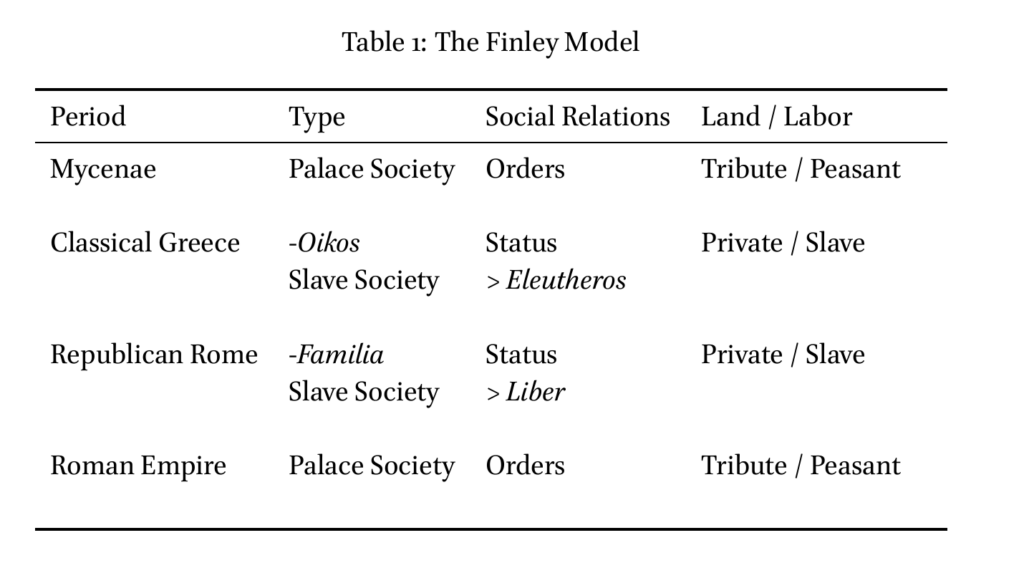
When Finley turns to the analysis of “Landlords and Peasants,” he is now able to use these categories in order to show how they help to explain the dynamic changes that take place in early Greek and late Roman history. His basic thesis is that the City-State engenders land-tenure without tribute-taxation. By contrast, empire is built on tribute-taxation. The paradox of the free peasant is described as the contradiction between the former providing freedom with economic insecurity and the latter providing economic security without freedom. This reflects the broader categorization of the “Orders” society and the “Status” society. He uses this scheme to explain the general forces that lead to the end of the Roman empire and the transition from the orders (patrician / plebs) to status (optimates \ popularis) and back to imperial Feudalism (honestiores / humiliores) which transitions eventually into the coloni form of proto-Feudalism. It is, at its heart, a very simple model. It reduces the complexity of Marx and Engels analysis to an extremely simple binary. Largely, it preserves much of the myth of `Western” civilization. It only demands that slavery be admitted to the basic paradigm of Western exceptionalism. Perhaps its simplicity has been important to its appeal.
With a few notable exceptions, Finley’s basic arguments came to provide the shape for the study of economic history in ancient Greece and Rome. Scholars in the 1970s and 1980s focused primarily on excavating the structures of ancient society which were reflected in the literary presentation of status. Despite the obvious epistemological pitfalls, the same method was also extremely influential in archaeology. Thus, The Ancient Economy provides an important look into the establishment of what Classical historian, Keith Hopkins, correctly termed ‘the new orthodoxy’ of ancient economic history. The orthodoxy, which was a product of Finley’s tenure at Cambridge University in the 1970s and early 1980s, dominated the study of ancient Greek and Roman history and today a small cadre of Cambridge doctorates, their students, and their ideas hold a monopoly on the study of the economic history of ancient Greece and Rome in the English language. Like most orthodoxies, however, it has effectively obscured its own intellectual foundations. The basic chronological and categorical shape of ancient history today represent the ossification of his ideas (Table 1).
It is fitting that today the majority of his students now question the two central claims that gave his research meaning: the anti-Capitalist critique of the trans-historical rationalization of capitalism in history and (2) the fundamental role of slavery in the creation of “free” as a status in ancient Greece and Rome. Among many of the students who have fashioned careers out of the body of Finley’s work, perhaps none have cannibalized his life more grotesquely than the cadre of ancient historians at Stanford University who work in close conjunction with Hoover Institute. No institution better marks the forces of free-market capitalism that he dedicated his life to fighting.
V. Conclusion
M.I. Finley’s ideas took shape in the United States in the 1930s, and were directly influenced by the Marxist intellectual work and communist organizing that resulted in M.I. Finley’s termination from Rutgers University in the early from 1948-1952. Like both Karl Marx and Max Weber before him, Finley’s early intellectual life was shaped by the land question. In the 1930s, the land crisis famously captured in Steinbeck’s The Grapes of Wrath, was a (if not the) central topic of the global political struggle, something elderly American scholars are apt to forget because they were able to enjoy the benefits of the U.S. National Housing Act shaped modern middle class ideology and wealth. The importance of the land tenure question is reflected in the revolutionary struggles of Zapata in Mexico in 1909, and Mao in China in the late 1940s. Globally, the privatization of the commons and communal land remained a burning issue of revolutionary politics. In reading Thurnwald, Bücher, Polanyi, and Marx, Finley struggled to understand the historical dimensions of land tenure in his dissertation at the University of Columbia. After his PhD, Finley appears to have been actively working as an communist informant for the USSR after WW2. In fact, it was recently discovered that Finley was noted to be “a devoted person, member of the communist party” in the state papers of the U.S.S.R. This statement was written in 1947. In 1951, he testified before the Senate Internal Security Committee, where he was ‘named’ as a communist by colleague and former Marxist comrade, Karl Wittfogel (see Oriental Despotism). Finley refused to out his colleagues or himself, which resulted in Finley’s termination in 1952. Ultimately, it was the “Red Scare” that brought Finley to Cambridge.
M.I. Finley’s work can only be properly understood within the framework of the Marxist thought and politics that effectively exiled him from the United States. This, indeed, is how Finley framed his intellectual development and ideas. This is also how The Ancient Economy was received by Finley’s friend, G.E.M de ste Croix, the British Marxist Classicist. The book spurred G.E.M de ste Croix to produce the monumental defense of the Marxist theory of class, aptly titled The Ancient Greek Class Struggle. The extent to which this succeeded is a topic for a future essay. It is important to remember that M.I. Finley’s work was part and parcel of the post-Marxism which arose in professional academia as a direct result of both Stalinist and U.S. persecution. It is extremely important because his career at Cambridge in England after his exile from the American academy in ‘the Scare Scare’ marked the abandonment of his political and scholarly Marxism. Finley’s critique of class, the class struggle, and class consciousness is essential to The Ancient Economy, and since its publication in 1973 it has served to make it almost impossible to to seriously debate and discuss the fundamental Marxist categories of analysis in Greco-Roman history. By contrast, Finley’s critique of capitalist history has been forgotten and effaced by the very scholars who pretend to carry forth his research and ideas. In the end, we are left with the narrative of Greco-Roman exceptionalism and the vague concept of status. Most troubling, however, is the way in which Finley critiqued Marx without serious engagement or theoretical argument. It is frequently stated that Finley provided a fatal refutation to Marx’s theory of the mode of production and class. This, however, is untrue. Finley was part and parcel of a milieu of Marxists who were forced to account for Stalinism in the wake of World War 2. Among themselves, they sought concepts and arguments that defended their past and future place in academia. “Western Marxism” and the New Left forged this solution. While they had every right to redefine the terms of their politics and debates, they often failed to explain the content of their ideas and history fairly. This, no doubt, was a result of political persecution in many instances. This is certainly true for M.I. Finley. The problem, in the end, is that we have inherited many confused ideas and research agendas. Few works are more influential and more confused than The Ancient Economy.