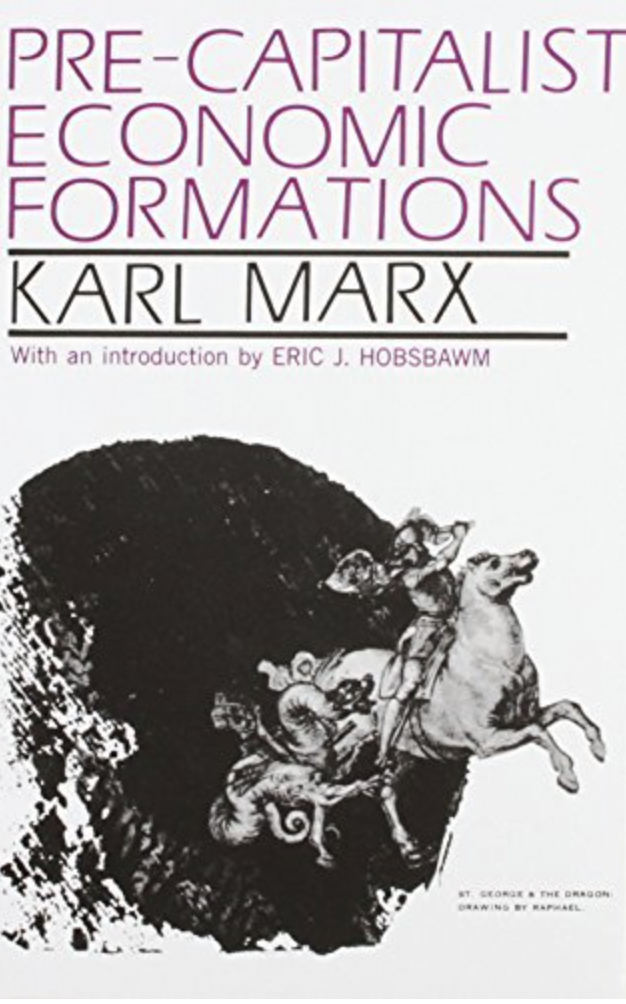
Hobsbawm’s Precapitalist Economic Formations (1965)
A Re-introduction to Marx’s Method of History
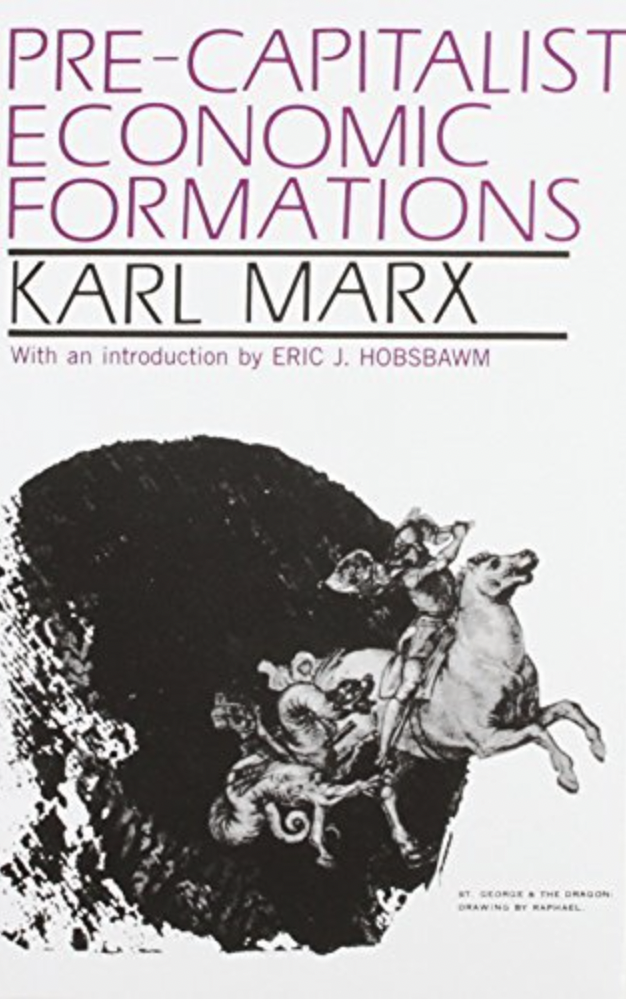
The publishing of Karl Marx: Precapiltalist Economic Formations in 1965 should have transformed the landscape of radical, socialist economic history. What is perhaps most notable is how little influence it has had on Marxist ancient history. Edited and introduced by the renowned British Marxist historian, Eric Hobsbawm British historian, the work offered scholars precisely the non-teleological, and non-unilinear, and non-deterministic Marxist method of history that critics of Stalinism since the Third International had demanded. The work offers a selection of Marx’s Grundrisse (der Kritik der Politischen ökonomie), which focus primarily on pre-capitalist economic history. The Grundrisse were notes written by Marx in 1857-1858 in preparation for the publication of Marx’s A Contribution to the Critique of Political Economy [MECW 28-29]. Published in the same year as Darwin’s The Origin of the Species and Charles Dickens’ A Tale of Two Cities, the work is most famous for its Preface which outlined the basic theory of historical materialism in its most concise form:
“In the social production of their existence, men inevitably enter into definite relations, which are independent of their will, namely relations of production appropriate to a given stage in the development of their material forces of production” (263).
It is “the mode of production of material life” that “conditions the general process of social, political and intellectual life” (263). The modes of production, which Marx put forth in brief Preface, have become canon and fodder for Marxist and anti-Marxist since: (1) the primitive mode, (2) the asiatic mode, (3) the ancient mode, (4) the feudal mode, and (5) capitalism. It is unfortunate that the work itself is rarely read (especially by commentators, critics, and admirers of Capital. However, it is a work that even Engles found difficult, so it is understandable that is deeply misunderstood today. What Hobsbawm’s reintroduction of select passages of the Grundrisse offered above all was the opportunity to understand Marx’s theory of history in its fullest form of expression – in the words that Marx used to explain his own ideas to himself. This essay then will offer two sections: the first part will look at Hobsbawm’s Introduction and its importance for understanding ‘Marxist’ historiography in the late 1960s and 1970s; the second part will offer an overview and outline of Marx’s theory of ancient economic history in the Grundrisse.
Eric Hobsbawm is a major figure in British Marxism and a central voice in the formation of The New Left. His central work was dedicated to understanding the “long 19th century.” Like E.P. Thompson’s The Making of the English Working Class, Hobsbawm sought to understand the central problem of 20th century Marxism: why didn’t the working class revolution that Marx predicted ever come to pass? Why didn’t the proletarian revolution happen? And, since it didn’t happen, what should Marxists do in the wake of the collapse of 19th century capitalism and the rise of the modern well-fare state in ‘the first world’ ? Before World War Two, Hobsbawm was a member of the Sozialistischer Schülerbund (Association of Socialist Pupils) in Berlin, the Communist Party of Britain, and the the Communist Party Historians Group. After World War Two, the shift from international communism to state-sponsored socialism (i.e. the social well-fare-state) led to Hobsbawm and other’s establishment of the new Socialist History Society in 1946. As Hobsbawm explains in “The Forward March of Labour Halted?” in 1978, the years following World War Two created a serious crisis for Marxism and Marxist intellectuals:
I wish to underline is something which a marxist analysis alone will help us to understand, but which Marx’s texts cannot; that the forward march of labour and the labour movement, which Marx predicted, appears to have come to a halt in this country about twenty-five to thirty years ago. [MARXISM TODAY, SEPTEMBER, 1978 279 The Forward March of Labour Halted? Eric Hobsbawm (This article was given as the 1978 Marx Memorial Lecture.]
The years between 1946 and 1978 were indeed catastrophic for the labor movement. These were the years in which the generation of “the baby boomers” were born and came to power. In 2026, we are watching the collapse of the the post-World War Two world in which the United States empire exported capitalism and wage-labor to almost every inch of the planet. From 1965 to 1969, however, there was one last gasp of global radicalism and
I. Marx and Engles’ Study of History [p. 20-27]
According to Hobsbawm, the Grundrisse shows Karl Marx “at his most brilliant and profound” (p. 10); It was based on 15 years of intense study, much of which was done in the British Museum Library in London. Marx dedicated himself to the study of economic history in order to elucidate the thesis of revolutionary socialism so powerfully expressed in the The Communist Manifesto. H. provides an extremely helpful overview of the state of Marx’s research and knowledge in 1857-8.
A. Primitive Communism
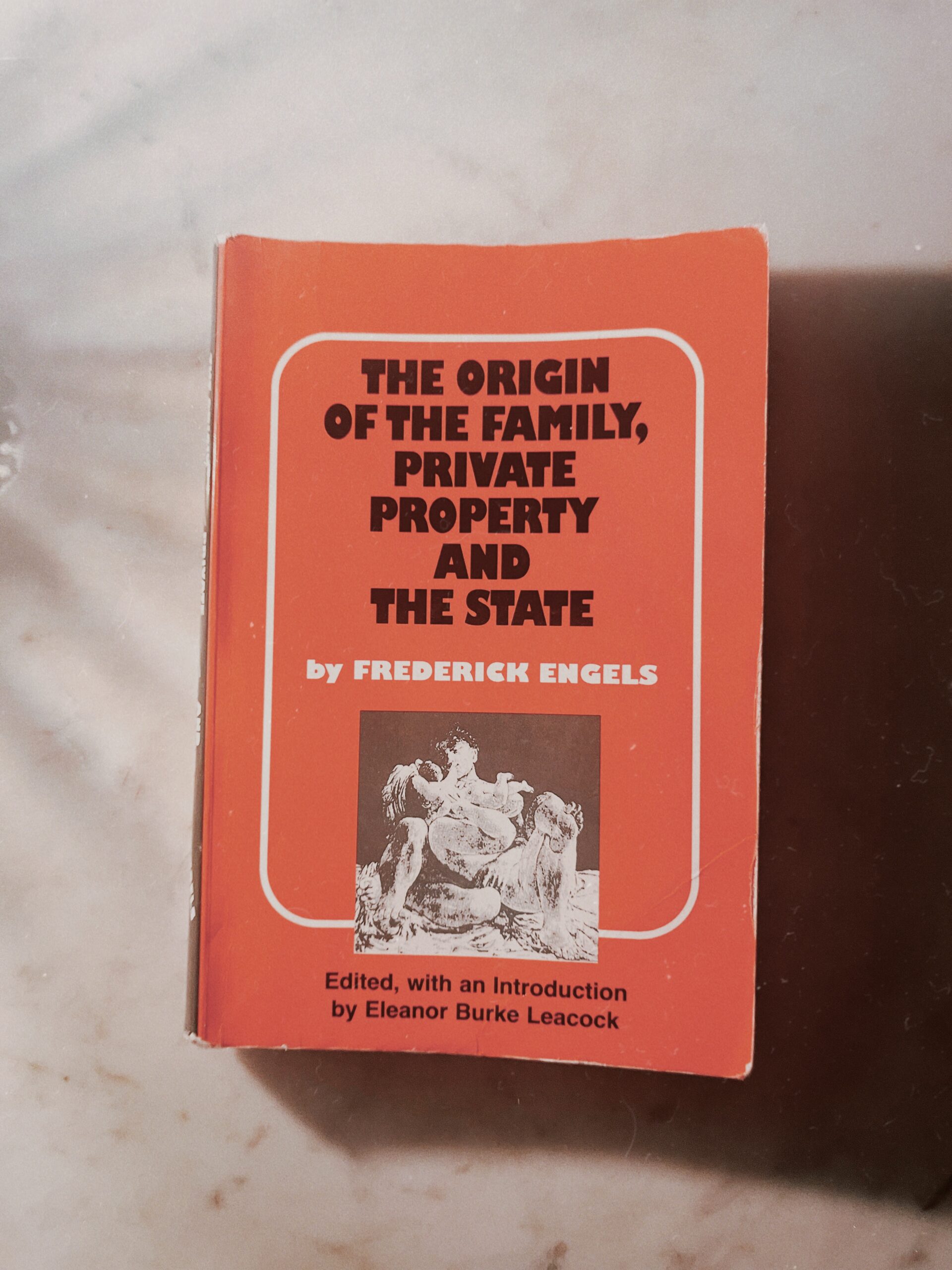
As H. writes, “At the time the Formen were written, Marx’s and Engles’ knowledge of primitive society was… only sketchy” (p. 25). Until the works of the American anthropologist, H.L. Morgan (1877) the Marxist theory was based on “mainly on material from early medieval Europe or the study of communal survivals in Europe” (p. 25). This area of study was only studied seriously in the later years of Marx and Engles’ lives. The work of Maurer became available to them in 1868, Morgan in 1877, and Kovalevsky in ? Marx’s Ethnological Notebooks were unavailble to H. in this review and even today are extremely understudied and difficult to use. Engles works were published at the very end of and after Marx’s life: The Mark (1882), Origin of the Family, Property, and the State (1884). See Bellamy and Kevin B. Anderson among the few scholars working on this research today.
B. The East (primarily India)
Marx’s knowledge of the near east was extremely limited in 1848, perhaps consisting of little more than that which was available in Hegel’s Lectures on the Philosophy of History. In 1853, Marx studied China and India in order to produce his works on the regions in The Daily Tribune (MECW citation). In these years, Engles attempted to study Persian. These studies and views are discussed in Marx’s letters (MECW citation, May 18-june 14, 1853?). The central works Marx studied were: (1) Foster’s A Historical Geography of Arabia, (2) Bernier’s Voyages, (3) Sir William Jones Parliamentary Papers, (4) Stamford’s History of Java (5) Cambell’s Modern India, Child’s Treatise on the East India Tradfe (1681), James Mill’s History of India (1826), Mun’s A Discourse on Trade, from England into the Easst Indies (1621), Pollexfen’s England and East India (1697) Saltykow’sLettres sur l’Inde (1848). [See p. 22 for full bibliography]. Marx appears to have known little about Egypt and have had little knowledge of archaeology.
C. Greece & Rome
Marx’s knowledge of ancient Greek and Roman literature was better than the majority of professional scholars in ‘Classics’ today. His dissertation on the Greek philosopher, Epicurus, remains misunderstood and understudied by Marxists and Classicists. Marx therefore knew at least as much as the “modern student who relies on purely literary sources” (p. 21). He did not, however, have a basic understanding of Greek archaeology or literary inscriptions. Much of his work on the period was based on personal reading and the work of the German historian, Barthold Georg Niebuhr (1176-1831). Though H. does not discuss it, Niebuhr’s study of the ager publicus was central to Marx’s understanding of ancient Classical history.
D. Feudalism
Marx’s studies were based primarily on the works of Hansen, Meitzen, and later the essential work of Maurer (1868). These studies are discussed in Marx’s letters (March 14, 1868, March 25, 1868?, March 8, 1881, and Sept 23, 1881?).
II. Marx’s Periodization of History [p. 27-
A. The German Ideology
In The German Ideology (1845–1846), Marx articulates his basic theory of historical materialism (the name is not given by Marx – see footnote for discussion). H. offers a brief and largely correct overview of Marx’s principle and periodization of history. Unlike in later works, Marx draws his historical categorization directly from this analysis of property, which he defines as: “the relationship of the individual to the natural conditions of labout on reproduction… the objective body of his subjectivity” (p. 69). [check to see if def. is from Grundrisse or German Ideology]. There are three basic forms of property, which provide the basic analytical tools for categorizing history:
-
-
-
- Tribal Property
- State Property: It was “state ownership,” the ancient property which arose out of the “union of several tribes” that gave rise in Greece and Rome to the development of the classical “citizen.” The ancient city arose out of the conditions of domination, which demanded the organization of war and the transformation of conquered land into the central contradictory forms of classical property: (i.) the Ager Publicus and (ii) private family land. The development of slavery in agricultural production created the first true class struggle between citizen and slave.
- Feudal Property:
-
-
B. Preface to A Contribution to Political Economy (1857-8)
-
-
-
- The Primitive Communal System
- Oriental
- Slavonic
- Germanic
- Ancient
- Feudal
- Bourgeoise
-
-
III. Internal Dynamics
A. The Ancient Greek and Roman Society
Here, H. attempts to chart out Marx’s theory of internal dynamics (i.e. class antagonisms) within the mode(s) of production. This is an important question that goes back to the opening lines of The Communist Manifesto: “The history of all hitherto existing society is the history of class struggles.” Engles famously amended the line in later editions with a footnote: “That is, all written history.” He added:
In 1847, the pre-history of society, the social organisation existing previous to recorded history, all but unknown. Since then, August von Haxthausen (1792-1866) discovered common ownership of land in Russia, Georg Ludwig von Maurer proved it to be the social foundation from which all Teutonic races started in history, and, by and by, village communities were found to be, or to have been, the primitive form of society everywhere from India to Ireland. The inner organisation of this primitive communistic society was laid bare, in its typical form, by Lewis Henry Morgan’s (1818-1881) crowning discovery of the true nature of the gens and its relation to the tribe. With the dissolution of the primeval communities, society begins to be differentiated into separate and finally antagonistic classes. I have attempted to retrace this dissolution in The Origin of the Family, Private Property, and the State, second edition, Stuttgart, 1886. [Engels, 1888 English Edition and 1890 German Edition (with the last sentence omitted)]
The question of internal antagonism has been a point of inquiry and debate ever since since it is essential to the theory of capitalism’s collapse. Since class – according to Marx – develops within the ancient mode of production, it is a essentially a problem that confronts the ancient Greek and Roman mode of production. This theory has been persistently mis-represented and / or misunderstood. Land ownership is the principal prerequisite of the ancient citizen. It is what establishes the princiapl preconditions of class struggle in the ancient world between “Freeman and slave, patrician and plebeian.” As Marx states, ancient Greek and Roman history is “a history of cities founded on landed property and agriculture” (p. 77). With land ownership arises chattle slavery and the first great class struggle. “Surplus time” belongs to all landowners. It does not belong to slaves. This is clearly stated in the Grundrisse and by Hobsbawm. It is a point that is never understood by de Ste. Croixe or Finley. Surplus wealth serves the citizen and the city. The intensification of slavery and the concomitant necessity of military organization leads to the intensification of the conflict between patrician and plebeian. The way in which this conflict lead to the collapse of the Athenian and Roman society is not seriously discussed, leaving open the question of how the fall of Rome lead (or did not lead) to the development of Feudalism. It is a problem Engles attempts to answer in 1884 and which Marx likewise associates at times with the Germanic mode of production.
B. Feudalism
The medieval society is juxtaposed to the ancient Greek and Roman. Unlike the ancient society, feudalism is based in the country. Feudalism breaks down at the basic opposition between “lord and serf, guild-master and journeyman.” The bond between lord and serf breaks when wool and pasturage and then the industrial factory separates the rural population from the land – a process intensified by the enclosures of the commons. The guild-master and journeyman system likewise collapses with the development of the factory system and the mechanization of skilled labor. With the factory system arises the basic preconditions of capitalism: (1) the separation of the producer from the land and (2) the transformation of craft production into industrial production.
IV. After the Grundrisse
The most important developments in Marx’s conception of pre-capitalist history were in the study of primitive communism. As H. writes,
It is certain that Marx’s own historical developments after the publication of Capital (1867) were overwhelmingly concerned with this stage of social development, for which Maurer, Morgan, and the ample Russian literature which he devoured from 1873 on, provided a far more sold base of study than had been available in 1857-8″ (p. 49).
This research was central to the question of Russian revolution. It is often claimed that Marx believed that the primitive commune must be transcended – i.e. it must pass through capitalist development – before ‘progressing’ revolutionary socialism could be possible. This, however, is not what Marx argued and as his studies progressed, he saw the primitive communal society as a possible form of resistance to and possibility after capitalism (see p. 50-51 for an outline of his general views). At the end of his life, Marx wished to write a book on the question of primitive communism. Unfortunately, he didn’t live to complete the work and we must look to Engles and the Ethnological Notebooks if we wish to capture his final thoughts on the topic. Engles, “who was more preoccupied than Marx with the rise of nationality and its function in historical developoment” worked on feudalism throughout the rest of his life. The Anti-Dühring (1877-78) and the Mark (1882) provide Engles’ most important later contributions to the study of the feudal period.
V. After Marx & Engles
Conclusion:
We have already seen that the halt in the forward march began even before the dramatic changes of the past twenty years; that even at the peak of the “affluent society” and the great capitalist boom, in the middle 1960s, there were signs of a real recovery of impetus and dynamism: the resumed growth of trade unions, not to mention the great labour struggles, the sharp rise in the Labour vote in 1966, the radicalisation of students, intellectuals and others in the late 1960s. If we are to explain the stagnation or crisis, we have to look at the Labour Party and the labour movement itself. The workers, and growing strata outside the manual workers, were looking to it for a lead and a policy. They didn’t get it.
[MARXISM TODAY, SEPTEMBER, 1978 279 The Forward March of Labour Halted? Eric Hobsbawm (This article was given as the 1978 Marx Memorial Lecture.]