Austin and Naquet’s (1977) Economic & Social History of Ancient Greece
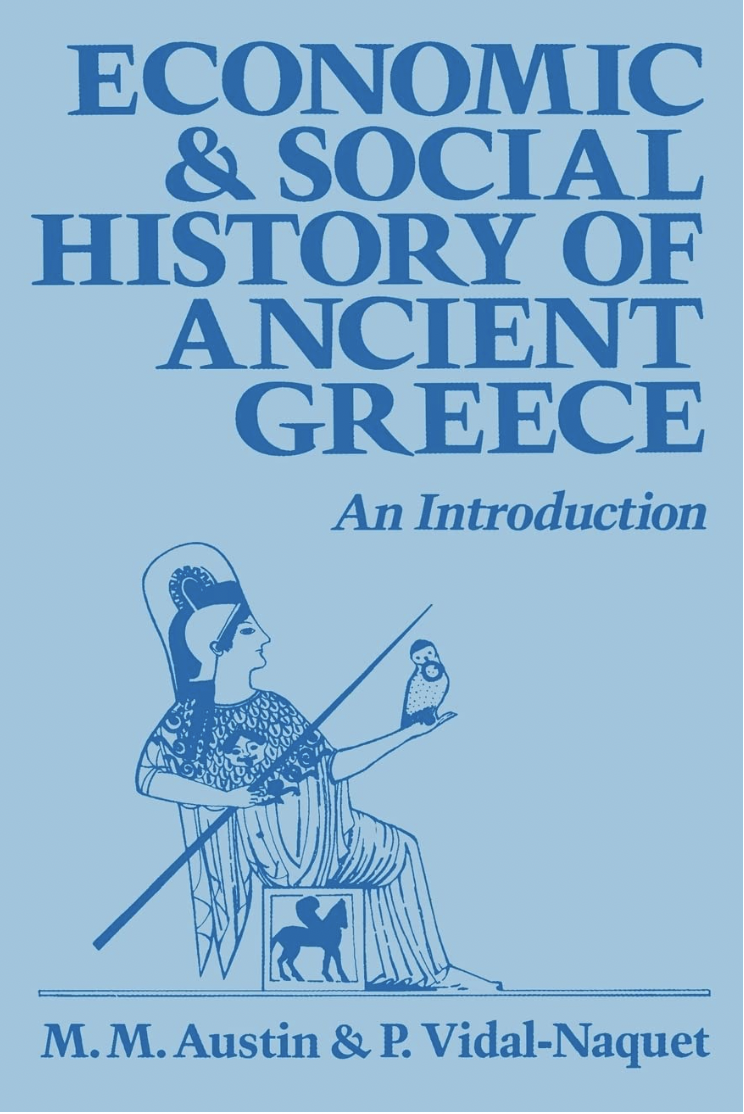
For one who wishes to understand the modern interpretation of ancient Greek history (as well as the theoretical foundation of ancient Roman history), M.M. Austin & P. Vidal-Naquet’s Economic & Social History of Ancient Greece provides the most comprehensive, clear, and honest introduction. Originally published in France in 1972, the English translation has been available since 1977. It lays out the basic paradigm of “social history,” a synthesis of “Substantivism” and “ Critical Theory.” It is a work that would also serve well to remind current scholars of how drastically the questions and categories of history shifted in the 1970s. P. Vidal-Naquet was influential in establishing M.I. Finley’s basic ideas in France; his 1965 article, “Économie et société dans la Grèce ancienne: l’œuvre de Moses I. Finley,” outlines the ideas and influence. In many ways, ESAG serves to articulate M.I. Finley’s theoretical work and central arguments.
Thus, the story of economic history begins in earnest with “The Meyer-Bücher Debate” in the late 19th century. The story is first articulated (to my knowledge) in an article by Pearson, published in Trade and Market in Early Empires in 1957. Since the 1970s, it has been retold in every serious work on the ancient economy of Greece. The two sides of the debate represent the modernist and the primitivist interpretation of antiquity. Karl Bücher argued that ancient economies were fundamentally primitive, arguing that they expressed the first stage of a tri-partive evolutionary progression: (1) the household-economy, (2) the city-economy, and (3) the national-economy. Without discussion or citation, we are told that his “scheme” was in the end “a mere abstraction characteristic of the great syntheses of the 19th century,” which ultimately “could not stand up to scrutiny” (p. 4). Thus enters Ed. Meyer sought to argue that “the Greek world witnessed a considerable development of industry and commerce” with “production and exchanges of a capitalist kind” which ultimately created a “monetary economy” (p. 4). Put simply, was the ancient economic modern like industrial capitalism or primitive? Meyer famously argued that “the seventh and sixth centuries correspond to the fourteenth and the fifteenth in the modern world, and the fifth corresponds to the sixteenth” (p. 5). Thus, the primitive vs. modernist debate is framed as a debate between two models:
Primitive Modern
- House-hold Economy 14th c. Renaissance = 7th c. b.c. Archaic
- City Economy 15th c. Renaissance = 6th c. b.c. Archaic
- Nation Economy 16th c. Early Modernity = 5th c. b.c. Classical
The debate, we are told, came to a theoretical dead end. They critique the 19th century state of the debate on the grounds of two a priori assumptions: (1) “unilinear evolution” and (2) “positivism.” This is at its heart a philosophical failure in the authors’ view (p. 5). This led to “the straightjacket” of early 20th century scholarship. “A fresh start was needed to emerge from the impasses…”
In the 1920s and 1930s, the “great sociologist” Max Weber and his students paved the way forward. The “grand narrative” of unilinear evolution theory and the “metaphysics” of positivism were transcended. The focus of investigation turned to the “institution,” a concept that sought to capture and compare general forms of social organization. Finally, in the 1940s and 1950s, the foundation of the new method was laid by Karl Polanyi’s theory of “substantivism” and the Frankfurt school’s theory of “status” (which A & N chose to also call “social class”). To recap the story: economic history began in the late 19th century. It was invalidated on theoretical grounds because it was built on 19th century beliefs of unilinear evolution and positivism. It was saved by Max Weber, who introduced the study and theory of the institution. Finally, Karl Polanyi and the Frankfurt School provided the foundation for work today: economic history is the study of the embedded institutions and social status.
From the general theory, we can move to the particular theories that pertain to ancient Greek history. M.I. Finley’s paradigm of ancient social history contained two essential empirical claims: first, bronze age Greece was not part of the story of Greek civilization; second, Greek (and Roman civilization) were not part of capitalist civilization. Furthermore, the first division was marked by the existence of two different forms of “society” : the palace and the oikos; the second division was marked by the rise of the slave society and the market society. It has often been overlooked that this model provides the following four categories of economic history:
- The Palace Society (Bronze Age)
- The Oikos-Society (Archaic Age)
- The Slave Society (Classical Age)
- The Market Society (Industrial Age)
Here, A & N (following Finley) introduce the question of ancient slavery. What was slavery? When did it arise and how did it define the societies of the Classical era? Contra Marx’s theory of class, class struggle, and class consciousness, the new paradigm sought to understand slavery as a status and a “social class.” What function did slaves play within the society as a whole? How could their history be excavated and integrated into the understanding of ancient history? These became the central research questions of the 1970s and 1980s. The theory put forward in the 1970s provided a simple narrative that still serves as the foundation for college textbooks and historians today.
The “palace society” was fundamentally Near Eastern. Slavery existed but was not essential to the social organization of society, which was based on the centralized collection and redistribution of basic goods. This form of society was destroyed and in the Homeric Archaic age a new type of society arose independently. This was the “oikos society” which became the foundation of Western political life and society. Slavery was introduced into agricultural production at the end of the Archaic period and it ultimately provided the foundation of the extension of citizenship to the majority of the populace. Thus, it was only slavery that allowed the oikos-society (a fundamentally aristocratic form of social organization) to become a democracy (a free and democratic society for citizens based on the extreme intensification of slavery). The modern synthesis provided by A & N is as follows:
- The Palace Society (Bronze Age): palace centralization, redistribution, domestic slavery
- The Oikos-Society (Archaic Age): house-hold self-sufficiency, family-land, domestic slavery
- The Slave Society (Classical Age): political organization, personal-land, agricultural slavery
The book is organized by this basic framework and provides opening chapters on the following periods:
Chapter 1: Mycenaean is Not Part of the Story
Chapter 2: Homeric World
Chapter 3: The Archaic Period
Chapter 4: Archaic States and Sparta
Chapter 5: Classical Athens
The remainder of the book discusses the classical period. Part II will provide an overview of the case studies and arguments of these chapters. In conclusion, it must be asked how this paradigm manages to escape the basic critiques levelled against prior theories and work. At the most general level, it is impossible to contend that this model is not an evolutionary theory of economic history. In fact, it is extraordinarily similar to the basic framework of Bücher and one cannot avoid the fact that Finley’s concept of the “Oikos” society is extremely similar to Bücher’s theory of the “household economy.” It appears that the only difference appears in the separation of Near Eastern and Greek categories of society. Thus, the developmental model is if anything more evolutionary. In fact the “Oikos” society is more likely the refashioning of Polanyi’s important category of historical categorization: the self-sufficient household. This is a term he in turn takes from the Austrian anthropologist Richard Thurnwald. Thurnwald himself provided an evolutionary theory of social and economic development that only differs from Polanyi and Finley in being better theoretically articulated and empirically informed. The authors, like Finley, appear to be unaware of their own evolutionary commitments and ideological views of “progress” and “history.” With the added knowledge that Thurnwald sought to work with the Nazis and advance their intellectual and political aims, it is difficult to accept the “Oikos” (and “familia”) theory of ancient Greek (and Roman society) on ethical or philosophical grounds. Finally, there is a much more basic problem. The intellectual history provided by A & N contains foundational errors and omissions that indicate they themselves have little to no understanding of the ideas they are critiquing. Before theories and hypotheses can be invalidated on philosophical or empirical grounds, it is necessary to state and understand what their ideas actually were. There are three basic facts that must be discussed before a serious intellectual history and debate can even begin. First, the debate between Bucher and Meyer was in fact on the epistemology of German Historicism and Austrian ‘Economics,’ Second, this debate included a third interlocutor: Marx’s historical materialism. Third, Max Weber theories and ideas were formulated as a response to all three. To rewrite history in the form it is told in A & N is simply wrong. Errors and confusion follow. Bucher is not a ‘primitivist’ because that was not a serious position. He was a German nationalist who supported state control of the economy and argued that the German national economy must be structured in order to compete against Europe. Meyer was a free-market capitalist who believed that nationalist restrictions and control were not beneficial. Weber was a conservative German who sided with the nationalists and sought to articulate a new defense of German historicism against both European free-market capitalism and international and state socialism (especially the German Socialist Party in Germany). The basic facts reintroduce a series of philosophical and ethical problems that were simply erased by the foundational mistakes of A & N (and Finley). When one writes socialism out of history, we see the types of errors that one expects under authoritarian oppression but are surprising in ‘radical’ quasi-Marxist scholars in an open society. Nonetheless, the “grand narrative” told by A & N manages to treat two branches of German conservatism as the “whole story” of the discipline.