Engels wrote The Origin of the Family, Private Property and the State in 1884. It was written to fulfill a request from Karl Marx in the final year of his life. Karl Marx, whose work on the study of colonial ethnography and anthropology intensified in the later years of his life, had articulated the theory of historical materialism in anthropological terms as earlier as The German Ideology (1845). Two works, however, transformed Marx and Engels understanding of anthropology and the importance of early human communism: (1) Georg Ludwig Maurer’s Einleitung zur Geschichte der Mark-, Hof-, Dorf-, und Stadtverfassung und der offentlichen Gewalt (1854), which he discusses reading in a letter to Engels (March 4, 1868), and (2) Henry Lewis Morgan’s Ancient Society (1877). One of the central discoveries of this work was the widespread existence of common, communal land ownership.
“Common property in its primitive form,” as Marx argued in Capital, further repudiated the myth of Locke’s theory of natural private property. Against the liberal theology of “economic original sin,” Marx and Engels ultimately argued that there were three components of “primitive communism” : (1) communal ownership preceded the development of private property, (2) the production of basic goods (i.e. use-value) preceded the production of commodities (i.e. exchange-values), and finally that (3) matristic kinship preceded the patriarchal family. It is the third argument that serves to introduce The Origin of the Family.
According to Engles, Henry Lewis Morgan “discovered” that “communism in living” (the phrase is Morgan’s) existed in the pre-colonial, indigenous societies of America. Furthermore, Morgan argued that “mother-right” (i.e. matrilineal kinship) pre-dated “father-right” (patrilineal kinship). In Engles’ view, this turned the 19th century bourgeois theory of the natural, nuclear, monogamous family on its head. Put back on its feet, the “modern family” (the foundational atom of liberal social organization and political economy) was revealed to be “the first form of the family to be based not on natural but on economic conditions – on the victory of private property over primitive, natural communal property” (p. 128).
For Engles, this theory was based on the Morgan’s discovery of the unique, alternate forms of family portrayed in the indigenous terms of kinship. Among the Iroquois, for instance, children described not only their own mother but also their mother’s sisters as “mother.” They did not, however, call the brothers of their father “father.” This general division also appeared in the kinship terms for siblings, with cousins on the mother’s side being called “brother” or “sister” but not the father’s. This is an extreme simplification, but it is necessary in order to understand Engles’ general line of thought. This extraordinary difference between emic and etic terms of classification revealed a fundamentally different system of social organization. The extent to which we can understand this difference (and the ethics and politics it entails) remain a central problem in anthropology.
Morgan, Engels believed, solved this problem in Ancient Society (1877) when he discovered that the diverse systems of kinship description were best explained in terms of the development from matrilineal to patrilineal kinship. For Engles, the kinship systems related directly to the forms of material reproduction in which they were theorized to exist. Kinship and property were causally correlative. The first chapter provides an outline of Lewis Henry Morgan’s evolutionary model of cultural, technological development. The terms he uses are ethically offensive to most scholars and socialists today and have been critiqued for the functional role they played in supporting the ideology of colonial expansion and domination. Engels (following Morgan) categorizes human social development into three broad categories: savagery, barbarism, and civilization. Each is marked by a corresponding form of technology and culture. If translated into the categories and chronology accepted today in bourgeois scholarship, Engles’s model is as follows (TABLE 1):
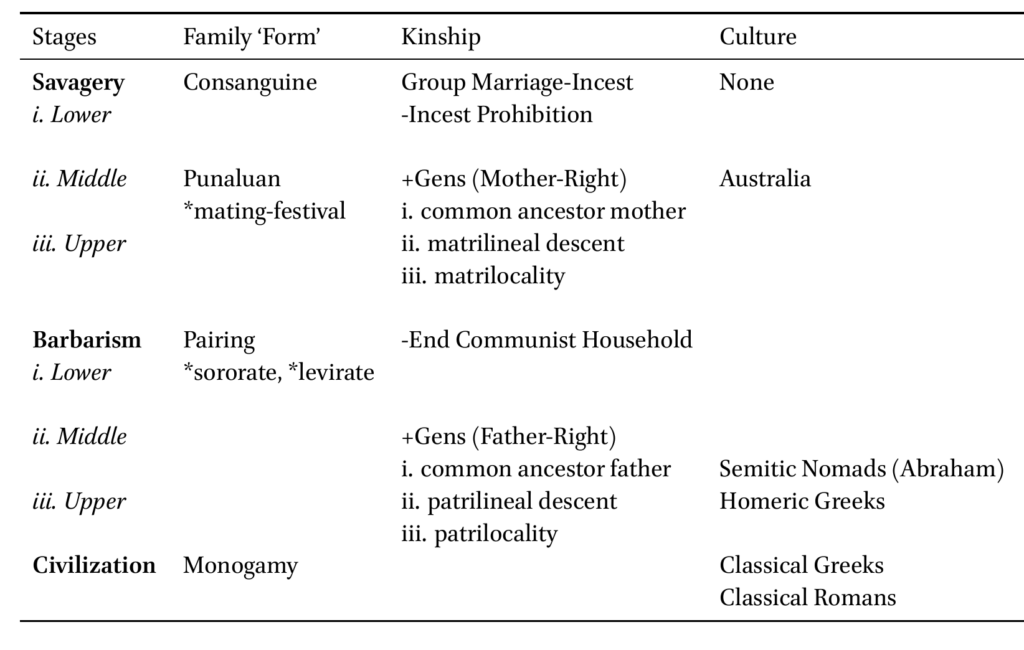
Engles sets out the theory in an open fashion, admitting that “here lies a newly discovered field of research which is still almost completely ignored” (p. 111). It is a theory developed in close communication with Marx and derived from first principles. Based on Morgan’s research on kinship, it seeks to explain the historical relation between the observed facts of kinship. It’s most simple formulation is stated as follows: “The pairing family is the form characteristic of barbarism, as group marriage is the characteristic of savagery and monogamy of civilization” (p. 117). His case studies reflect his basic paradigm, with “America” – above all, the Iroquois – portrayed as “the classic soil of the pairing family” ; the Classical “Greeks” by contrast the example of “civilized” monogamy.
For Engles, the decisive period occurred when the development of private property created the conditions for the overthrow of ‘mother-right’ (matrilineal) kinship. With the development of private property, first in the domestication of animals (i.e. cattle) and agriculture (i.e. intensive agricultural production) and then in the individual private ownership of land, “mother-right” (matrilineal kinship) was replaced by “father-right” and heritable private wealth from father to son. In our terms, this process began in the neolithic period with the development of intensive agriculture and the domestication of animals.
For Engles, cattle and slavery share an intimate history in “the Old World,” where he located the extreme intensification of male wealth that leads to the development of the household society and the ultimate subjection of women to the role of private property in the ancient Greek (i.e. oikos) and Roman ‘household’ (i.e. familia). The two words provide the etymology of the eco-nomy and the family. This form (the economic family) provides the seeds from which the extreme subjugation of women arises in the exclusive monogamy of capitalism. In comparison to the slavery and commodification inherent to 19th century bourgeois marriage, Engels concludes that the conditions described for women in Iroquois society and other indigenous societies were “free” and “honorable.”