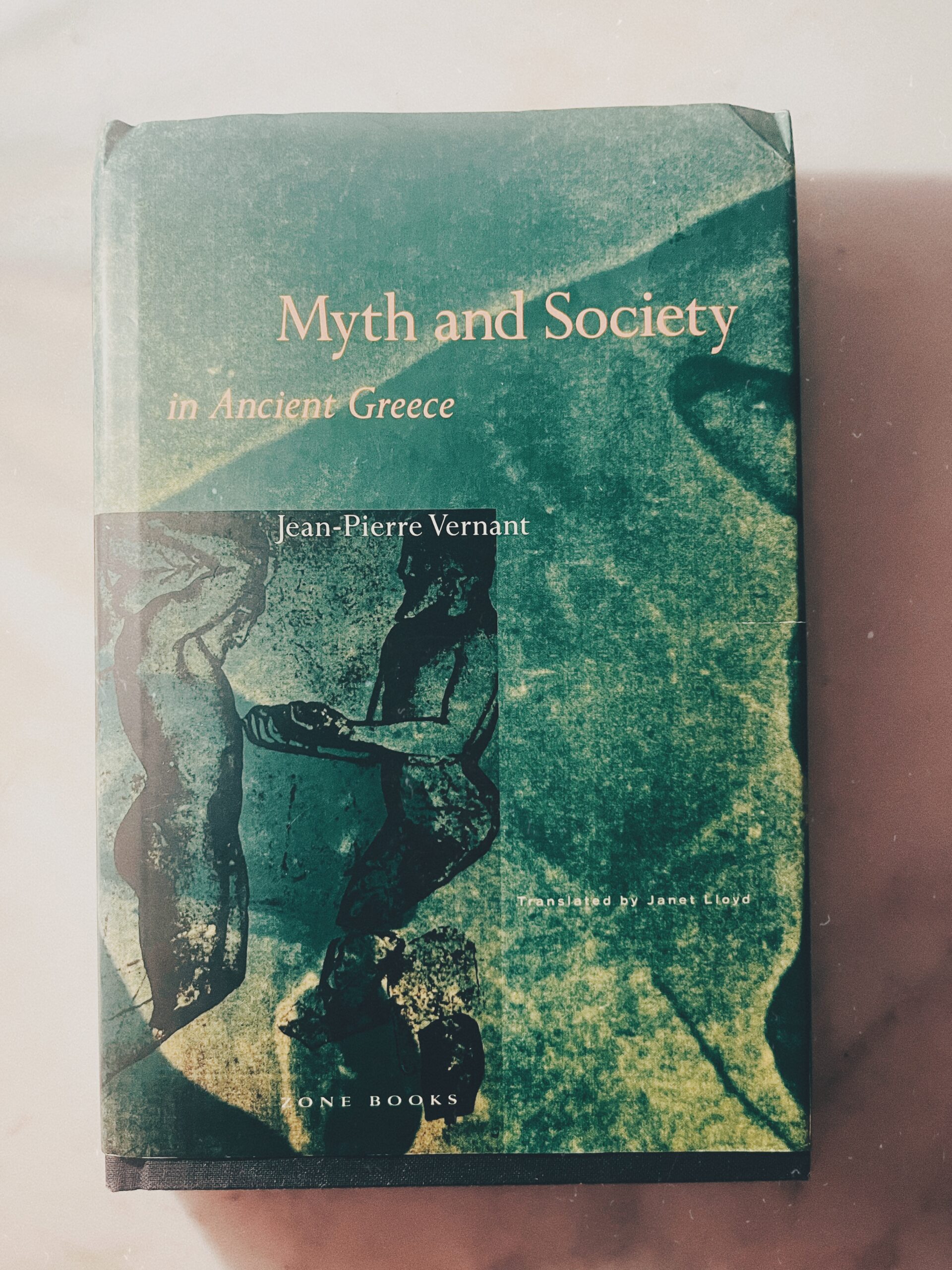
Jean-Pierre Vernant is widely regarded as one of the most influential scholars of Classics in the last century. His life and life’s work intersection with Marxism is largely forgotten. Born in the years before World War I, he died in the year before the economic crisis of 2008. In his youth, he was an active member of the Jeunes Communistes, who organized resistance against the Nazi occupation of France in WW II. After the war, he worked at the Centre National de la researche scientifique (CNRS), where he worked closely with Marxist scholars to study anthropology and precapitalist history. The culmination of Vernant’s Marxist thought is captured in his 1965 article, “Class Struggle.” He would remain a member of the French Communist Party (Parti Communiste Francais) until 1969, after which his work largely returned to the Durkheimian socialism and anthropological history in which he was trained under Louis Garnet. (“The Work of Louis Garnet” 177). In the world of Classical studies, Vernant went on to influence a generation of scholarship dedicated to the cultural anthropology of ancient Greek literature. This is best understood as a reaction to the rationalist philology in Germany associated most famously with the scholar, Wilamowitz. It also stood in political and epistemological contrast to the British school of Classical anthropology under Sir James Frazer, Jane Harrison, and Gilbert Murray. These debates went on to define the study of anthropology within ancient Greek and Roman history. The socialist politics of the Garnet school, however, have been mostly incorporated and forgotten alongside the imperial liberalism of the British ritual school. Together, the two contrary political strains have become part and parcel of the incoherence of modern research programs and scholarship (e.g. the Harvard Center for Hellenic Studies under the directorship of Gregory Nagy). In the process, the Marxist research on economic anthropology (e.g. Godelier 1973) that took place in Paris (especially at CERN) between the end of WW 2 and 1975 has unfortunately been almost entirely forgotten.
In “Class Struggle,” however, we are able to see the state of a research program that has largely been left in situ since 1975. The principal thesis is put succinctly: “For Marxists, the ancient world is a class society which in its typical form can be defined as a slave mode of production” (11). What is class and what is the slave mode of production? These are the two central questions. Furthermore, class “depends neither on property nor on income levels” but on social relations defined “in the system of production” (24). This means that the study of class was “rooted in problems connected with land tenure “ (15). It is rooted in the question of property.
This is at the heart of why Marx and Engles contended in the The Communist Manifesto that, “The French Revolution… abolished feudal property in favor of bourgeois property” (80) What type of property existed in the ancient world? To excavate the roots demanded the analysis of the principal form of production in the ancient world: agricultural production. Therefore, the study of class ought to begin with an understanding of how social labor was organized in relation to the ownership of land. It is worth stating that this is fundamentally different than how both M.I. Finley and G.E.M. Ste. De Croixe approached the question.
Vernant, following a commonly held view in scholarship from the late 1800s to 1970, held that there were two contrastive forms of land tenure in the ancient world: (1) communal ownership of land, which included communal forms of state control, and (2) private alienation of land, which included state land appropriated by the elite (14). The latter included a broad interpretation of the ager publicus, largely agreed upon since the work of Niebuhr to be the base of elite appropriation of the common natural resources (i.e. ‘the commons’). Focusing in particular on Marx’s Grundrisse and Capital, Vernant argues that the Marxist approach to class in ancient Greece provides the following developmental narrative of the polis.
- The City-State: “a system of institutions which allows a privileged minority (of citizens) exclusive access to landed property within a definite area” (16), which allows the Eupatridae to exploit the demos in the countryside. As he writes, “… the economics base of the polis was a form of land appropriation” (16). The city rises with the development of private property among the ruling class. As Marx wrote, “The history of classical antiquity is the history of cities, but cities founded on landed property and agriculture” (15). This provided the base of elite wealth and created the foundational division in the early city-state. The dependent was subject to state taxation and tribute which lead to the eventual privatization of land in the demos and the end of the communal form of land redistribution that preceded.
- Slavery: The rise of the city-state led in turn to the development of the need for a labor reserve which first appeared in the form of debt-bondage. With the enfranchisement of the citizen body, however, the labor needs of private property were met by slaves. Slavery becomes the foundation of agricultural production, especially elite production in olive oil and wine. The demos, the free independent farmer, is forced into economic competition with slavery and the slave run farms. They turn to production for the city and produce limited retail. They compete with metics for access to the industry of trade. Over time, they are incapable of competing with the extension of slavery to small-scale industry and some become a proletariat within the city of Athens. The politics of the demos becomes inextricably linked to the Athenian empire, which is capable of providing for the needs of the people. The revolutionary conflict, however, between the eupatrids and their supporters and the demos leads to the catastrophe of the Sicilian expedition, which exposes the unsustainable problems introduced by alienable land and slavery. This conflict is expressed in the fundamental cultural divide of (A) Oikonomika and (B) Chrematistikē:
- The agrarian economy based on the family, upon which the city state was constructed
- Need for food-supply, financial resources, mobilization of war, which resulted in the extension of: (1) Maritime trade 77, (2) Credit banking, and (3) Bottomry loans .
Instead contrast to the reductive debate in economic history between primitivists/substantivist and modernists, Vernant argues that there is both (A) the elite domestic economy of the oikos and (B) the extension of the early market and trade which follows in the wake of the invention of coinage. However, he also stresses the obvious fact that “There was no industrial capital in antiquity. Profits were not reinvested in business” (22). There were no stock joint corporations or international credit systems such as those developed in the Dutch and Italian republics of Early Modern European history. Furthermore, there was no ‘labor market’ in the sense of the modern free-wage labor system that defines modern capitalism.
Almost all of what Vernant states could be argued on the basis of the empirical record today. It certainly fits the historical record better than the dominant economic history of the period today, which begins with the a priori belief that New Institutional Economics – an economic theory developed to explain the institutional protections that promote free-trade growth in the global capital market as the primary forms of progressive in world history – captures the reality of ancient Athens. Why Vernant abandoned the analysis of class is part and parcel of the economic trends in France that led to the rise of and eventual dominance of post-modern Marxism.