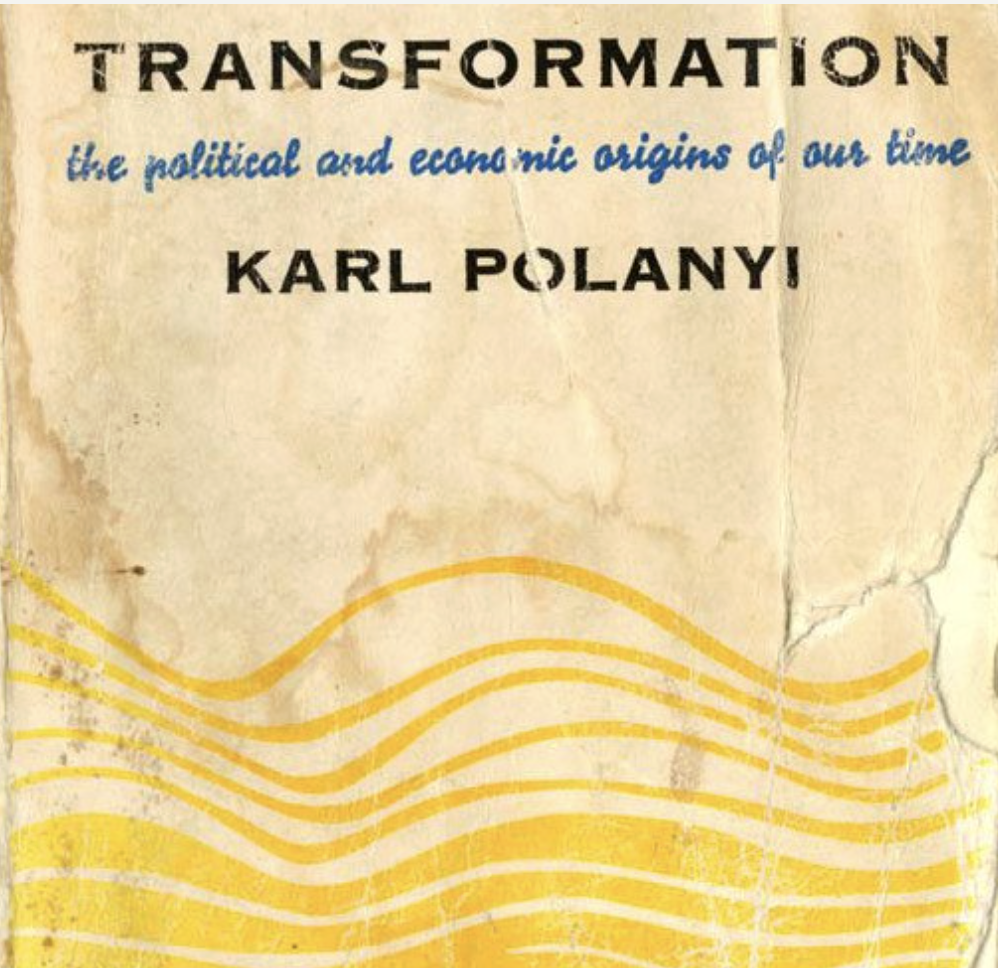
Like many socialist intellectuals of the 20th century, Karl Polanyi serves as an intellectual totem for scholars in the 21st. By this I mean that he serves as a symbol of identity and a rallying point of ritual. In the ritual performance of his ideas (especially as they become filtered and re-interpreted through the works of Marshall Sahlins’ work and others), the point and the politics of Polanyi’s argument disappears. The Great Transformation is a book that sets out to define socialism in the wake of the collapse of civilization after World War I. Polanyi’s explicit theology – his christian socialism – is reserved for the final chapter of The Great Transformation. Nonetheless, it pervades the book because it is what is truly at stake. There is truly only one thesis at the heart of this famous book. Put simply: the market-society caused the collapse of 19th century civilization. From this thesis, which he believes he proves in the course of the book, Polanyi draws his lesson for the 21st century: social-institutions must be fostered and created which provide democratic and social control over the power of the market. Such socialization, according to Polanyi, must accept the basic preconditions of capitalist property and the state. In Polanyi’s words, “resignation” to the “possible” is the great wisdom which must guide civilization in the wake of The Great Transformation. Thus, all appraisals of Polanyi’s ideas must begin from the basic fact that he is a Christian, reform socialist opposed to international revolution. Thus, he ends his work with the triumvirate of spiritual ideals: Yahweh, Jesus, and Robert Owen.
What Polanyi retains of Marxism is above all his critique of the “two pillars of liberal capitalism” (p. 241): liberal, constitutional government and liberal free-trade. This, unfortunately, is where contemporary socialists (reform and revolutionary) are least invested historically. For both Marx and Polanyi, the central intellectual enemy of human progress and happiness is liberalism. The critique of liberalism, which is foundational to Marxist thought, begins with the critique of Locke and Smith’s conceptualization of “the state of nature.” For Marx and Polanyi, precapitalist history revealed the “myth” of “natural” “economic man” (See Part I). For Polanyi, unlike Marx, the answer is not revolution but “institutions” of reform, regulation, and protection. “No mere declaration of rights can suffice: institutions are required to make the rights effective” (p. 264). He critiques liberals on the basis that they fail to regulate and protect labor, land, and money from the free-market: “… to turn against regulation means to turn against reform. With the liberal the idea of freedom thus degenerates into a mere advocacy of free enterprise – which is today reduced to a fiction by the hard reality of giant trusts and princely monopolies.” Much of his critique speaks no less well to the liberalism of the democratic and labour party in the U.S. and Britain today. Where the free-market is allowed to reign the interests of society, history slouches towards fascism. His warning ought to be remembered: “the victory of fascism was made practically unavoidable by the liberals’ obstruction of any reform involving planning, regulation, or control” (p. 265).
In order to make his argument, he offers a comprehensive reading of “the long 19th century.” He breaks this period into five periods: (1) 1789-1833, (2) 1834-1848, (3) 1849-1871, (4) 1872-1918, (5) 1919-1933. Polanyi’s analysis covers much of the ground Marx discussed in Capital, using many of his ideas in new forms and offering little substantive critique or engagement. From Marx and revolutionary socialism, Polanyi took the fundamental dialectical contradiction between the liberal political ideal (the constitutional, liberal state) and the liberal economic ideal (capitalism), and refashioned it in reformist socialist terms as “the double movement.” For Polanyi, “the double movement” captured the anti-thetical relationship between “the self-regulating market” (i.e. free-market) and the “protectionist institutions” of possible in the modern nation-state (i.e. social legislation, factory laws, unemployment insurance, trade unions). For Polanyi, the economic and the political was ultimately embedded in the social. Together, they provided a total picture of society – what György Lukács called “totality” and Polanyi (like German Critical Theory) preferred to term “society.” The danger then, new to civilization, was “the market society.” From the French revolution to the Great depression, this new new society took form and was ultimately overthrown by its own forces. While it lasted, it was predicated on 4 basic institutions (2 National and 2 international):
- National
- The Self-Regulating Market [Economic]
- The Constitutional State [Political]
- International
- The Concert of Europe [Political]
- The Gold Standard [Economic]
The Self-regulating market achieved the complete commodification of labor, land, and money in the 19th century. Polanyi calls these “fictitious commodities” and provides an overview of the struggles to privatize and to protect them from complete integration into the market. Each market has a corresponding “price” on the market: wages, rent, and inflation / debt. Polanyi denies the validity of the commodity theory of money (Riccardo and Marx) as well as the Marx’s theory of industrialization and the machine, seeking the collapse of the 19th century system in the internal logical of the market system itself. For these reasons, he sets out to prove that it is the “self-regulating market” that differentiates capitalism from pre-capitalism.
This has been difficult to sustain as a historical argument since. By moving the principal definition from industrialization and the factory system (i.e. the modern machine), Polanyi’s argument becomes fundamentally non-material. What material – what archaeological – fact correlates to the rise of the market society? Since the 1980s scholars have repeatedly shown that the important elements of Polanyi’s market society exist, for instance, in ancient Greece and Rome. M.I. Finley set out to provide that financialization in Polanyi’s terms did not exist in ancient Greece. He continued to base his central arguments on the strong, central claim that the market society did not exist in antiquity. The problem, unfortunately, is that much of what Polanyi defines is in fact too vague to study in history. Let’s look at his central definition of the market society, which he argues begins in 1834 with the New Poor Laws:
“Prices must be allowed to regulate themselves.” Furthermore,
All incomes must be directed from the sale of something or other, and whatever the actual source of a person’s income, it must be regarded as a resulting from a sale, No less is implied in the simple term ‘market society.’ (p. 44)
Thus, Marx’s historical periodization is profoundly reformed into broad and poorly defined categories. How can a historical or archaeologist determine is all income is derived from sales? These are abstractions applied to abstractions and depend on the definition of both terms. This leads scholars like Josiah Ober to contend that slaves had income in ancient Athens. What we are ultimately left with is a powerful condemnation of the free-market and an emotional call to the extension of social institutions to protect the majority from the ravages of capitalism and self-interest. It attempts to argue that the modern capitalist system is unnatural and self-defeating. Its central historical thesis is both too weak and too strong. It is too strong when it contends that the market society only exists in the 19th – 20th century. We know now that important elements pre-existed capitalism; furthermore, after 50 years of neo-liberalization, we know that it has survived the great transformation and is not a relic of the 19th century. It is alive and more dominant than it was in 1944. Last, Polanyi’s theory is too weak because it fails to define the material basis of the market. Unlike Marx’s theory of the commodity, Polanyi’s theory of the market has nothing to hold on to and from which to begin its analysis. This is a philosophical problem that threatens to become a political failure. Where it has failed to define the material facts of capitalism’s past, it offers a spiritual ideal for the “market society’s” future. Time has shown that the ideal collapsed no less spectacularly than the liberalism Polanyi castigates. The social institutions that made up the welfare state and the social world from 1945 to 1989 have almost completely collapsed since 2008. They have been the victims of the very problems Polanyi argued The Great Transformation had transcended: exploitation, industrialization, and private property.

Leave a Reply