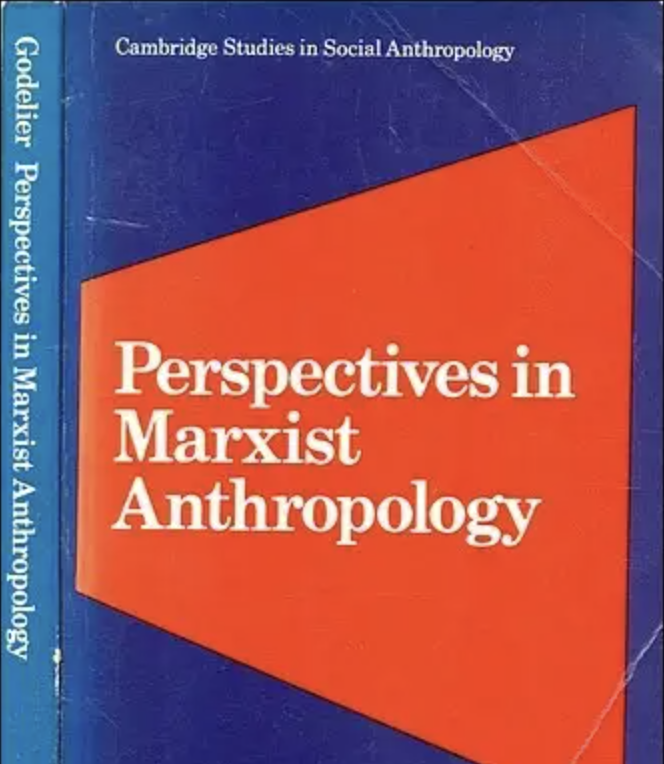
Is economic anthropology possible? This is Godelier’s opening question in Perspective in Marxist Anthropology (1973), and to it we must also add: is the economic history of precapitalism possible at all? The division of anthropology and history, G. stresses, is a 19th century consequence of colonial capitalism and the bourgeois categories of ‘civilization’ and ‘barbarism’ and any Marxist theory of history must seek to unify them. But – and this is the crux of the matter, the question is how? (33-35) in order to clarify the epistemological question, G. quotes Levi-Strauss’ analogy of the molecule and electron microscope
Ultimate proof of the molecular structure is provided by the electron microscope which enables us to see the actual molecules. This feat does not mean that in the future the molecule will become more visible to the naked eye. Similarly, it is pointless to expect that structural analysis will change the perception of concrete social relations. It will only express them better. (45)
Like the biologist then, the anthropologist sets out to reveal the structure(s) of society. Whether or not we can ultimately succeed remains a question, but G. sets this forth as the criterion for economic anthropology.
The first chapter provides an intellectual history of two contending schools of economic history: rational and irrational economics. In these broad categories, one can categorize the following debates in economic anthropology: (*) Modernism vs. Primitivism, (1) Functionalism vs. Substantivism, and (2) Ecological Anthropology (New-Functionalism) vs. Cultural Anthropology. To update the antimony, we could add (4) Structuralism vs. Post-modernism. G. critiques Formalism on the following grounds: first, it provides no way to justify the epistemological priority of the categorical ‘functions’ or ‘structures’ it chooses to study; second, its demand that all functions or structures are simultaneously interdependent and in equilibrium (i.e. they achieve homeostasis qua status quo) is tautological; third, and perhaps most troubling, it is categorically incapable of capturing contractions in the structures of society (i.e. class struggle). Ecological Anthropology, despite its scientific claims, is little better. In categorizing the social relations and forces of production as adaptive structures designed to meet the evolutionary challenges of resource scarcity, they merely add a 4th epistemological error to their predecessors: “We now have the metaphysical assumption that men are condemned by nature to not satisfying their needs, and are constrained therefore to calculate the optimal employment of their resources: herein lies the object and base of economic science” (43). The blunt problem with this theoretical postulate is two-fold: empirically, it is completely false; logically, it asks us to accept a view of human nature that seeks food security and equilibrium in precapitalist society, but seeks infinite surplus accumulation and growth in modernity. Why increase production and surplus once scarcity is solved? In Luxemburg’s terms, the goal is no longer to meet needs of human consumption but instead to maximize accumulation. The outline of the book provides an overview of Goedlier’s attempt to answer these central problems.
Table of Contents
- Anthropology and Economics [15-62]
- The Concept of ‘Social and Economic Formation’ : the Inca Example 63-69]
- The Concept of the ‘Tribe’ : a Crisis of Involving Merely a Concept or the Empirical Foundations of Anthropology itself ? [70-98]
- An Attempt at a Critical Evaluation [99-126]
- ‘Salt Money’ and the Circulation of Commodities among the Baruya of New Guinea [127-151]
- Market Economy and Fetishism, Magic and Science according to Marx’s Capital [152-168]
- Fetishism, Religion and Marx’s General Theories Concerning Ideology [169-185]
- The Non-Correspondence between Form and Content in Social Relations [186-195]
- The Visible and the Invisible among the Baruya of New Guinea [196-203]
- Myth and History: Reflections on the Foundations of the Primitive Mind [204-220]
In the end, Godelier marks the limit of bourgeois Marxism in the years following World War II. The radicalism of the May 68′ movement led scholars like Godelier to push back against the resignation and despair of Polanyi and Horkheimer’s generation. This spirit, however, was short lived. Godelier abandoned Marxism in the 1980s and 1990s, turning to the paradoxes of status and the gift. Like Durkheim and Mauss before him, the gift became a central paradox of the modern condition. His inability to understand the basics of Marx’s theory of the commodity in Capital is unfortunate. Godelier is one of the few scholars to take the distinction between use and exchange-value seriously. If he had understood it, he could have avoided the misunderstanding that led him to abandon its study. The Marxist anthropology that could have been is present in many of his best chapters.

Leave a Reply