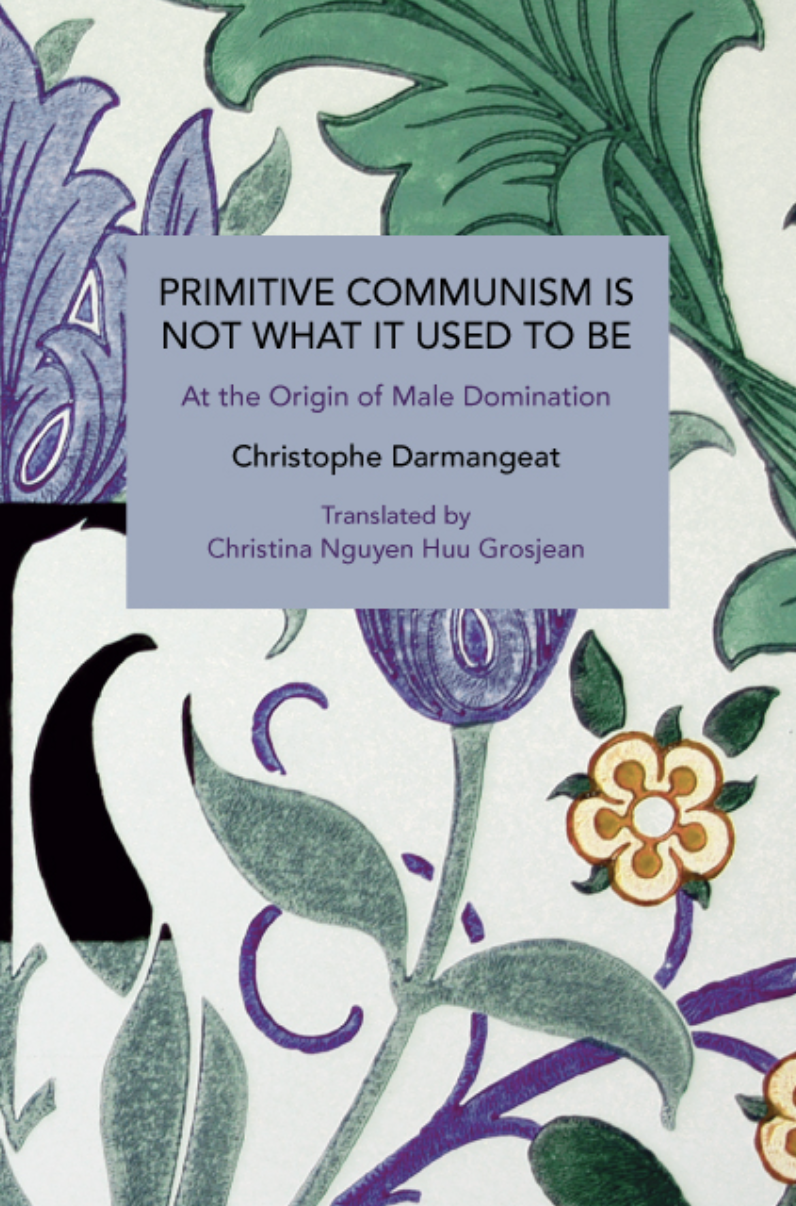
Darmangeat, Christophe 2024, Primitive Communism is Not What it Used to Be: At the Origin of Male Domination, Chicago: Haymarket Books.
Matriarchy, primitive communism, private property, and patriarchy. The recently published Primitive Communism is Not What it Used to Be: At the Origin of Male Domination, by Christophe Darmangeat and translated into English by Christina Nguyen Huu Grosjean, reintroduces topics rarely discussed in Marxist theory today. Were there long stretches of human history before the development of private property? Did women have significant, superior, or equal power in societies before the rise of the patriarchal family? Darmangeat’s book offers to renew the Marxist debate of a topic that has stagnated for more than 140 years, offering an analysis of what ethnology and archaeology say about Engels’ theory of “primitive matriarchy” today. With the resurgence of its popularity in the protest movements around the world, it is an essential time to ask what Marxist history and anthropology offer for our understanding of property and kinship before capitalism.
According to Darmangeat, Friedrich Engels’ The Origin of the Family, Private Property and the State (1884) “is not only the main Marxist reference on the subject; it has remained, so to speak, the only one.” Ultimately, the goal of Darmangeat is to refute Engel’s theses and all subsequent work supporting them, once and for all, with “real” anthropology. In this way, we are told, Marxists can transcend the dogma of historical materialism imposed by Stalinism, and refuse to give in “to bourgeois ideological reaction” (3). Any attempts to revive Morgan’s work on matrilineal kinship and its correlation to common land ownership (what he termed “communism in living”) in anthropology, or the ideas Engles’ puts forth in The Origin of the Family are charged with supporting the thesis of “primitive matriarchy.”
For example, Darmangeat critiques Makarius’ important 1971 introduction to the first French translation of Morgan’s Ancient Society: “his text remained overall much more a presentation and a tribute than a critique” (4). Likewise, he reduces Eleanor Leacock’s essential 1972 introduction to The Origin of the Family: “Leacock’s aim was to defend Morgan (and beyond, Marxism) against his detractors, rather than to point out his errors” (5). Any readers seeking a Marxist defense of Primitive Communism or matriarchy will be disappointed. Instead, they will find a century of work on kinship and land tenure reduced to a single critique. All Marxist scholarship on the topic since 1884 has reiterated Engles’ outdated and empirically invalid theory of primitive matriarchy. On such terms he dismisses Leacock’s work: “But on the thorny issue of the status of women, to which the bulk of this book is devoted, Leacock continued to hold to the main positions advocated by Engels in his time. The remainder of this text will attempt to demonstrate that these positions have been largely invalidated by the ethnographic material accumulated over more than a century” (5). Claude Meillassoux’s work is given a sentence, and dismissed with a phrase: “too abstract.” Darmangeat thus presented himself as the first scholar in over 140 years to “follow in the footsteps” of Engels’ historical materialism. All other scholars, most of whom happen to be women, have blindly towed the Engles’ line.
The “central argument” then is that anthropology no longer supports Engels’ theory “primitive matriarchy.” It is a critique that is presented more or less in the following order. First, “primitive matriarchy” is defined by the absence of male domination (a term he never defines but we can perhaps assume is taken from the academic tradition of French structuralism from Levi-Strauss to Maurice Godelier). Second, it is claimed that male domination was a fact of humanity’s earliest known history – above all, it predates the rise of wealth inequality in hunter-gather and horticulture culture societies. Third, it is argued that there is no correlation between the rise of private property and “women’s subjugation” (p. 19). Last, the book concludes with Darmangeat’s own contributions to historical materialism and gender, which he offers as political praxis for Marxism and feminism today. The sexual division of labor, which began no later than with the development of hunting weapons and perhaps as early as human nature itself, “remained for millennia the foundation on which gender inequality has continued to rest” (p. 270); “Capitalism has been able to lay the foundations for genuine gender equality, but it has been unable to achieve it fully” (p. 273).
Engels’ theory, which is traced back to its roots in Johann Bachofen’s Das Mutterrecht: eine Untersuchung über die Gynaikokratie der alten Welt nach ihrer religiösen und rechtlichen Natur (1861) and Henry Louis Morgan’s Ancient Society (1871). He reduces Engles’ complex review of Morgan’s theory of prior matristic kinship in human social evolution to a singular question: “matriarchy.” Against Engels (and Morgan), Darmangeat claims that the theory of primitive “matriarchy” perpetuates the 19th century evolutionary theory of Bachofen – a theory that is simply no longer valid in light of 20th century anthropology. The problem, however, begins with the fact that Engels did not use the word “matriarchy.” The term that Engels used (with qualified reservation) was “mother right” (mutterrecht). We must understand the complex ideas of Marx’s last years within the framework of critique that begins with Marx’s Critique of Hegel’s Philosophy of Right. This demands, however, the type of serious engagement with Marxist intellectual history (replete with citation) that is absent in Darmangeat’s work. We cannot simply reduce the development of Marx and Engels’ ideas on property and rights from The German Ideology to The Origin of the Family to “matriarchy.” The terminology is important. “Mother-right” is chosen precisely because it allows Engels to connect the study of early human kinship to the development of state “rights.”
This preserves the contradiction between the prior “natural” and later “social” forms of social organization that they believed made historical materialism scientific. It also serves to efface many of Engles’ ideas that still demand critique. The way in which Darmangeat reduces all of these questions to the singular theory of primitive “matriarchy” is indicative of his general method and argument. All of this is reduced to a single conclusion: Engles’ theory of primitive matriarchy is presented as a theory of non-male domination. Matriarchy, despite being a theory of “mother-right” and matrilineal kinship, is presented as the theory of female “power.”
The method is reductive. In the following chapters, the book provides an empirical critique of “matriarchy,” arguing that male domination is nearly ubiquitous in pre-capitalist history. Do we have any evidence that male domination didn’t always exist in pre-capitalist history? What material evidence is there for the absence of male domination? This, of course, depends on the definition of male dominance. The examples Darmageat provides in the second and third chapters appear self-evident: among hunter-gatherers in Australian indigenous societies, small scale-horticulture societies, and low wealth agricultural societies there are indeed horrifying ethnological reports of male violence and control. On these grounds, Darmageat claims that Leacock’s claims to show that male domination often arose after and from contact with European capitalism and not before are incorrect. We must accept male domination in societies that Engels (and “his followers”) claimed were egalitarian and matriarchal.
When the argument is presented this way, it appears self-evident. However, when we attempt to understand what male domination means they begin to fall apart. Whereas the technical definitions of “matriarchy” (i.e. mother-right) are ignored, the technical definition of “male domination” is never provided. To determine whether or not Darmageat is correct, it would be necessary to understand what he means. We must state clearly and strongly, however, that where the definitions of “matriarchy” are properly cited, elucidated, and discussed, there are many who support parts of Engles theories still today. For instance, Engles argued that matrilineal kinship is correlated to common ownership of the means of reproduction and patrilineal kinship is correlated to the rise of private property in herd animals. He also argued that matrilineal kinship (and group marriage) preceded the rise of pair-marriage and monogamy. These are open and serious questions in human evolution, the study of kinship – in both physical and cultural anthropology. At best, Darmageat can claim that academic cultural anthropology is highly critical of such theories and the evidence they provide.
The evidence is simply not there. On the other side of the debate, Marxist scholarship contends that “Early Human Kinship was Matrilineal,” Bourgeois scholarship treats the theory of matrilineal kinship and common property as a serious theory that challenges the dominant evolutionary view of primate, male domination, and DNA studies even now contend that matrilineal kinship and “matriarchal” social structures appear in the Bronze and Iron Age record.
In the third and fourth chapters, Darmageat argues that Engels’ attempt to correlate the rise of male dominance to the development of private property has also been invalidated. He spends the majority of his effort on a critique of Alexadndre Kollontai’s work. Like his other attacks on women scholars, these demand monographs or articles of their own because they are complex thinkers with independent theories and ideas that cannot be reduced to Engles work. Darmageat is correct, however, in his basic analysis of Engles theory of the rise of “patriarchy.” Patriarchy – patrilineal descent and inheritance of property through the male genealogical line – is argued to be a product of private property in domesticated animals. Above all, Engles’ argues that cattle marks the irreversible change in property systems that leads to the development of patrilineal kinship and male inheritance. Again Darmageat contends that modern ethnography has invalidated this theory, but he fails to note that this too is an open question. Again, studies contend that this theory is still possible and even probable. The studies that discuss it and their claims are too vast to review here but the bibliography is largely found in the following three articles.
In Chapter 4, Darmageat, turns to his own analysis with the words: “The previous pages have identified the essential elements for understanding the status of women in primitive societies. We now need to bring these scattered materials together to sketch a general picture” (p. 152). He summarizes his findings. First, no society has ever been found in which “women have held an unquestionably dominant position” (153). Second, we cannot find the period or conditions in which “women’s subordination emerged.” (153) The diversity is broad and “male domination” is not universal but “In particular, on all continents and at all levels of social development, men hold most, if not all, of the political and military functions. In this respect, modern capitalist society is one of the few (very timid) exceptions.” (153) As far back as it is possible to see, one finds women’s “subordination.” Third, “women’s participation in productive work appears everywhere to be a necessary, though not sufficient, condition for a more favourable social position for them; this can also be formulated by saying that, whatever the level of economic and social development, the condition of women is invariably unfavourable when they participate little in productive work.” (153). This finishes his description. The problem, ultimately, is simply that he is wrong on each account. He failed to define the object of his critique – “matriarchy” – adequately, he then offered no definition of his own theoretical category – “male domination,” in order to prove that male domination pre-exists matriarchal and patriarchal property. The first two demand serious theoretical engagement and citation. The second two demand empirical and scientific citation. This is never provided. Where the argument can be reconstructed, it appears that the central questions remain open and in many cases validated by scientific and ethnographic study.
In Chapter 5, he articulates the main argument that he understands to be a new contribution to Marxist materialism. Contra Engles’ theory of primitive matriarchy and private property patriarchy, Darmageat contends that male domination can be explained in terms of the monopoly of violence. The control of violence gives men the “fundamental lever” (185) of male domination. As he writes, “When women, by contrast, control all or part of the material products of society, they enjoy a de facto counterweight to the de jure authority exercised by men.” (154) Male domination, we must assume, is a theory taken largely from Godelier. (p. 192) Chapter 6 shows how “the male domination which, at least in part of the human societies, was already in place at the dawn of the Upper Paleolithic.” intensifies with the rise of “wealth.” (268). Intensification of agriculture then leads to the “exploitation” of women, which is secondary to both the monopoly of violence and the sexual division of labor. As he concludes, “the ultimate origins of male domination lie in the sexual division of labor and the monopoly of hunting and weaponry” (270).
This provides a lesson for feminism and marxism today. According to Darmageat, the primitive history of gender inequality in labor and inequality in property in general are largely irrelevant to the political cause. It is only through and from capitalism that liberation can proceed. We are asked to take solace in the fact that, “Very few intellectuals, however conservative they may be in the social domain, dare today in our countries to openly affirm the biological superiority of one sex over the other” (p. 12). With the relative dearth of Marxists among the many who have and are pursuing the very topics Darmangeat raises – of matrilineality, matrilocality, communal property, etc. – it is a wonder that Darmangeat can claim, on Marxist grounds, that to be a proper practitioner of historical materialism today, one must eschew those fields of study pertaining to matrilineality, matrilocality, and communal property (which he lazily characterizes as uncritically supportive of universal, egalitarian matriarchy) because Morgan and Engel’s works were influential to Marxist thought for far too long.
This is a book that raises the big questions. It takes on a topic – primitive communism and early human kinship – that is extremely contentious and extraordinarily important for Marxism. It is a radical question.To seriously embark on its study, one must have a map of the vast terrain of scholarship it covers and the political dangers it entails. Darmangeat fails to address or provide either. To track and refute every erroneous claim in this book would require its own volume. The false claim, however, that no work yet has provided a serious, materialist critique of Engels’ central theories and claims is the most absurd. This just completely untrue. There is a vast amount of literature on the topic, some of which provides precisely what this book both offers and lacks: a careful review of Marx and Engels’ theory of primitive communism. (For instance, Maurice Bloch’s Marxism and Anthropology (1983), with its chapter, “Present-Day Standing of Marx’s and Engels’ Anthropology.”) Eleanor Leacock, of course, provided the essential review and critique in her 1972 Introduction, which is reduced to a defense of the “primitive matriarchy” thesis. Therefore, when Darmangeat proclaims that he alone (unlike all Marxist scholarship on the topic since 1894) “follows in the footsteps” of Engels, it is clear that he has completely lost his bearings. His attack on “the lost raiders of matriarchy” is largely imagined. He reduces a rich body of serious, difficult, and active scientific study to an absurdity. Matriarchy, so defined, is asked to concede its fantasies to the cold, hard facts of “male domination” and “women’s oppression.” We are never provided with a definition of these terms. What is male domination? What is oppression? These are treated as self-evident categories of materialist analysis.
Darmangeat, in the end, recalls one of Marx and Engels’s favorite literary heroes. “Don Quixote,” as Marx warned in Capital, “long ago paid the penalty for wrongly imagining that knight errantry was compatible with all economic forms of society.” Is this not exactly what Darmangeat has done? We have been asked to accept that “male domination” is eternal, natural, and transhistorical. We must, however, leave the question open. The ideology of male domination, in many ways, is capitalism’s knight errantry. It is an ideology that permeates evolutionary theory no less than the epstein files. To argue that it has a place in historical materialism – that it is historical materialism’s first principle of anthropology – should be laughable. Where it is accepted, however, Marxism becomes grotesque.
On the one hand, Darmangeat is right to raise the point, in so many words, that no study should manipulate its data to confirm its hypothesis; however, by the same logic, Darmangeat’s own arguments in the final chapters of the book ought to be rejected on these very methodological grounds. As if it is not bad enough that he misrepresents Engel’s book and Leacock’s assessment of it, or that he grossly misrepresents the theory of ‘primitive communism’ and its numerous receptions over time in this book; he goes one step further, offering the opposite narrative of early human society as essentially male dominated, and posing this instead as the primitive communism that Marxists today should accept. Ironically, Darmangeat ultimately proves the falsity of his own argument by replacing the straw woman with his own straw man.
In a letter, written in 1890 to Conrad Smidt, Engels addressed the disappointment he felt on account of how few scholars were dedicated to the difficult labor of historical materialism. He called those self-proclaimed “Marxists” who entered the fray with grand theories and grand phrases “dangerous friends.” Darmageat is such a friend.

Leave a Reply