Karl Polanyi is an intellectual figure whose influence far outweighs his renown. His life was largely defined by the great World Wars. World War broke out in Europe in 1914 when he was eighteen; The Great Transformation, was published in 1944 in the year of the Normandy Invasion. Born in Vienna, Polanyi was part of the European socialist and communist intellectual community that included György Lukács, a principle influence on the intellectual foundation of ‘Western Marxism,’ and Max Horkheimer, the founder of the Frankfurt School of ‘Critical Theory.’ In the 1920s and 1930’s Polanyi was the editor of The Austrian Economist, a position he was forced to leave in 1933 because of the rise of Hitler and Nazism. He then worked in London as a lecturer for the Worker’s Educational Association, but after failing to find secure employment in Britain, he established a series of academic positions in America, where he ultimately became an essential figure in the development of modern economic history and anthropological theory. The school he founded, often termed “substantivism,” was socialist in political orientation and profoundly influenced by Marx. Politically, Polanyi advocated for state-sponsored socialism (or, the modern well-fare state), which received institutional support in the years of the F.D.R. administration and the newly reformed Democratic Party.
This was the world that Karl Polanyi set out to explain in the The Great Transformation. In the works of Marshall Sahlins, M.I. Finley, Timothy Earle, David Graeber and David Wengrove, his central ideas continue to anchor what remains of the radical branch of economic and anthropological history. It is important to remember the central arguments of Polanyi’s work. To do so, one must remember the problem he set out to answer. Polanyi asked, Why did the industrial revolution lead directly to the “veritable abyss of human degradation” for the masses? (p. 41) Why did modern capitalism lead to the catastrophe of World War One and the Great Depression?
In the 19th century, two answers were put forth to answer this question: liberalism and Marxism. According to Polanyi, both have failed to provide an adequate explanation. Liberalism failed because two of its central tenets – the law of wages (Ricardo) and the law of population (Malthus) – have been disproved; Marxism, in turn has failed, because exploitation (Marx and Engels) “was unable to account for the fact” of rising wages (p. 42). If both of these traditional theories are incorrect, what created the extreme urban poverty of the 19th century and how were real wages and standards of living increased from 1848 to 1944? Last, how did rising wages fail to save the protect people from the great crises of free-market capitalism in the early 20th century? Despite the fact the scholars frequently treat the book as a theory of pre-capitalist anthropology. Polanyi’s Great Transformation is dedicated to answering the collapse of capitalist society in the years of the Great World Wars. And, now that we live in an era in which the crises of 19th century capitalism appear to many to have returned, it is necessary to pay attention to book’s argument. Polanyi’s thesis is this: The cause of urban poverty and social disintegration is the market-society. According to Polanyi, the market-society is an “institution” that is defined by two factors: (1) “All incomes must derive from the sale of something” (p. 44); (2) “It must be allowed to function without outside interference” (p. 44).
The market-society, a society organized by the “free market,” is one in which all income is made from the selling of something (i.e. goods or services). Furthermore, it is a society in which the market is “free” from the control and coercion of non-market forces. This, according to Polanyi, is the cause of the modern ills of human social life. To fix it, it is necessary to embed the market within society and to allow citizens and governments to regulate and redistribute its productive powers. Only at this point in the argument does history become important. This is because history reveals the truth of Polanyi’s thesis. Before the modern market-society, economic exchange (the selling and buying of life) was always subordinate to the society and never its governing force. In contrast to the myth told by Adam Smith, Herbert Spencer, Ludwig von Mises, and Walter Lippmann, Polanyi believed that history and anthropology revealed the modern invention the market-society. The theory that human nature was defined by its propensity to barter and trade could be shown to be false. This is why Polanyi turned to the economic history. The record of anthropology and history revealed the fact that the market society was a recent social invention – one dangerous to humanity and the flourishing of society.
Polanyi offers a new theory and categorization of economic history. Despite the obvious debt owed to Marx, he cites Max Weber as the central modern practitioner of economic history (p. 48). The central axiom of Polanyi’s method is that “economics is socially embedded.” As he writes, “The outstanding discovery of recent historical and anthropological research is that man’s economy, as a rule, is submerged in his social relationships. He does not act so as to safe guard his individual interest in the possession of material goods; he acts so as to safeguard his social standing, his social claims, his social assets. He values material goods only in so far as they serve these ends. Neither the process of production nor that of distribution is linked to specific economic interests…” (p. 48). Contra the motives of economic man (i.e. the rational actor motivated by the search for accumulated surplus and gain), history reveals the primacy of “communal activities such as partaking of food” and generosity (49). Much as Mauss argued in The Gift (1925), non-capitalist history revealed the primacy of reciprocity and redistribution.
This becomes the starting point of Polanyi’s influential model and theory of anthropological economic history. Pre-capitalist society’s economic organization is fundamentally defined by the nature and extent of its (1) Reciprocity and (2) Redistribution. To this, he added a third category, (3) Householding.
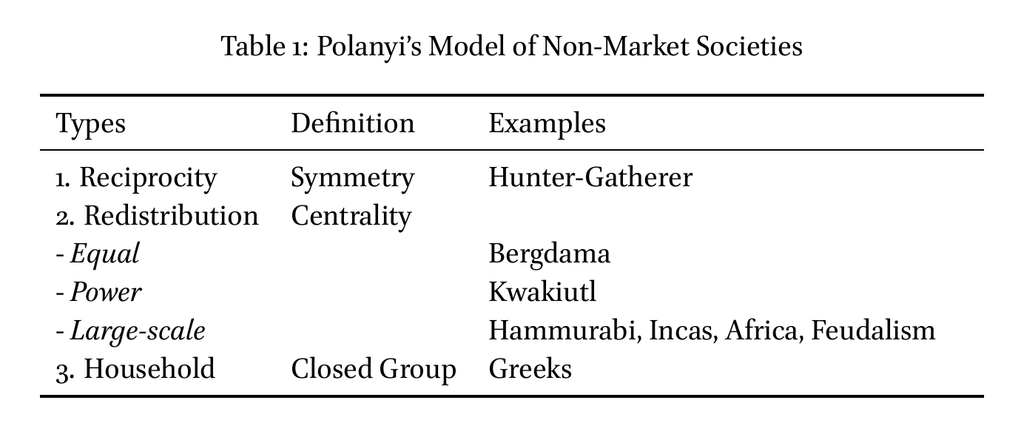
Though these were substantially re-fashioned by Marshall Sahlins in the 1960s and 1970s, they remain the two essential theoretical concepts of anti-capitalist economic anthropology today. Polanyi himself will further develop and define these categories and ideas in subsequent work, especially in his years at the University of Columbia, New York. In The Great Transformation, however, they serve a secondary role to Polanyi’s central thesis. What is important is that none of these three types represent the modern market society, something that only develops from mercantile capitalism in the 16th c. (which was state-sponsored and highly regulated) and ultimately becomes modern capitalism’s “self-regulated market” in the 19th c. (p. 57-58). The non-capitalist ideal types are used to illustrate the aberration of the modern market-society, which Polanyi charts from the 17th to the early 20th century in order to show how it transformed society into something unrecognizably dangerous and destructive – 20th century financial capitalism.